Jump to …
Town Lane and RCG Ventures Raise $2.4B and Sterling Organization Gets $125M Commitment
Simon and MCB Announce Retail Property Transactions Covering 1.1M SF
Retail Investment Prospects Improve for 5th Consecutive Year in PwC and ULI’s 2027 Real Estate Outlook
San Francisco Climbs 40 Spots in Emerging Trends’ Markets To Watch
5 U.S. Markets To Watch for Retail and Restaurant Growth in 2027
Limited Retail Construction Could Support Rent Growth and Low Vacancy Rates
Hanley Investment Group Acquires Visintainer’s Retail Investment Sales Division
Town Lane and RCG Ventures Raise $2.4B and Sterling Organization Gets $125M Commitment
Real estate investment firm Town Lane — which focuses on seniors housing, data centers, necessity retail and distribution centers — raised $1.9 billion for Town Lane Real Estate Opportunities Fund II. Founded in 2024, the firm raised $1.25 billion for its first fund that year. In the first quarter, Town Lane acquired a 27-property grocery-anchored portfolio and the ShopOne retail platform from private investment firm Pantheon. As of Monday, the firm managed about $3.5 billion in capital from institutional investors.
RCG Ventures, the retail real estate investment arm of Argonne Capital Group, raised $515 million for RCG Ventures Fund VIII, which focuses on value-add investments in shopping centers in high-growth markets that are anchored by national retailers. The fund already has made nine acquisitions in the U.S. and has another five under contract. Last year, RCG bought a $1.7 billion multitenant retail portfolio comprising 99 properties and more than 14 million square feet from publicly traded Global Net Lease, more than doubling RCG’s multitenant retail footprint. RCG has acquired more than 300 properties across 40 million square feet since 2003.
Meanwhile, the Pennsylvania Public School Employees’ Retirement System committed $125 million to a Sterling Organization fund targeting grocery-anchored shopping centers in major U.S. markets, IREI reported. The Sterling United Properties I CF fund aims to raise $850 million in equity. Earlier this year, California’s Santa Barbara County Employees’ Retirement System put $7.5 million into the fund.
MORE FROM C+CT: JV Wave: As Institutional Investors Demand Retail, Partnerships Give Them an Entry
Simon and MCB Announce Retail Property Transactions Covering 1.1M SF
Simon Property Group agreed to acquire University Village, an open-air shopping center in Seattle, through a subsidiary. Located near the University of Washington, the property features more than 100 businesses, including Apple, RH Gallery, Crate & Barrel, Sézane, Lululemon, Aritzia, Vuori and Din Tai Fung. The transaction is expected to close this year.
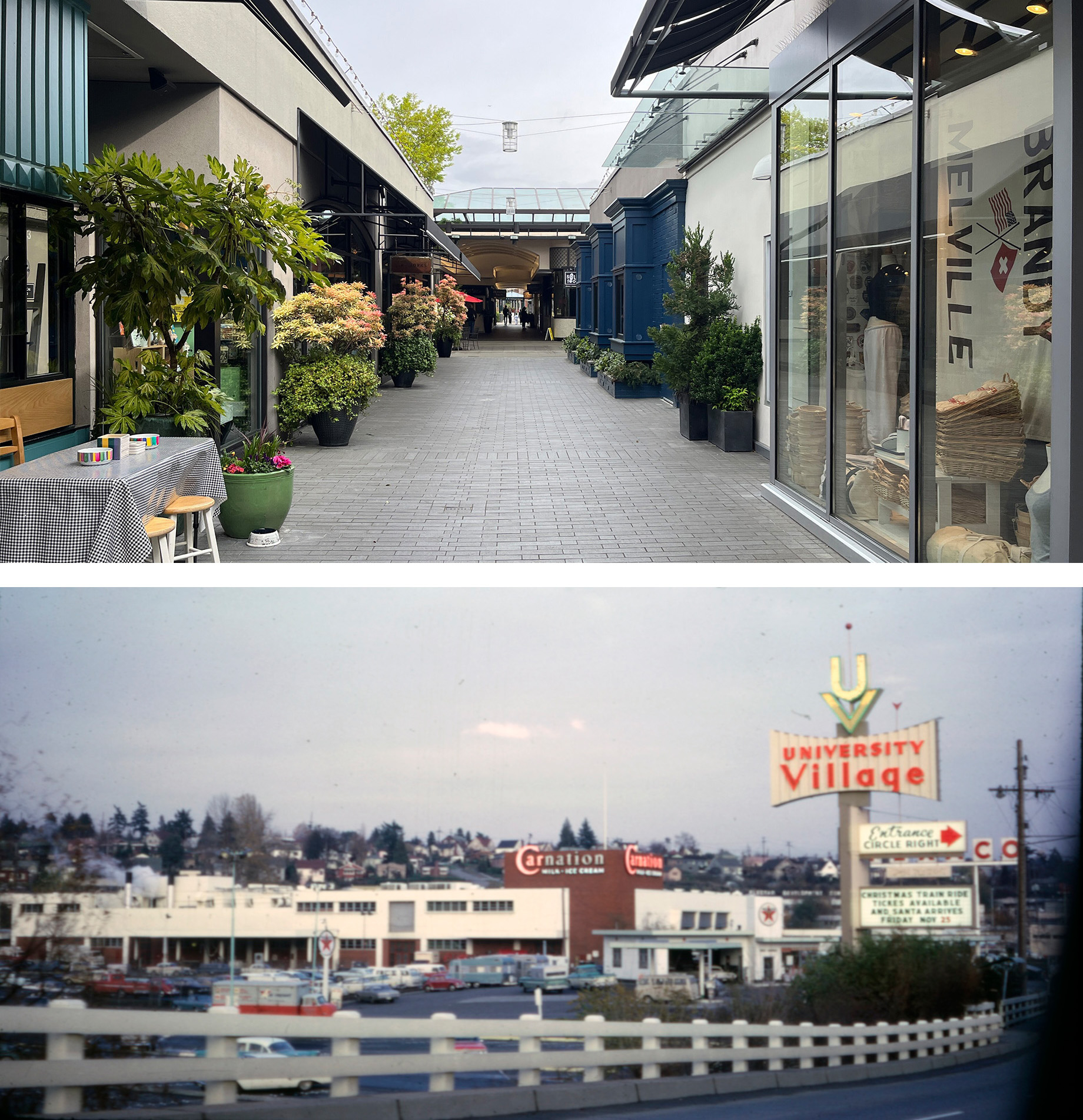
Located near the University of Washington, Seattle’s University Village opened in the 1950s and has grown to nearly 600,000 square feet. The open-air center is pictured at top in 2024 and in 1966 at bottom. Photo at top: Another Believer, CC BY-SA 4.0, via Wikimedia Commons. Photo at bottom: Seattle Municipal Archives, CC BY 4.0, via Wikimedia Commons
University Village opened in the 1950s and has grown from approximately 300,000 square feet to nearly 600,000 square feet. Simon president, CEO and COO Eli Simon said the acquisition “underscores our focus on owning distinctive, high-quality assets in strong markets.”
MORE FROM C+CT: Retailers Look to Campus Districts To Capture Gen Z Spending
Meanwhile, real estate investor and developer MCB recently sold three grocery-anchored shopping centers totaling 517,000 square feet. Phillips Edison & Co. acquired the 168,532-square-foot Alafaya Square in Oviedo, Florida, for $69.1 million and the 203,717-square-foot Easton Commons in Houston for $51.9 million, according to the company’s third-quarter financial disclosures. MCB came into ownership of the properties via its acquisition of Epic Real Estate Partners, announced in January. And BC Wood Properties acquired the 145,148-square-foot Damascus Shopping Center in Maryland from MCB.
Retail Investment Prospects Improve for 5th Consecutive Year in PwC and ULI’s 2027 Real Estate Outlook
PwC and the Urban Land Institute’s Emerging Trends in Real Estate 2027 report points to improving investment prospects for U.S. retail real estate, with the sector’s score rising from 3.48 out of 5 for 2026 to 3.54 for 2027. Among the seven U.S. property types included in the report, retail ranked fourth for investment potential in 2027. Rankings were based on surveys of commercial real estate professionals in the U.S.
“Retail ratings improved for the fifth consecutive year, a trajectory few would have predicted when the sector sat near the bottom of the rankings just four years ago,” the report said. “Open-air centers aligned with value and necessity retail, combined with a decade of undersupply, have repositioned the sector as a durable income play.”
The property types within U.S. retail that ranked highest were, in descending order, neighborhood and community shopping centers, lifestyle and entertainment centers, and standalone retail. The lowest ranked were power centers, urban/high street retail and malls.
MORE FROM C+CT: The Pandemic Didn’t Kill Urban Retail, but It Sure Changed It
Also in the report, the category of mixed-use and alternative assets posted the top score among the seven property types — 3.76 for 2027, up from 3.69 for 2026. Suburban mixed-use edged out urban mixed-use in popularity. The report started tracking this category last year.
San Francisco Climbs 40 Spots in Emerging Trends’ Markets To Watch
San Francisco climbed 40 spots in PwC and ULI’s U.S. commercial real estate markets to watch in 2027. In their Emerging Trends in Real Estate rankings, the city rose from No. 45 in 2026 to No. 5 for 2027.
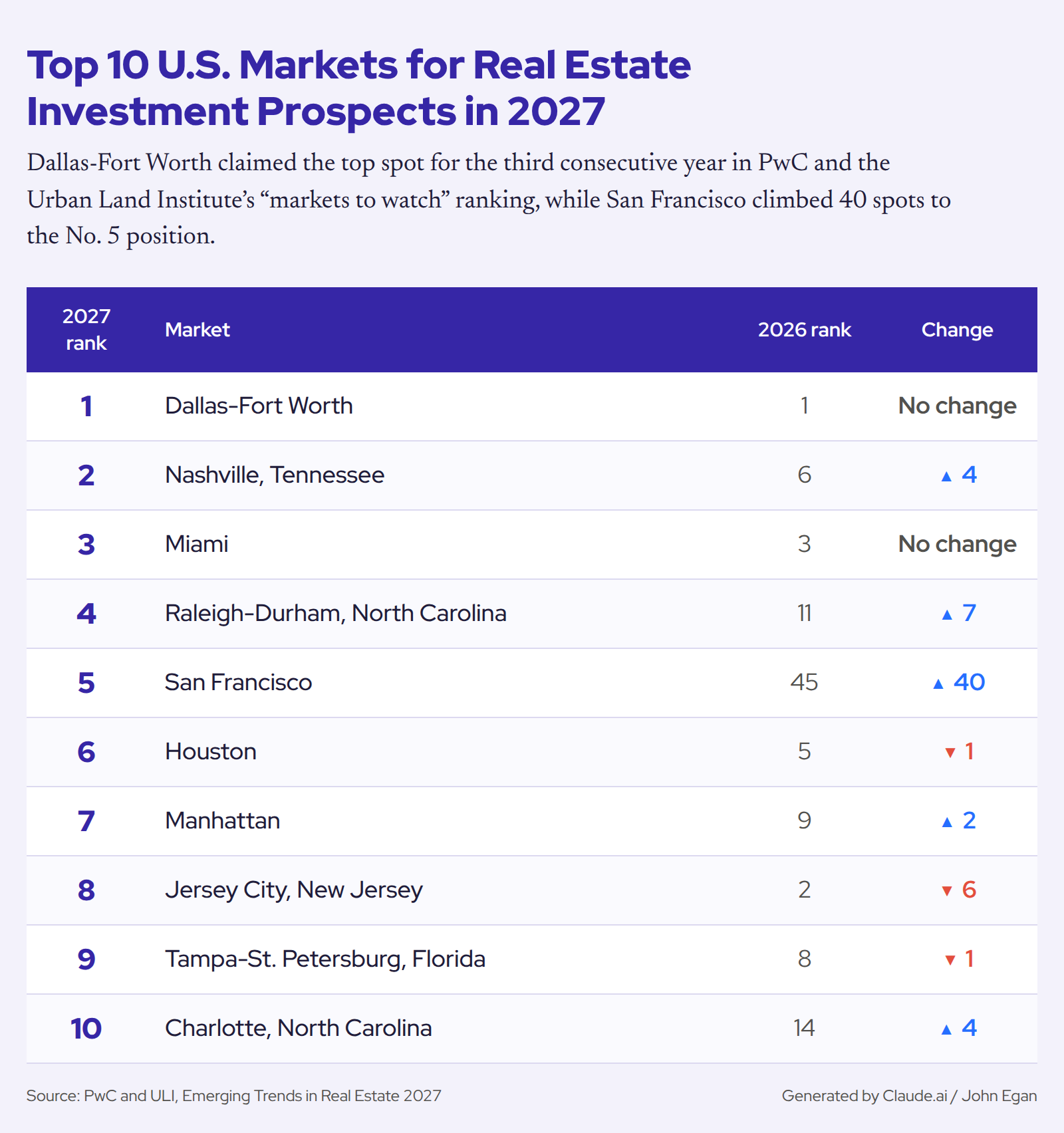
“Few cities can boast a comeback story like San Francisco,” Cushman & Wakefield said in the report. “After years of challenges since the pandemic, it is safe to say a new chapter in San Francisco’s history is being written, and AI is at the center of it.”
In tandem with the AI boom, San Francisco’s retail sector is staging a comeback, Cushman & Wakefield said in the report. Elements of the comeback include expansion of luxury boutiques, growth of bars and restaurants and stepped-up attention to safety and security.
PwC and ULI based their findings for the U.S. and Canada on insights from nearly 1,500 real estate investors, developers, lenders and advisers.
5 U.S. Markets To Watch for Retail and Restaurant Growth in 2027
A new Placer.ai report identifies its own five U.S. metros to watch in 2027 based on population growth and retail and restaurant traffic trends. All five grew faster than the average U.S. metro from 2024 to 2025 and saw retail and restaurant traffic outpace national trends from October 2025 to September 2026. Stockton, California, leads the list, with Placer.ai identifying it as a potential residential alternative to San Francisco for workers in the Bay Area’s growing AI industry. Each of the five markets approaches 2027 “on strong footing and with a growth story of their own — though only time will tell what the year has in store,” according to the report.
Limited Retail Construction Could Support Rent Growth and Low Vacancy Rates
With retail construction pipelines near historic lows, even modest tenant demand should help sustain rent growth and low vacancy rates, according to Cushman & Wakefield’s U.S. Retail Q3 2026 MarketBeat report. The report covers community and neighborhood centers, power and regional centers and strip centers but excludes malls, outlet centers, themed retail centers, airport retail and freestanding retail.
New construction remained limited in the third quarter, with only 2.3 million square feet delivered, the report said, and the development pipeline represented just 0.4% of existing inventory. New construction remains concentrated in the South, which accounted for 52% of national completions in the first nine months of 2026. “Performance will remain uneven across markets and property types, however, with tenant quality, location and retailers’ omnichannel capabilities increasingly important differentiators,” Cushman & Wakefield wrote.
Hanley Investment Group Acquires Visintainer’s Retail Investment Sales Division
Hanley Investment Group Real Estate Advisors acquired Visintainer Group’s retail investment sales division. The two firms have collectively closed more than $665 million in deals in California’s Central Valley since 2021, including in markets such as Bakersfield, Fresno, Modesto, Sacramento and Stockton.
By John Egan
Contributor, Commerce + Communities Today