The Short Version
- Recent joint ventures highlight institutional investors’ interest in acquiring and operating shopping centers.
- Operating expertise is an important consideration for investors entering retail, where tenant mix, leasing and local market knowledge can drive property performance.
- JVs can provide operators with capital for acquisitions, development and expansion, as well as access to market expertise and strategic partners.
- Despite recent deals, JV equity remains difficult to secure in the current market. Some institutional investors also are pursuing direct ownership of retail operating companies.
Institutional Investors Want More Retail Exposure. JVs Offer a Way In
PSP Investments and Nuveen Real Estate just announced a joint venture with an initial investment of $790 million to acquire open-air centers across the U.S., anchored by grocers, necessity retailers and essential services. They have acquired 3 million square feet across 19 properties in eight states.
And they’re not the only JV in town these days.
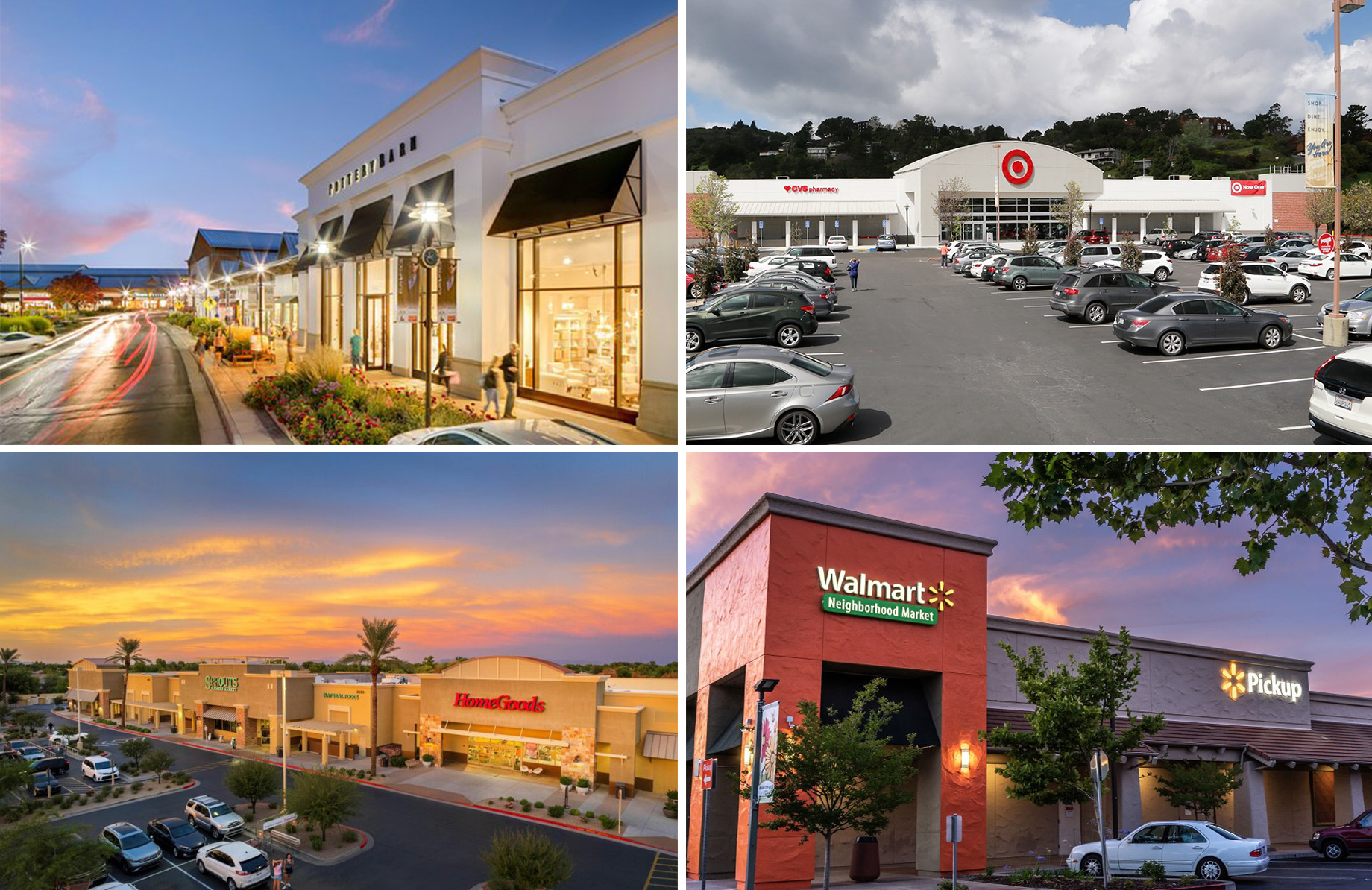
A new joint venture between PSP Investments and Nuveen Real Estate has closed on property acquisitions totaling 3 million square feet across 19 properties in Virginia, Arizona, Florida, Minnesota, Texas, California, Colorado, and Washington. Nuveen Real Estate’s Brian Wallick cited PSP’s long-term capital, while PSP Investments’ Julien Roy-Décary noted Nuveen’s “sourcing reach and operating depth.” Photos courtesy of PSP Investments and Nuveen Real Estate
Big-name investors like Bain Capital, CBRE Investment Management, Norges Bank and New York Life are making headlines lately for their retail real estate JVs. Institutions, private equity groups and family offices that are looking to deploy capital into shopping centers are behind a flurry of recent JV activity. Deals range from large portfolio acquisitions and recapitalizations to single-asset development and redevelopment projects. Notable deals include:
• CBRE Investment Management and developer and investment manager MCB Real Estate purchased a grocery-anchored retail portfolio totaling 1.1 million square feet with properties in Hawaii, Louisiana, Minnesota, North Carolina and Texas.
• Pacific Retail Capital Partners formed a JV with Conversant Capital to acquire Pacific View mall in Ventura, California.
• Norges Bank Investment Management will put $500 million into a new strategic partnership with Asana Partners to invest in and operate high-quality retail assets throughout the U.S.
• Phillips Edison & Co. is expanding its JV with Northwestern Mutual, giving the insurance company an 86% interest in a 13-property portfolio currently owned and operated by PECO.
“The common theme is that these institutions all have high conviction in retail being an asset class that they want exposure to,” said JLL senior managing director of investment banking Sher Hafeez. Ten years ago, many institutions were avoiding retail due to fears of negative impact from what appeared to be an “Amazon-apocalypse,” noted Hafeez. Retail has since proved that consumers still value the retail experience. “Retail is an important component of the U.S. consumer ecosystem, and shopping centers are the way that people want to consume,” he said.
Supply-and-demand dynamics in the retail real estate sector are contributing to strong performance, and investors looking to increase their retail allocations find that partnerships offer a practical entry point.
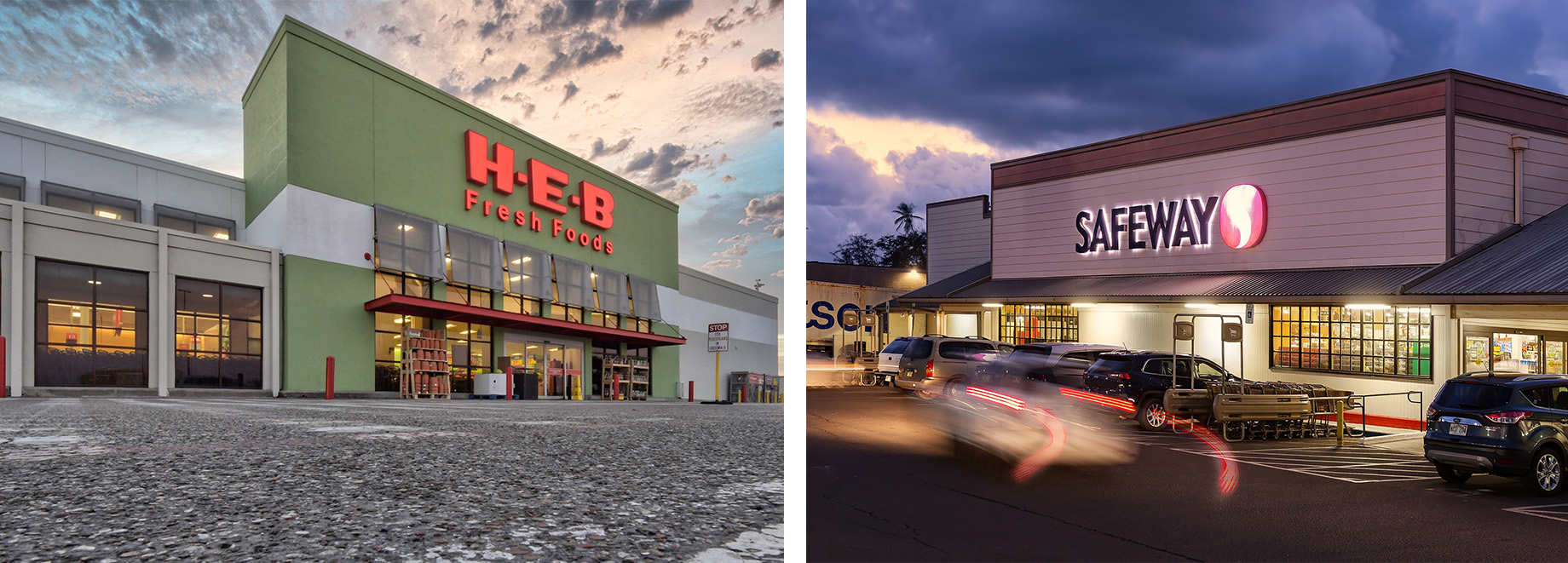
A joint venture between CBRE Investment Management and MCB Real Estate recently purchased a grocery-anchored retail portfolio totaling 1.1 million square feet in Hawaii, Louisiana, Minnesota, North Carolina and Texas, including Temple, Texas’ 285,518-square-foot Marketplace Shopping Center, at left, and Kapaa, Hawaii’s 111,021-square-foot Kauai Village Shopping Center, at right. Photos courtesy of CBRE Investment Management
Why Operating Expertise Matters
But investors want more than retail exposure; they want to invest alongside partners with operating expertise. Market participants agree that retail can be a tricky sector to navigate. Operators need to understand the nuances of the trade area and of the merchandising mix that will drive traffic to a center. When there is a vacancy, what is the best use to fill that space?
“You also have to have the relationships to bring the right tenant because you’re really creating experiences,” added Hafeez. “Whether it’s a 20,000-square-foot strip center or a million-square-foot mall, what your neighbor is doing matters, and that helps the entire retail center.”
JVs are common across all commercial property types. What makes retail unique is that the operator is critical to driving long-term value creation, agreed Tanger executive vice president, chief investment officer and CFO Michael Bilerman. Over its history, Tanger has engaged in a number of JVs, and partners currently co-own eight properties in its portfolio. “What we really lean on is our operating platform,” he said. “That’s our secret sauce. We feel that our leasing, operating and marketing platform drives value for our stakeholders, and whether we’re doing it wholly owned or in a joint venture, that strategy doesn’t change.”
JVs Serve Varying Strategic Goals
Partnerships can range from a single-property acquisition or development to programmatic JV structures that provide steady sources of capital to fund acquisitions or development over years. Bringing in an equity partner can give an operator access to capital to help grow and scale the business. “One motivation is that you’re bringing in faster, deeper and more constructive capital that can also grow with you,” said Hafeez.
Yet a JV is one of several capital-allocation tools that a company can use to grow its platform and deploy capital. “At the heart of it, it’s a capital decision,” said Bilerman. “It’s a tool in the tool kit to be able to take advantage of potential opportunities, and everyone’s going to have different motivations and drivers as to why they may want to do a joint-venture relationship.”
Although a JV equity partner can help finance a project, other reasons to engage in a strategic partnership include a desire to access specific market expertise or partner with a property owner to develop, redevelop or expand a project. “For Tanger, we really start with our strategy, not the capital side,” said Bilerman. For example, Tanger partnered with RioCan in 2011 when Tanger expanded into Canada. The two companies currently own Tanger Cookstown in Ontario and Tanger Ottawa as 50-50 partners.
As in Tanger’s case, JVs can result in very long-term relationships. “Every time you get into a joint venture, you’re getting married to someone, and while you don’t foresee getting divorced, a lot of times the capital partner needs an exit,” said Bilerman. “So understanding and aligning on that exit strategy is really critical.”
JV Equity Remains Hard To Secure
Some market participants view JVs as challenging in the current environment. They’re still the exception, not the norm, according to Adam Mengacci, senior managing director of capital markets for Marcus & Millichap Institutional Property Advisors. “JV equity for any project, regardless of property type, is hard to come by in current market conditions, as has been the case for the past three-plus years,” he said.
Mengacci noted that the majority of equity these days is structured more like debt, with the last dollar lower in the capital stack and 20% to 25% of sponsor equity ahead of it. Rising interest rates, a wide bid-ask gap across most asset classes, and general uncertainty on a macro level all contribute to the challenging environment for JV deals. “Given the valuation uncertainty at the end of a business plan, equity is very cautious and less available,” said Mengacci. “I think the volatile capital markets are keeping a lot of equity on the sidelines as investors wait for basis resets before deploying capital. There is a very wide bid-ask gap across most asset classes.”
Yet Mengacci agreed that JVs, though less common, are still getting done. IPA’s Dallas office recently closed a JV equity placement for The Cliff at Green Valley Ranch, a redevelopment in Henderson, Nevada, with an unnamed equity partner. Developer VAC Development plans to convert two obsolete office buildings into a 100,000-square-foot, pedestrian-friendly campus with a 16,000-square-foot Arhaus anchor and a 26,000-square-foot, covered outdoor dining lounge. “The deal had a tremendous return on cost and increased rent capture due to the change of use,” said Mengacci. “That, combined with a strong submarket experiencing tremendous growth, attracted several investors to the transaction.”

Marcus & Millichap Institutional Property Advisors arranged joint-venture equity for The Cliff at Green Valley Ranch, a Las Vegas-area development. The concept from VAC Development emphasizes experiential retail, chef-driven dining, wellness, art and community gathering space. The first tenants are expected to open in the second half of 2027. Image above and at top courtesy of Marcus & Millichap Institutional Property Advisors
Investors Take Stakes in Retail Real Estate Operators
Interest from prospective equity partners can vary widely depending on the specifics of an individual deal. JVs are more active in acquisitions than new development, where new construction remains limited. That can produce a bottleneck in which a lot of capital is chasing very few deals, noted Hafeez.
Another notable trend: Some institutions also want direct ownership of the operating company itself versus a traditional general partner-limited partner relationship. Among recent deals in which institutional investors are buying into the operating companies as part of the equation are:
• In June, TPG Real Estate acquired grocery-anchored real estate owner and operator Echo Realty. The transaction, valued at approximately $2 billion, was led by TPG in partnership with leading global investment groups, including PSP Investments, La Caisse and Norges Bank Investment Management.
• In July, Ares Management Corp. completed its acquisition of Whitestone REIT, taking the company private in an all-cash deal valued at $1.7 billion.
• In August, Almanac Realty Investors, the private real estate arm of global investment manager Neuberger, committed $250 million of growth capital to AmCap Ventures, a privately held, vertically integrated real estate company. AmCap will use the growth capital to accelerate acquisitions of grocery-anchored and necessity retail shopping centers across top-tier U.S. metros.
Hafeez explained: “In some cases, operators have figured out that aligning interest through ownership into the operating company, where you’re truly building enterprise value, is a better way to do things because you know: If my partner is aligned with me 100% all the way through, then I can be faster and more nimble when the competition is deep.”
By Beth Mattson-Teig
Contributor, Commerce + Communities Today