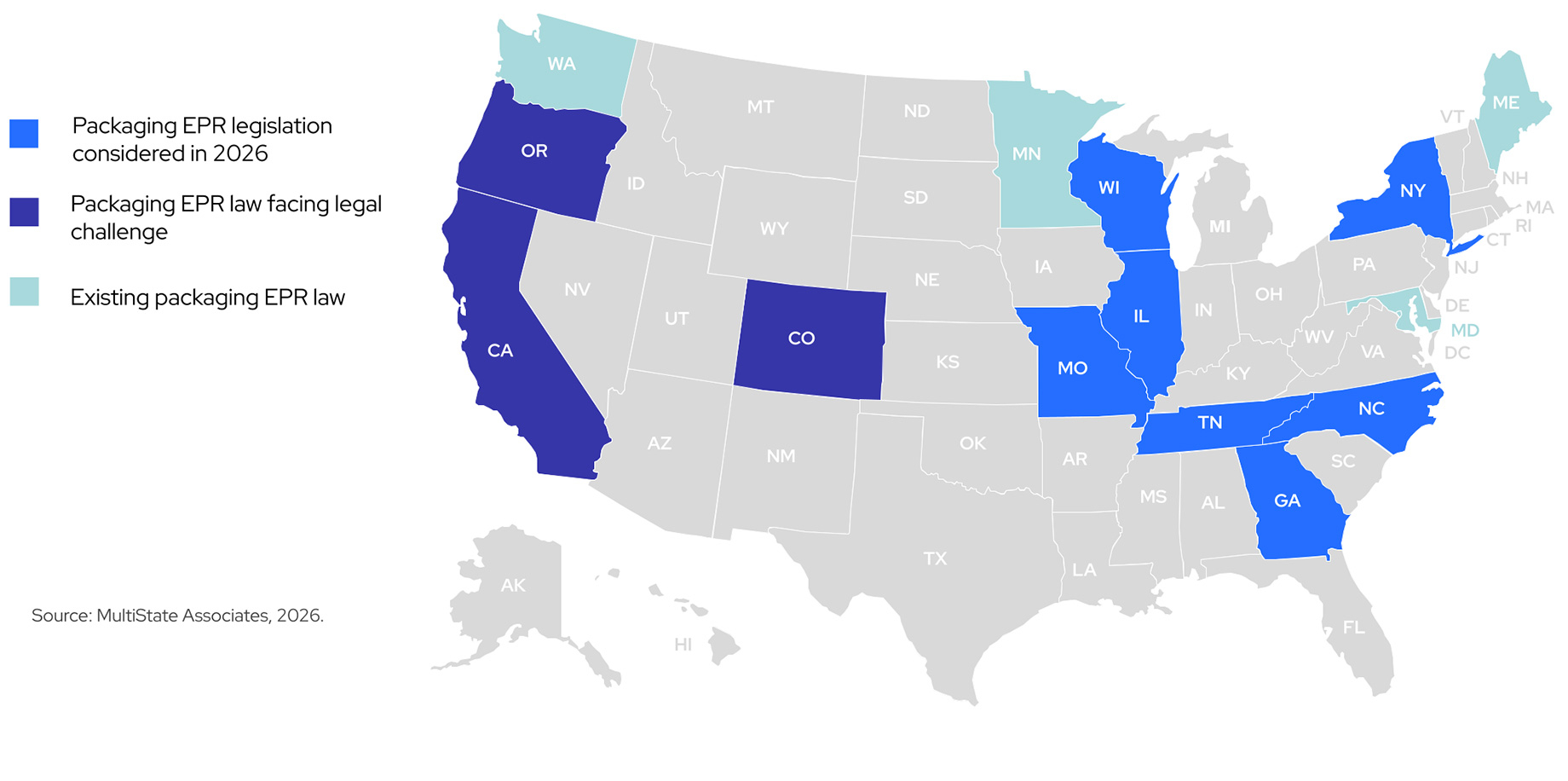
As lawmakers close out the year, several states face legal challenges and delays in implementing their packaging extended producer responsibility (EPR) programs. Most EPR programs require packaging material producers to join and fund a producer responsibility organization (PRO) to handle the disposal, reuse or recycling of packaging. These programs shift the responsibility and cost burden of recycling from state and local governments to private industry. Below is a brief update on where each state’s packaging EPR law stands heading into 2027.
Oregon
Oregon was the first state to begin implementing its packaging EPR law. In July 2025, the National Association of Wholesale Distributors (NAW) sued, arguing the law violates the Due Process Clause and the Commerce Clause of the U.S. Constitution and improperly burdens out-of-state businesses. NAW secured a preliminary injunction exempting its members while the case proceeded. In June 2026, Lollicup USA, a subsidiary of Karat Packaging, also challenged the law on the same grounds as NAW and similarly sought an injunction. Lollicup’s case was put on hold pending the outcome of the NAW case.
On August 27, the U.S. District Court issued a decision in the NAW case, ruling that Oregon’s Plastic Pollution and Recycling Modernization Act does not violate either the Commerce Clause or the Due Process Clause of the U.S. Constitution. The ruling ended the preliminary injunction, so NAW members are now subject to the law's requirements. NAW has since filed a notice of appeal to the U.S. Court of Appeals for the Ninth Circuit.
Colorado
In March 2026, the Independent Lubricant Manufacturers Association (ILMA) filed the first legal challenge to Colorado’s packaging EPR law, arguing that the program’s fees unfairly burden small businesses. On July 30, 2026, NAW filed a legal challenge to Colorado’s EPR law on the same grounds as its Oregon suit. NAW also argues that the Colorado Department of Public Health and Environment should have implemented the EPR program, not delegated the management to a PRO that NAW describes as an “unaccountable private party.”
California
In June, Nebraska Attorney General Mike Hilgers and 16 other state attorneys general sued to block California’s packaging EPR law. The legal challenge came shortly after the Circular Action Alliance (CAA) released its projected budget of nearly $2 billion to implement California’s packaging EPR law. The AGs echoed claims from producers in other states that California improperly delegated its authority to CAA.
Maine
Maine enacted the nation’s first packaging EPR law in 2021, but implementation of its program has stalled and fallen well behind other states. Unlike most states, Maine contracts with a single organization that collects producer fees and reimburses municipalities, rather than approving a producer-led group. In June 2026, the Maine Department of Environmental Protection (DEP) issued a Request for Proposals (RFP) for a Stewardship Organization to run the program. In August, DEP announced that it had received no proposals by the deadline. CAA, the only expected bidder, publicly declined to bid, saying the RFP’s scope did not align with its operations. The DEP has said it would revise the RFP and reissue it, but it has not given a new timeline.
Other State Updates
Washington is working to launch its packaging EPR program, which was enacted in 2025. In March, the state selected CAA to serve as the PRO, joining California, Colorado, Maryland, Minnesota and Oregon. Maryland has begun implementation, and the Maryland Department of the Environment is holding advisory council meetings this fall to gather stakeholder feedback. Finally, Minnesota is conducting a needs assessment to inform the development of its program. The needs assessment is due by the end of 2026 and will set a baseline for measuring program outcomes.
Packaging EPR Laws and Legal Challenges