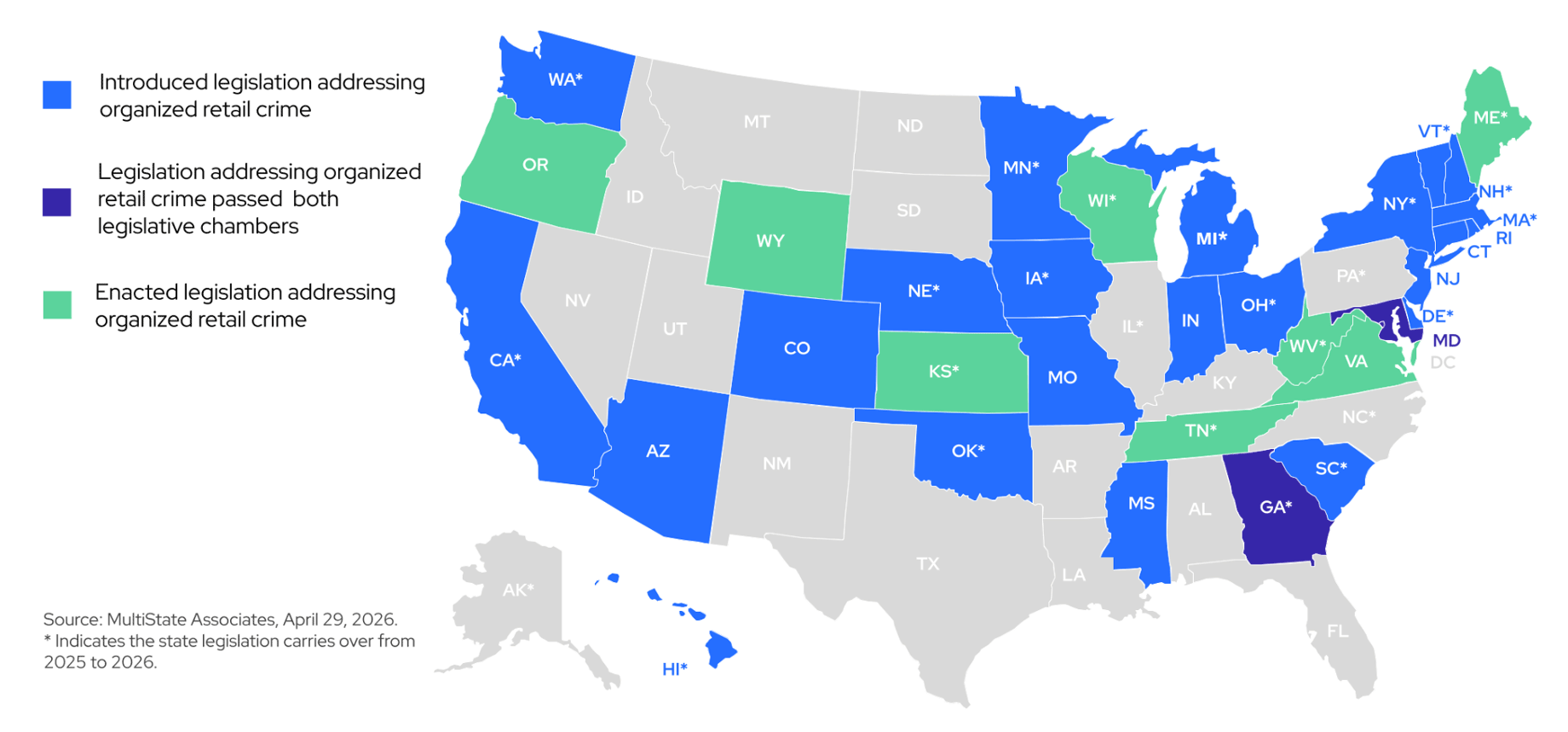
State lawmakers are continuing to show a strong commitment to combating organized retail crime (ORC) by advancing legislation that targets retail theft, cargo theft and gift card fraud.
So far this year, lawmakers in four states — Kansas (HB 2347), Virginia (SB 444), West Virginia (HB 4990) and Maine (LD 1773)—have enacted legislation that criminalizes the unauthorized use of gift cards and attempts by offenders to tamper with gift cards on store shelves. In addition, legislation in Georgia (HB 447), Maryland (HB 752) and Oklahoma (SB 1980) is awaiting approval by their governors, and a handful of states are still considering bills to create the offense of gift card fraud.
Several states have introduced bills aimed at combating cargo theft, reflecting a growing recognition that this issue poses a direct threat to retailers and consumers.
Lawmakers in Arizona (SB 1452), California (SB 1019), Michigan (HB 5126 & HB 5125), South Carolina (HB 5288) and Tennessee (SB 2466 & HB 2139) have each taken distinct approaches, introducing bills that would establish prosecutorial frameworks, increase penalties and create Attorney General task forces.
Tennessee’s bill (SB 2466), signed by Governor Bill Lee (R) this week, creates a definition for fraudulent freight theft that includes tactics such as illegally rerouting shipments, using false identities to obtain loads and unlawfully transferring cargo to third parties. In addition, the bill establishes that fraudulent freight theft can be a continuing offense with multiple acts in a common scheme.
The bills in California and Arizona would establish a task force authorized to investigate cargo theft offenses and coordinate with law enforcement and industry stakeholders on prevention strategies. South Carolina's bill focuses on a tiered penalty structure based on the value of stolen goods and the aggregation of multiple offenses, while Michigan's prioritizes establishing a felony penalty with a 10-year maximum sentence.
Several ORC bills are also moving through the Oklahoma Senate, including HB 4106 and HB 4140, which address the felony offense for grand larceny, and HB 3244, which adds organized retail crime to the definition of a pattern of criminal offenses. With adjournment not expected until May 29, Oklahoma lawmakers have several weeks remaining for these bills to reach the governor's desk.
In Delaware, HB 276 recently received a hearing in the House Judiciary Committee after stalling since its introduction in January. If enacted, the bill would authorize the aggregation of multiple thefts into a single charge. Delaware lawmakers also introduced a gift card fraud bill this month (SB 280). Both bills have time to advance since lawmakers do not plan to adjourn session until June 30.