As state lawmakers begin legislative sessions this month, revenue forecasts for states look much leaner than in previous years with recent tax deductions taking effect and the flow of pandemic stimulus funds ending. Governors’ recommended budgets for FY2025 are nearly $80 billion lower than requests for spending in FY2024, according to a report from the National Association of State Budget Officers (NASBO). While the decline in revenue for some states may suggest a fiscal imbalance, evidence suggests that this new environment is simply a return to normal economic conditions.
Following the pandemic, many states were flush with cash from the federal government to help businesses rebound after mandatory closures and other social distance policies were lifted. Many states took advantage of stimulus funds to pay down debt, finance infrastructure initiatives and offer taxpayers rebates. In Maryland and Wisconsin, lawmakers used federal funding through the American Rescue Plan Act (ARPA) to fund programs to encourage investors to redevelop vacant retail and commercial spaces.
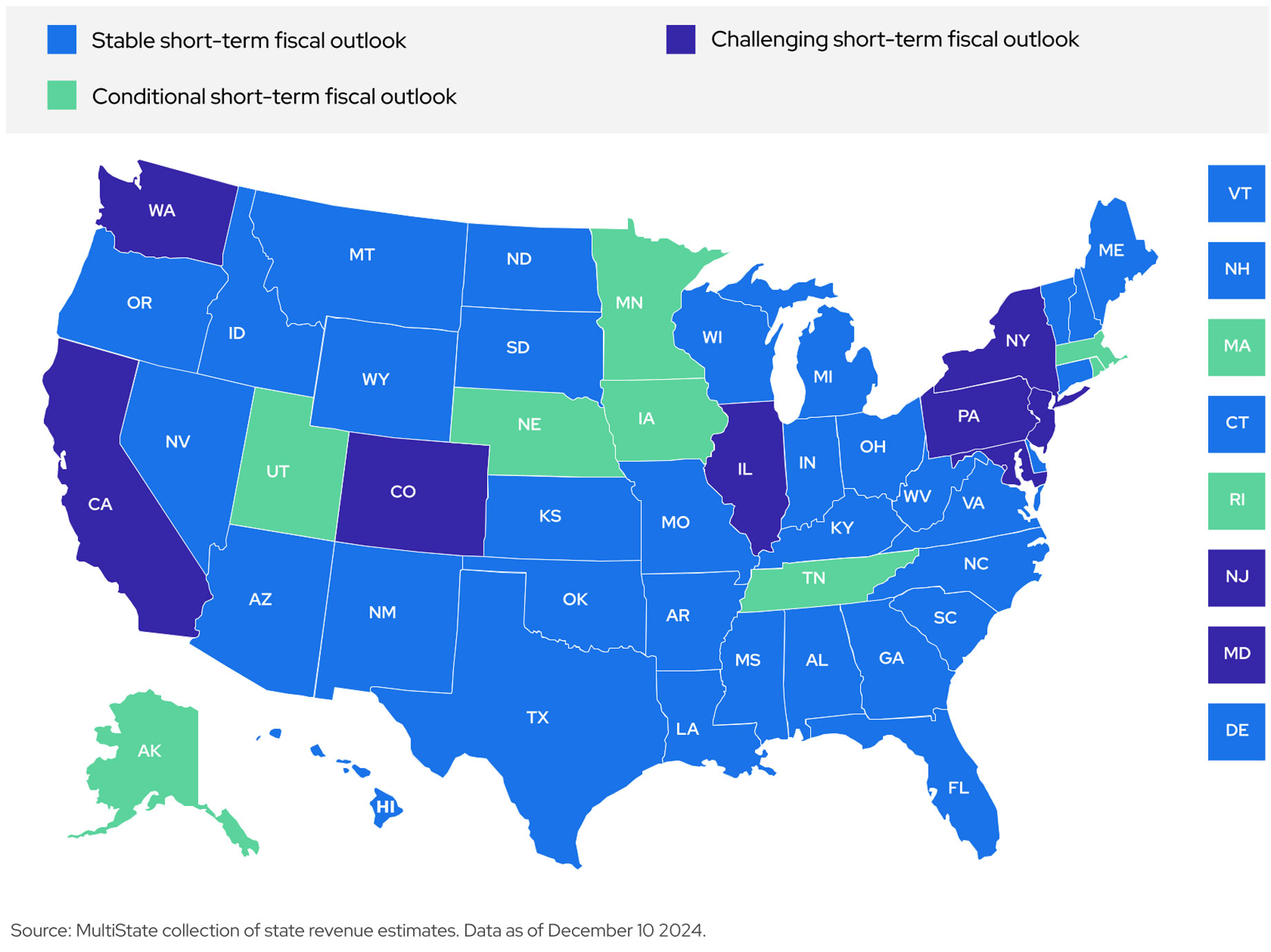
As of December, eight states — California, Colorado, Illinois, Maryland, New Jersey, New York, Pennsylvania and Washington — are experiencing challenging short-term fiscal outlooks heading into FY2025 and beyond, based on a recent survey conducted by MultiState Associates. Meanwhile, six states are closely monitoring their decreasing revenue forecasts. Most states, however, have stable fiscal outlooks heading into the year.
In Pennsylvania, estimates show that the state will face an operating deficit of $3.4 billion in FY 2025, growing to $6.7 billion by FY2030. Maryland is facing a widening budget gap as well. The state is facing more than $1 billion structural and cash deficit this year with the gap more than doubling in the following two years. The deficit is projected to increase further to $5.9 billion by FY 30. Governor Wes Moore (D) released his budget recommendations this week, which include tax and spending cuts, but nothing is guaranteed at the moment.
As the largest state, California’s revenue shortfalls have an outsized impact on the national average. While the state is projected to have a modest surplus in FY2025, California’s Legislative Analyst’s Office (LAO) warned that the state is projected to have a budget deficit of $20 billion in FY2027, up to $25 billion in FY2028, and nearly $30 billion in FY2029. (Note, these forecasts were made prior to the devastating fires and resulting property loss of January 2025, which could have a profound impact on the state’s fiscal health.)
Some states expecting budget surpluses have since modified those forecasts. In December, Iowa’s Revenue Estimating Conference predicted that their revenues would decrease by 6.2% in FY2025 and 4.7% in FY 2026, with some in the state sounding the alarm that expenditures will outpace revenues by FY2026. The state ended FY2024 with a significant surplus. In Minnesota, revenue forecasts anticipate a surplus of $616 million in FY 2026-2027, down from $1.1 billion from previous estimates.
Overall, most states are in stable financial standing. Hawaii still maintains a positive fiscal outlook after lawmakers enacted the largest state tax cuts in history last year. Delaware, Louisiana, New Mexico, and Maine have even recorded surpluses heading into this fiscal year. Some states, though, will be watching federal lawmakers as they consider whether to extend the cap on state and local tax (SALT) deductions for individuals and businesses. If Congress decides to let these provisions expire, high-income earners and businesses in high-tax states would benefit, but the states those earners reside in would also benefit by retaining their tax base.