The Short Version
- The traditional landlord-tenant specialty leasing transaction is giving way to a “better together” model in which the parties align on growth goals.
- Landlords encourage new retailers to start with smaller formats before leasing permanent locations, as specialty leasing a proven pathway from startup concept to established brick-and-mortar retail.
- Shopping center operators are using specialty concepts to diversify tenant mixes, create unique experiences and strengthen property performance.
- Automated retail is poised for major growth in specialty leasing from vending entrants like VenHub to established brands lke California Pizza Kitchen.
Specialty Leasing Trends: Collaboration, Flexible Formats and Automated Retail Drive Growth
The ICSC+SPECIALTY event in Orlando this week touched on the future of specialty leasing and marketing, the varied growth paths of specialty retailers have taken and automated stores.
Specialty Leasing Proves To Be a Win-Win When Retailers and Landlords Work Together
The current so-called “better together” approach, a collaborative relationship between specialty retailers and landlords, represents a shift from the traditional transactional relationship, observed Christina Russin, director of specialty leasing and brand partnerships for Kimco Realty’s Lifestyle Collection. Retailers agreed, reporting that shopping centers owners that take time to listen and understand a specialty concept’s goals prove to be the best partners. “When you’re doing specialty retail, it’s an idea that you want to bring to the marketplace that maybe nobody believes in,” said Mario Taylor, a co-founder of the Sock Gallery, a custom sock store that launched in a kiosk in 2015 and moved to brick-and-mortar stores within two years. “But once you get your idea out there, the retailer and landlord have to agree on the same vision to make it possible.”
Most specialty retailers starting out don’t have the luxury to choose who they think are the best landlord partners, said Slime Kitchen CEO Kathy Ando, whose panel discussed the journey from idea to store opening. With success, though, come more options. “There are some landlords that just want you to fill a spot, and that’s where we don’t want to be going forward,” said Ando, who started her experiential business during the pandemic and now has 20 company and franchise locations. “We do want to be in places where the landlord asks: ‘How can I help you be successful so that in turn you can bring more foot traffic to my property?’”
The Value of Starting Small With Physical Retail
Landlords, meanwhile, often must temper fledgling specialty retailers’ grand visions of full-size stores and motivate them to start in kiosks or carts, said Macerich assistant vice president of leasing Dana Peterson. “A lot of specialty tenants are small businesses and have one store, but they want to be the next Gucci or Louis Vuitton, so you have to use your experience to help them understand what’s the best choice for their business,” she said.
Specialty Leasing Has Become a Mainstay in Shopping Centers’ Merchandising Mixes
Specialty leasing has proven to be a speedy growth segment, said Brixmor vice president of specialty leasing Laura McLaughlin, who led a discussion on choosing the right locations during expansion. Once viewed as a convenient filler of vacant space, specialty leasing has become an important fixture in a shopping centers’ merchandising and income mixes, said 1-800 Flowers.com head of real estate Dennis Marnick.
MORE FROM C+CT: Specialty Leasing Is Expanding in Scope, Strategy and Revenue Potential
Beyond the Starting Line: Specialty Leasing Provides an Alternative Format for Established Businesses
Not all specialty retailers have permanent, inline leases as their end goals. DonutNV started in a kiosk at Philadelphia Premium Outlets and advanced to mobile trailers outside shopping centers. Now, its roughly 130 food trucks, both company-owned and franchised, cater to properties and events in 26 states. “There is a lot of flexibility in what we offer, and that gives a great opportunity to help our franchisees activate space that would otherwise go unused,” said DonutNV co-founder Alex Gingold.
Automated Vending Boom in Specialty Leasing
While specialty leasing evokes images of boutique shops and food-and-beverage delicacies, those aren’t the only models. VenHub Global senior director of expansion and partnerships Greg Clanton, spoke about the flexibility of its 24-hour, fully automated shipping container stores, in which robots fulfill customer orders from pet food to pharmaceuticals. VenHub owns containers that it can place in transportation hubs, on college campuses, at resorts and in other high-traffic environments, and it sells its platform to operating partners that can place the containers where they choose. “When we’re looking for a location, a lot of times it boils down to what problem are you trying to solve,” Clanton explained. “We’ve continually heard that after a certain time, everything closes around a hospital or that parents don’t want their kids leaving their college housing at night. We can help solve that.”
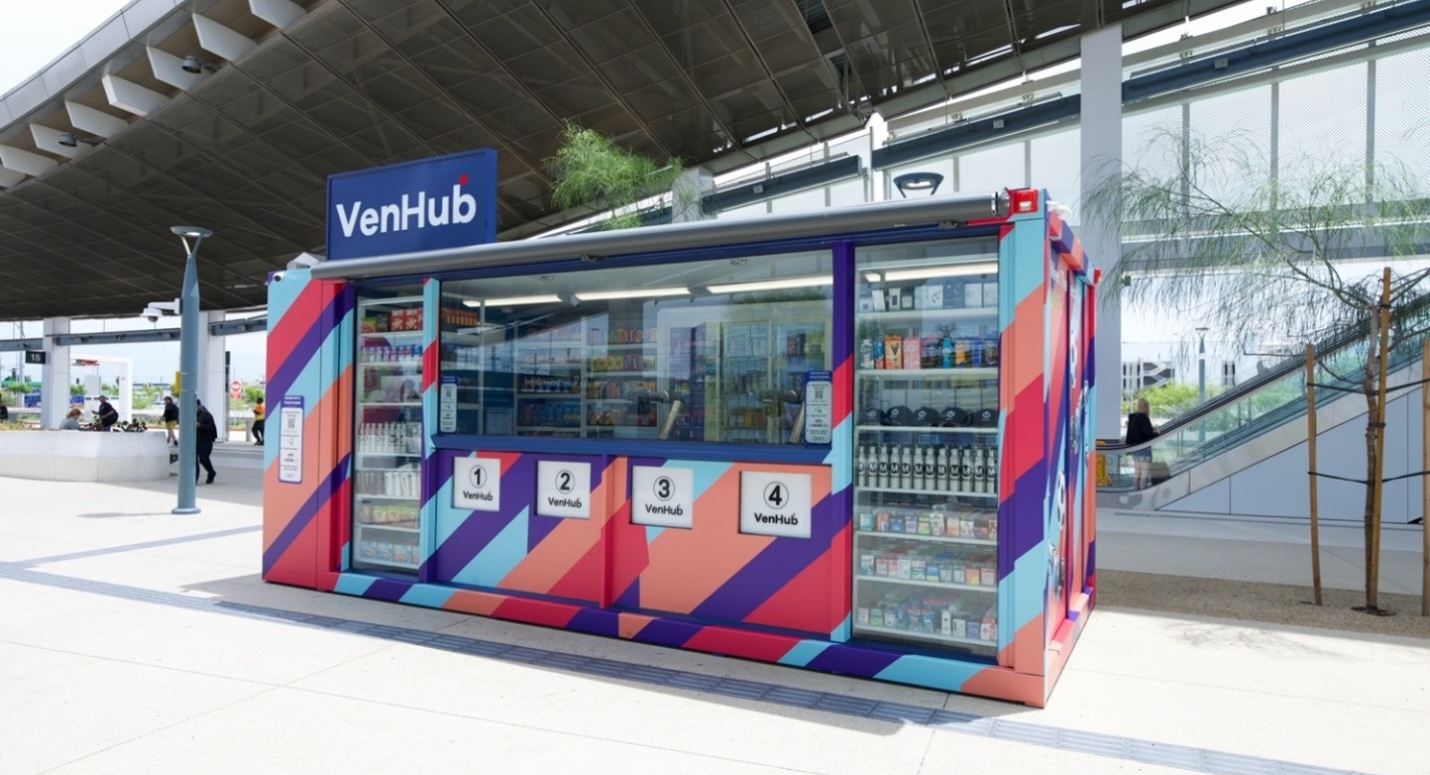
A VenHub smart store Photo above and at top courtesy of VenHub
VenHub may be putting a new spin on automated retailing, but vending machines tucked in the corners of malls were its earliest form. They were the “forgotten cousin of retail,” said Starr Cumming, director of ancillary revenue for the Americas at Hines, who led a discussion on automation. Today automated retail continues to fulfill its traditional role of providing convenience while some combine that convenience with experience, observed Tracey Hatley Williams, managing director of global business development for Blue Butterfly, a specialty leasing and retail consultancy. Those range from photo booths to Lucky Box machines that dispense authenticated sports collectibles, Pokemon cards and other memorabilia.
Automation also has caught the eye of traditional retailers and food-and-beverage operators who see an opportunity to appeal to younger consumers, said Linda Johansen-James, founder and CEO of retail management and consulting firm International Retail Group. Over the next three years, for example, California Pizza Kitchen plans to deploy as many as 1,000 pizza vending machines in airports, in hospitals, on college campuses and in other areas. “You’re going to see a huge influx of some pretty incredible brands that are adding automation to their omnichannel strategies,” she added.
By Joe Gose
Contributor, Commerce + Communities Today