The Short Version
- Dressbarn co-founder Roslyn Jaffe helped redefine women's retail by making professional apparel accessible to working women.
- Her people-first approach created opportunity inside the business and challenged traditional retail pricing models.
- That legacy continues through the Roslyn & Elliot Jaffe Retail Entrepreneur Prize, administered by the ICSC Foundation to support student entrepreneurs.
A Legacy of Access, Entrepreneurship and Opportunity
Applications are now open for the ICSC Foundation’s 2026 Roslyn & Elliot Jaffe Retail Entrepreneur Prize, with submissions due by March 2. Roslyn Jaffe, who died last year at age 96, has made major impacts on the Marketplaces Industry. She and her husband, Elliot Jaffe, founded Dressbarn in the 1960s, launching a retail revolution led by and for working women.
And since 2019, the award — endowed by the Jaffe family through the ICSC Foundation and guided by their daughter, Elise Jaffe — has incubated entrepreneurs who are enrolled in undergraduate or graduate studies and are developing bold retail concepts. Passionate about preserving the value and meaning of the award, Roslyn Jaffe herself played an active role in the selection of winners.

Roslyn Jaffe at the Roslyn S. Jaffe Awards Luncheon at Cipriani on 42nd Street in New York City on Oct. 27, 2015 Photo credit: Desiree Navarro/WireImage via Getty Images
A Woman Appears Where No One Expects Her To Be
It was the early 1960s, and New Jersey’s garment warehouses were stacked with overstock dresses, taking up room for companies that didn’t know what to do with them. Into this world drove Roslyn Jaffe, a warm but persistent mother of three from Connecticut. As her station wagon idled near a loading dock, she would rap on the door. As the story goes, manufacturers would answer with shouts of: “Who the hell are you?” She never flinched but instead would argue her case to check out their excess stock.
“It took a lot of patience and stick-to-itiveness and a little bit of charm offensive, as well — and, I suspect, a thick skin, as a lot of people blew her off at the end of the day,” said the Jaffes’ son Richard. His brother, David Jaffe, added: “She just had the force of will, and she’s so genuine and authentic and sweet. How could you ever say no to her?”
Roslyn Jaffe bargained her way through warehouse stockrooms, loading boxes herself, and then would drive back to Connecticut, the car full of dresses she had purchased for a song. She was able to bring designer apparel within reach of budget-conscious shoppers by selling those dresses for $5.99 compared with the $8.99 they were going for in stores.

Starting in the 1960s, Roslyn Jaffe drove from home in Connecticut to warehouses in New Jersey to acquire overstock women’s dresses. She was still at it decades later, as evidenced by the photo above of her 1980s Chevrolet Celebrity, stuffed with her purchases. Photo courtesy of the Jaffe family
The Wind-Down of Fixed-Prices Makes Room for Discount Retailers
Enacted during the Depression, fair trade laws had allowed manufacturers to dictate minimum prices for which retailers could sell their goods. Challenges to such laws started to take shape in the 1950s, based on the idea that a fixed-price system stifled competition and kept costs artificially high. During the ’60s, enforcement of these laws weakened, and the Consumer Goods Pricing Act of 1975 eventually outlawed most forms of retail price maintenance.
The Jaffes and other entrepreneurs took advantage of that weaker enforcement during the ’60s to buy directly from manufacturers at discounted rates. But the couple also knew retail — when they met, in fact, she was in an executive training program at Gimbels and he was in a similar one at Macy’s — and they saw an opening. “Others were discounting hard goods — radios, TVs, refrigerators — and our idea was to discount clothing,” she told Worth magazine in 2017.
Dressbarn’s Launch: A New Kind of Women’s Apparel Store
The Jaffes also spied opportunity in the form of women entering the workforce who would need stylish clothes that fit not only their budgets but also their professional ambitions. “She knew her customers wanted designer clothes but needed them at a value price,” said Valerie Richardson, who recently retired as senior adviser at ICSC and previously headed real estate for Barnes & Noble, Ann Taylor and The Container Store. Richard Jaffe, who founded the plus-size Dressbarn Woman division in 1989 and led it for a time before becoming an analyst covering the retail sector, added that his mother also understood the manufacturers: “She knew they had the inventory. She knew they could certainly afford to take a gamble on her.”
The simple idea of stylish clothes at affordable prices became the foundation of Dressbarn’s success. In 1962, the Jaffes spent $5,000 to open their first shop, a 500-square-foot space in a converted shoe factory in Stamford, Connecticut. They named it Dress Barn to emphasize the discount approach. “I think that conceptually, they liked the idea of a barn,” said Elise Jaffe, who later oversaw Dressbarn leasing. “It was sort of a homey look. It wasn’t glamorous. It wasn’t fancy because they were discounters.” Soon, they decided to carry the name over to the store’s appearance, as well, painting it red on the outside and white on the windows, and they expanded to 1,000 square feet.
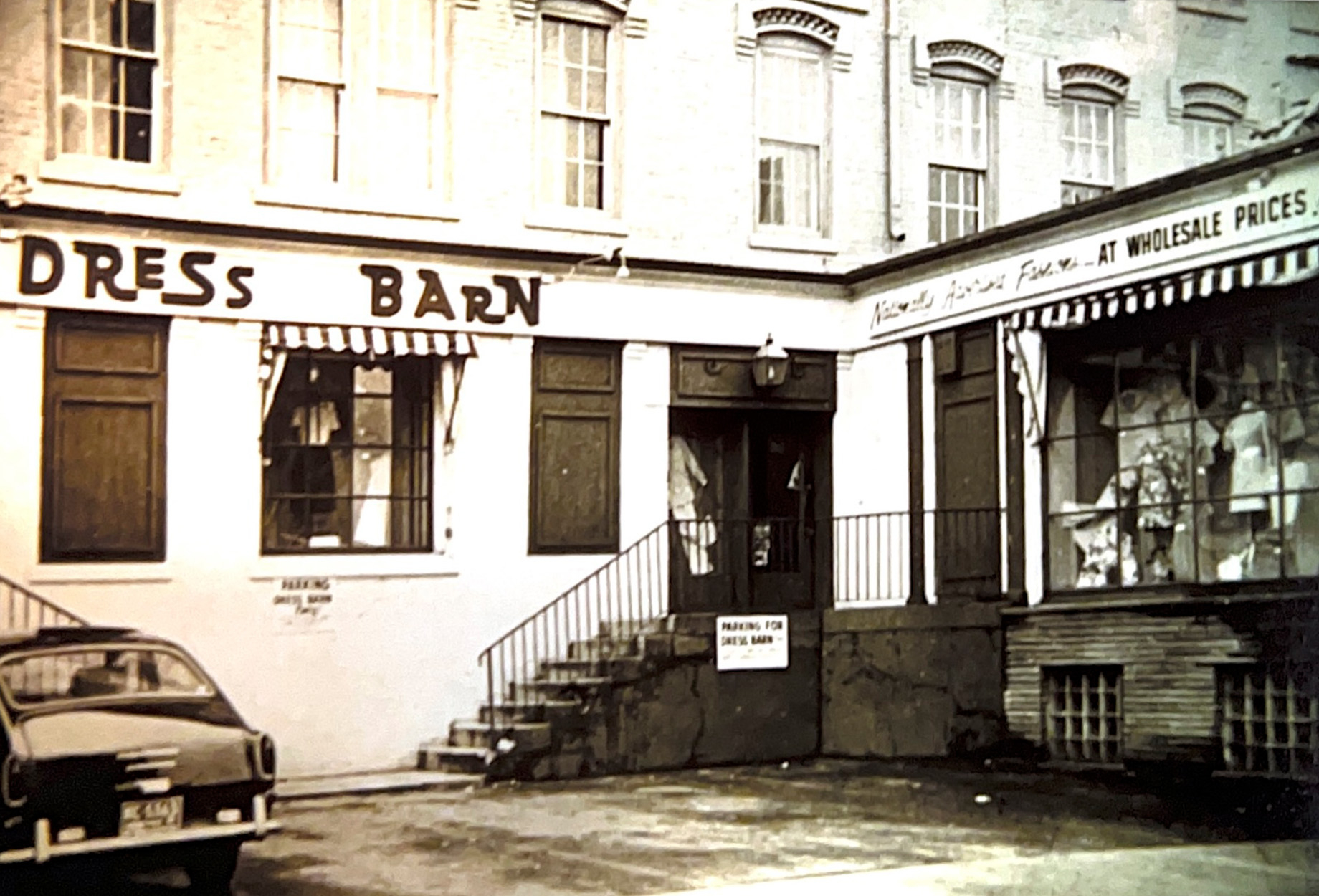
In 1962, Roslyn and Elliot Jaffe opened the first Dress Barn, a 500-square-foot space in a converted shoe factory in Stamford, Connecticut. That store eventually expanded to 1,000 square feet. Photo above and at top courtesy of the Jaffe family
From that modest beginning, the company grew into a national chain. It went public in 1983 and topped 800 stores in the 2010s. In 2009, it became Ascena Retail Group, expanding through acquisitions of Ann Taylor, Loft and Lou & Grey.
Building a Business and a Community for Women
The Jaffes’ entrepreneurial spirit stretched back to their earliest years. Both grew up during the Depression, and Roslyn Jaffe managed to attend college only because her brother used GI Bill benefits for his own education, freeing up enough family funds for his sister’s tuition.
Before Dressbarn, the couple tried small side ventures, such as selling mail-order items like a brass barware set or chronograph watch via ads in the backs of magazines.

Roslyn and Elliot Jaffe Photo courtesy of the Jaffe family
But Dressbarn was different. “In the early years, it was all their own money,” said David Jaffe, who later became CEO of the company. “There was no venture capital, and each store was basically a bet-the-company” move. At first, Elliot Jaffe stayed at Macy’s to maintain a steady paycheck and health insurance and Roslyn Jaffe ran the store while raising the three children then under the age of seven.
As the business grew, he focused on systems and teams while she, affectionately called Mrs. J by employees, remained its heart and soul. She preferred to be quiet, but her influence was magnetic. “Traveling with her was like traveling with a rock star,” Elise Jaffe recalled. “She wasn’t just running a company; she was building a community.”
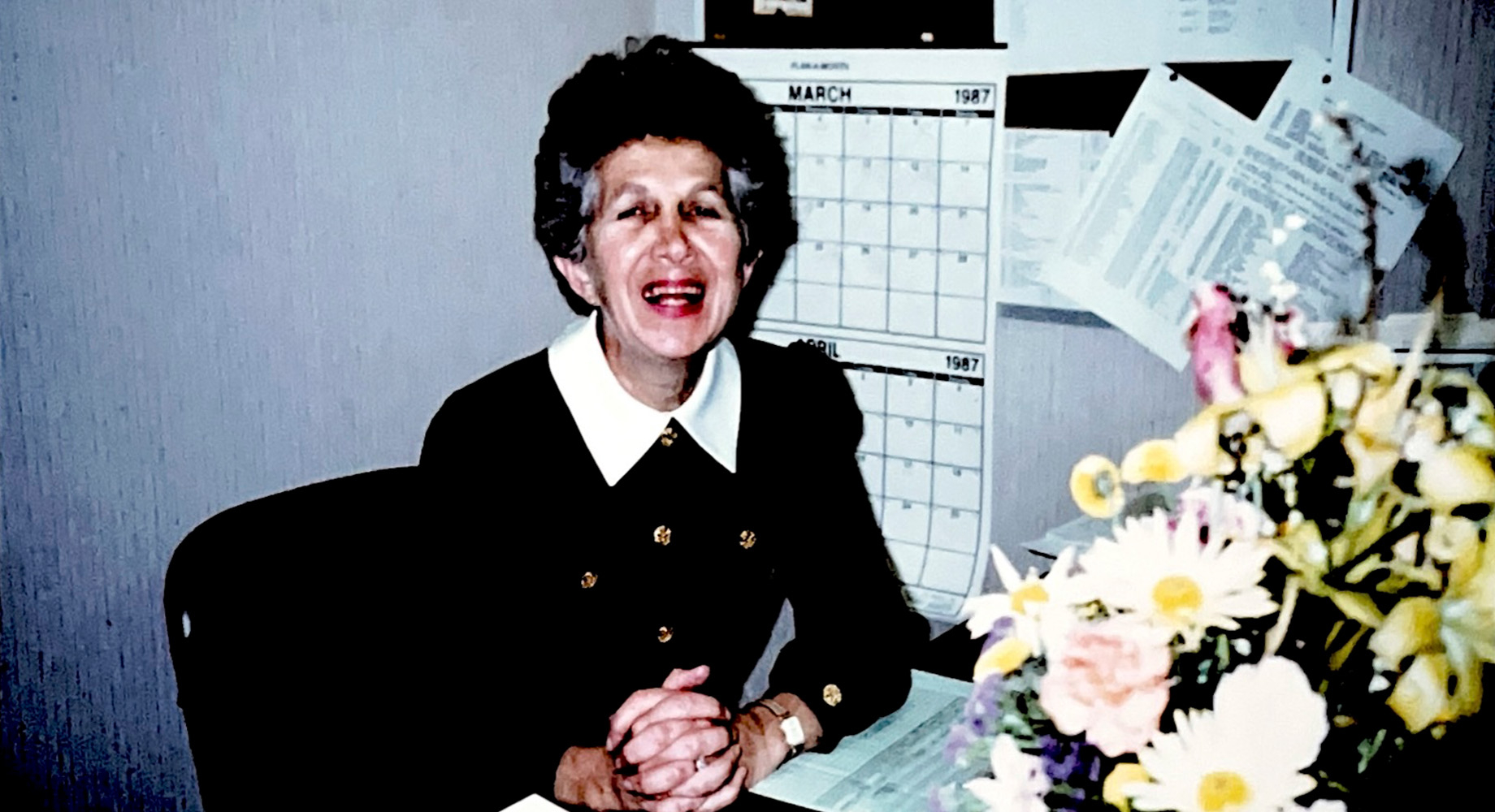
Dressbarn employees knew Roslyn Jaffe, pictured above in 1987, as Mrs. J. Photo courtesy of the Jaffe family
Roslyn Jaffe also built opportunity for those around her. Many Dressbarn employees were single mothers or women reentering the workforce, and stores became places where they could rise into leadership roles. She fought fiercely to secure benefits for employees, once cornering a reluctant insurance salesman in his car in the first store’s parking lot until he agreed to provide health coverage for her team. She also understood that the best employees were those who identified with her customers. Dressbarn stores were staffed by women who looked and lived like the shoppers coming through the doors, giving customers confidence. “If I’m shopping for clothes and the women behind the counter understand me, my life, my body type, I’m going to trust them,” Richardson explained.
Extending the Legacy
Roslyn Jaffe also embedded philanthropy into her work. She steered excess stock and damaged goods to support local fundraisers.
Her compassion was rooted in personal experience: “I had three children, and none of them were really healthy. ... I was always conscious of children and their needs because I lived through some of it,” she told Worth magazine. When Dressbarn went public, the Jaffes dedicated half the proceeds to a foundation supporting opportunity, education, health and women’s advancement.
Roslyn Jaffe’s legacy continued formally, too. In 2014, the Ascena Foundation established the Roslyn S. Jaffe Awards, recognizing everyday heroes improving health, education and economic empowerment for women and children.
And in 2019, the ICSC Foundation launched the Roslyn & Elliot Jaffe Retail Entrepreneur Prize to support an undergraduate or graduate student or a team with bold retail concepts.
It continues today, providing $10,000, pairing with an industry mentor, an all-expenses-paid trip to ICSC LAS VEGAS and complimentary student membership.
Applicants must submit business plans, and Roslyn Jaffe personally reviewed the applications, insisting on rigor. “Some years, she thought none of the applicants deserved it, and she was right,” Elise Jaffe recalled. “Tough as she was, she wanted [the scholarship] to mean something.”
Even while Dressbarn’s remaining 650 stores began to close in 2019 and Ascena filed for bankruptcy in 2020, Jaffe remained proud of what the company and its customers had accomplished.
Business and philanthropy were never separate tracks for Roslyn Jaffe. Both were about widening access, creating opportunity and proving that success is greater when shared. “My mother wove entrepreneurship into family life in a way that feels ahead of her time,” Elise Jaffe said. “She supported and encouraged all of us to find our own way to give back. That’s the measure of her success and of Dressbarn’s true legacy.”
By Rebecca Meiser
Contributor, Commerce + Communities Today