The Short Version
- Retailers are looking beyond population growth when evaluating new markets, weighing factors including household incomes, wage growth, job creation, demographics, housing trends and competition.
- Higher interest rates and rising land and construction costs are limiting new retail supply, with U.S. retail space under construction still well below 2008 levels and below the recent 10-year quarterly average.
- New demand indicators from NAR and First American Data & Analytics show why retailers are pairing residential growth with broader measures of retail activity before making expansion decisions.
Population Growth Still Matters, but Retailers Are Digging Deeper Before They Expand
The most quoted maxim in real estate is “location, location, location.” Among retailers, the mantra “follow the rooftops” not too long ago rivaled it in importance. But that’s not necessarily the case today given two decades of profound change that began with the 2008 financial crisis.
“The retail boom of the 2000s was largely a function of a strong housing market and the suburban sprawl that followed,” said R.J. Hottovy, who heads up analytical research at Placer.ai. “Retailers were certainly doing their homework on new openings, but population growth was often the key variable behind a store decision.”
During that housing boom, builders delivered homes and apartments at an average annualized rate of more than 1.6 million units from 2000 to the end of 2008, 322,000 units above the average annualized pace of the 1990s, according to data from the Federal Reserve Bank of St. Louis. Meanwhile, an average of 156.4 million square feet of retail space was under construction in each quarter of 2008, an amount not approached since, according to CoStar Group, which began tracking the data in 2008.
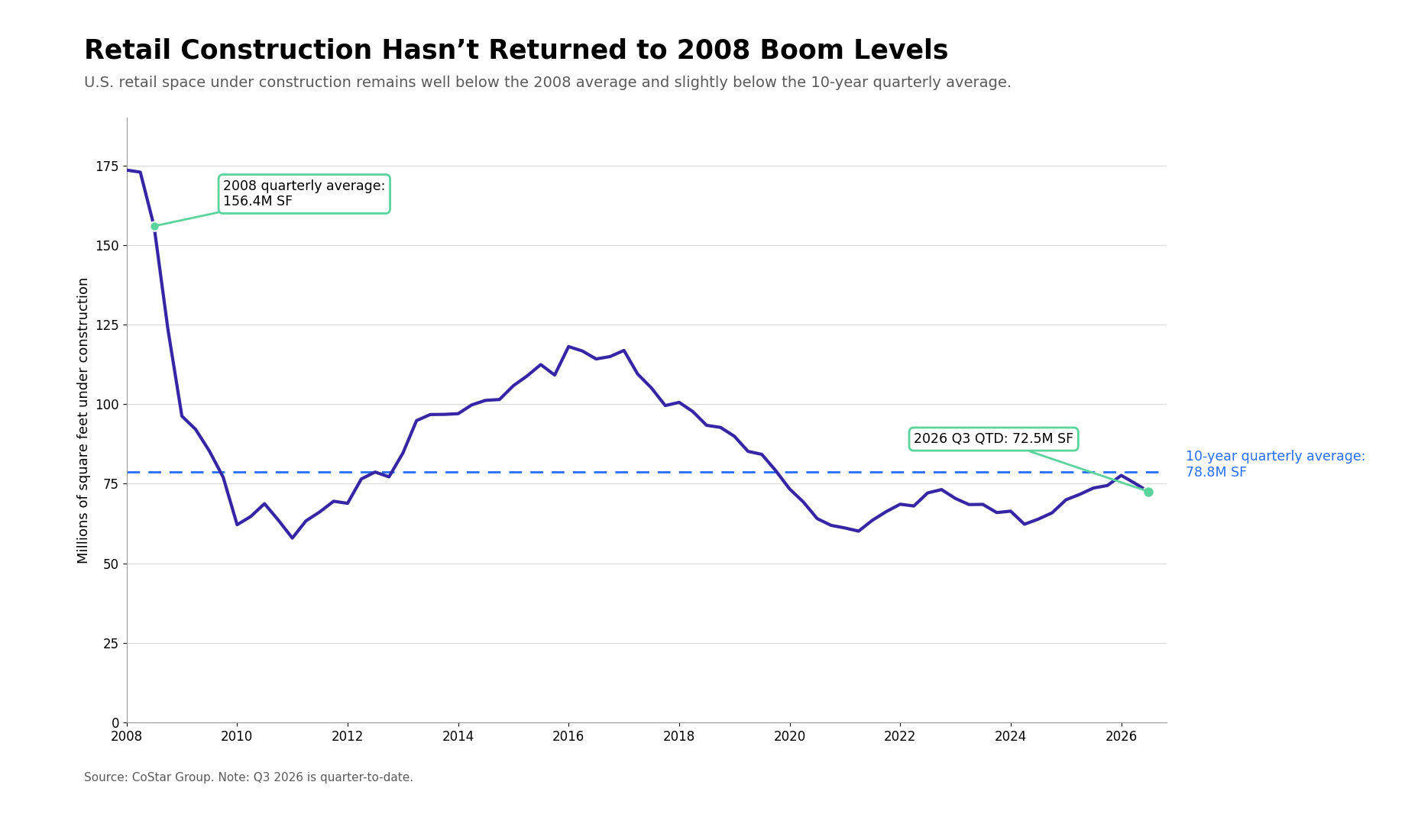
Graphic: ICSC Commerce + Communities Today/ChatGPT
But when the mortgage market imploded in 2008, housing collapsed, commercial property development plunged and retail bankruptcies surged. And while total residential completions have rebounded after a years-long decline following the financial crisis, the average annualized pace since 2020 remains about 200,000 units below the average during the boom years.
“Population growth certainly is still important today,” Hottovy said. “But there is a lot more nuance to how commercial real estate developers and retailers find new expansion opportunities.”
Retailers Look Beyond Population Growth
Household incomes and wage growth, existing and emerging industries driving job creation, the types of housing being built, demographic trends, and competitors in the market are some of the most influential considerations retailers mull to fine-tune location decisions, Hottovy explained. Expanding in the Sun Belt would seem like a good plan given its broad growth in the last several years, but digging into the varied demographic characteristics among markets can help retailers better identify their target audiences. For example, Dallas tends to have more multigenerational households of modest means compared with Tampa, which is seeing more affluent households, he added.
The state of the mortgage and homebuying markets also can influence retailer decisions, according to recent Marcus & Millichap research on how housing and homeownership trends affect commercial real estate. Although annual single-family home sales have stabilized at nearly 4 million units since interest rates began rising in 2022, they remain below long-term norms, the research noted. Marcus & Millichap has noted that softer demand for home-related goods can weigh on retail space demand; Census Bureau data released in mid-September showed furniture and home furnishings store sales fell 1.6% in the first eight months of 2026 compared with the same period in 2025.
Higher Costs Reshape the Development Equation
From a development standpoint, higher interest rates along with the rising cost of land and construction are limiting new retail supply, said Brandon Svec, national director of retail analytics at CoStar. As of late September, about 72.5 million square feet of retail space was under construction in the U.S., below the 10-year quarterly average of 78.8 million square feet, CoStar reported. Currently, retail rental rates in many markets aren’t high enough to cover construction costs, even in areas with strong population growth and leasing trends, Svec said. At the same time, developers and retailers alike remain sensitive to the risk of oversupply, he added.
Amid the challenging market dynamics, public-private partnerships are another factor that retailers and developers consider, said Michael Puline, leader of Marcus & Millichap’s national retail division. To attract development and generate tax revenue, municipalities, counties and states are offering aid ranging from paying for traffic lights to allowing developers to use a portion of the new sales and property taxes generated by a development to help fund it, he observed.
“Many forward-thinking municipalities are stepping up with the tools to spur new development, such as tax increment financing, Opportunity Zones or cost-sharing programs to recruit stores to their communities,” Puline said. “I would say that a good amount of new retail development includes some form of a public-private partnership. Without it, some projects wouldn’t get out of the ground.”
New Indicators Help Gauge Emerging Demand
But retailers still need to see emerging or unserved retail demand to justify expansion. To help identify that demand, the National Association of Realtors in August launched a commercial real estate demand index to gauge demand in 306 metros across office, industrial, retail and multifamily. Rather than looking at vacancy rates, rents and leasing activity, it tracks growth related to each sector — population growth and net migration for multifamily properties and employment growth in manufacturing, transportation and warehousing for industrial real estate, for example. To measure retail demand, it looks at retail trade growth and leisure and hospitality employment.
First American Data & Analytics, a division of title services firm First American Financial Corp., considers investment activity in existing retail properties, as well as land that has been bought and zoned for commercial use — additional signals retailers can use to help determine expansion decisions. FADNA assessed 306 markets based on new-home development and retail property investment transactions in the surrounding area, including resales. It found that, while positive, the overall relationship between residential construction and investment sales growth was relatively weak, indicating that new-home development alone doesn’t necessarily produce investment activity, said Matt Key, vice president of property data at FADNA.
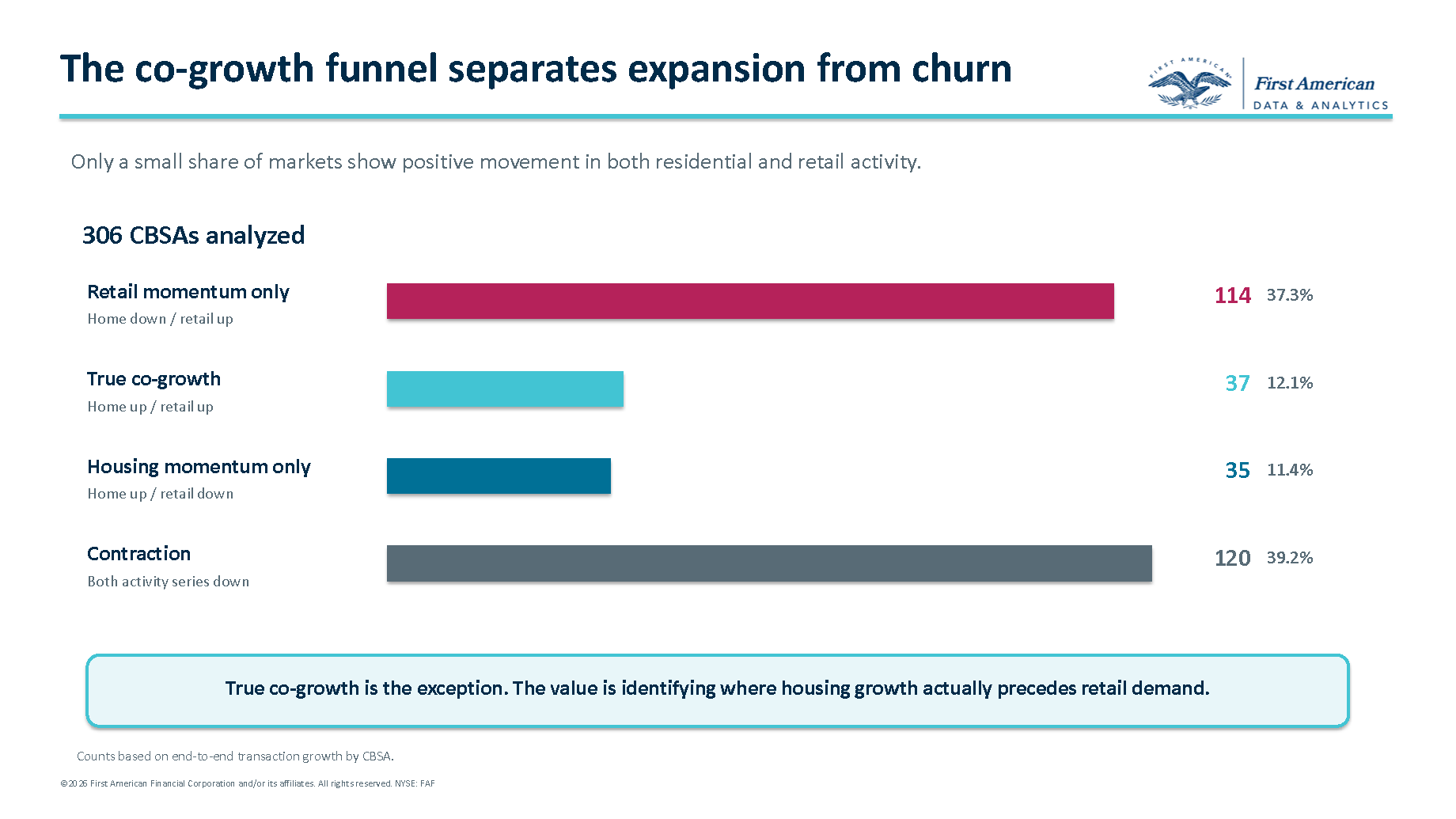
Of the 306 markets analyzed by First American Data & Analytics, 37, or 12.1%, posted growth in both new-home and retail investment. Graphic courtesy of First American Data & Analytics
Little Rock, Fayetteville, Jonesboro and Fort Smith in Arkansas were among the markets that displayed the clearest co-growth signals, with new-home and retail investment activity rising together. FADNA identified those markets as favorable candidates for residential-led, neighborhood-serving retail expansion. But large cities including Houston and Tampa, Florida, ranked high in retail investment activity despite declining land sales for residential development, suggesting that a retail market’s scale was the primary driver of retail property sales activity. All told, only 12.1% percent of the markets analyzed saw a parallel increase in residential construction and asset sales, Key added.
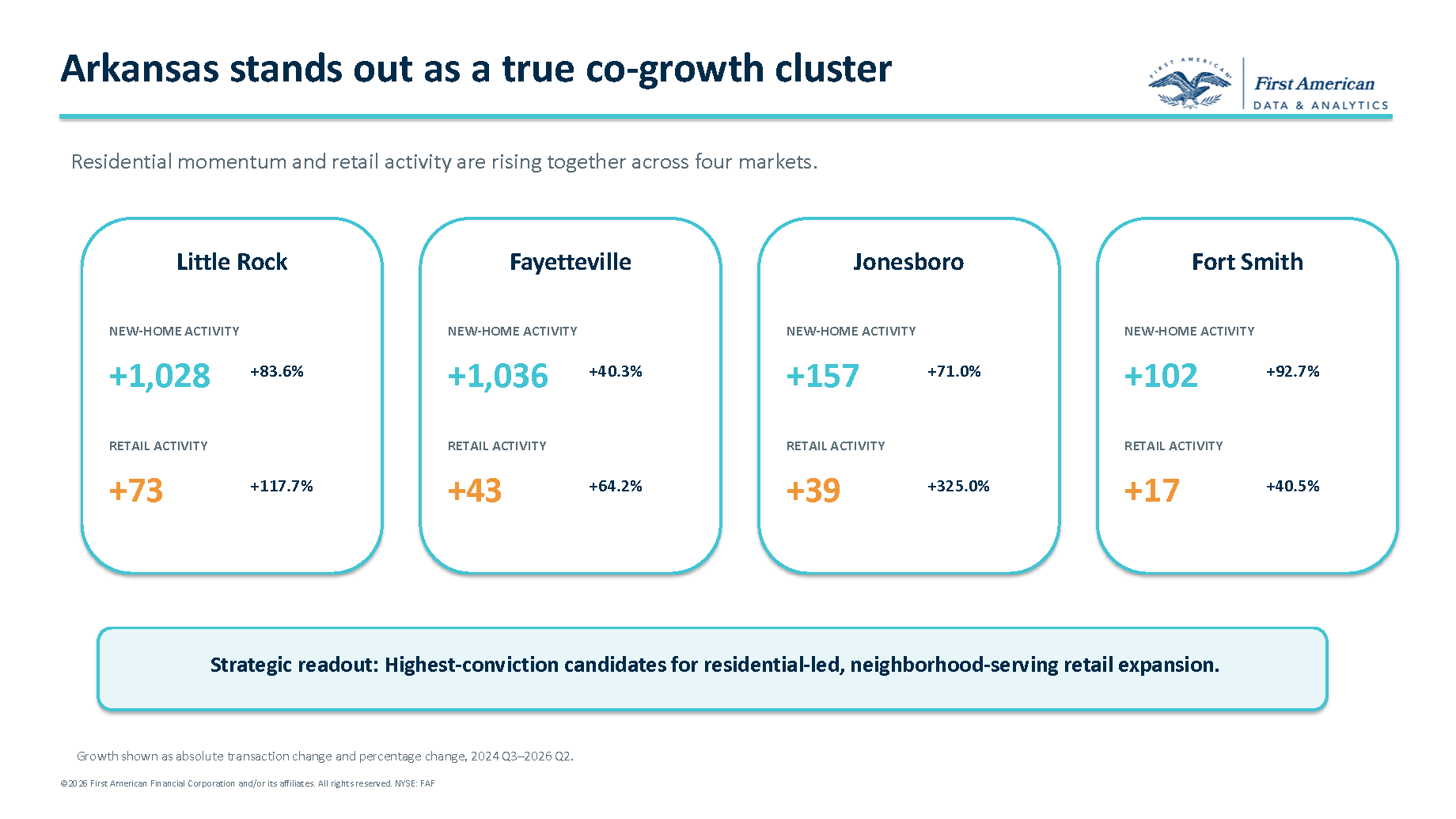
Four Arkansas markets — Little Rock, Fayetteville, Jonesboro and Fort Smith — posted increases in both new-home and retail activity from the third quarter of 2024 through the second quarter of 2026. Graphic courtesy of First American Data & Analytics
“New residential development can be an important indicator of future retail [investment] demand, but new-home growth alone doesn’t tell the full story,” Key said. First American’s analysis, he continued, highlights “why retailers need to evaluate residential trends alongside actual retail [investment] activity when making location decisions.”
By Joe Gose
Contributor, Commerce + Communities Today