The Short Version
- U.S. box office proceeds are up year over year, helped by a strong slate of 2026 releases.
- Surveys from Fandango and NRG point to continued interest in theatrical moviegoing among Gen Z and Gen Alpha.
- Theater owners and landlords are experimenting with immersive design, fan events and retail cross-promotions to extend the moviegoing experience.
- Industry observers say excess theater space remains a challenge, while stronger locations may benefit from reinvestment and rightsizing.
A Stronger Box Office Gives Movie Theaters New Momentum
Thanks to the blockbusters “The Odyssey” and “Spider-Man: Brand New Day,” the first weekend in August was “the biggest collective weekend in [U.S.] box office history, with roughly $430 million across all movies in the marketplace,” according to Variety. And then this week, Variety noted, domestic revenue hit $4 billion, “officially the biggest summer at the box office since COVID.”
Domestic year-over-year box office proceeds year to date as of Aug. 11 were 18.4% higher than the same period in 2025 and 27.4% higher than in 2024, per IMDbPro’s Box Office Mojo. That represents quite a story arc for Hollywood after years of theater closures, bankruptcies, AI jitters and production-delaying strikes.
For landlords like CBL, the surge of moviegoers has translated into higher sales and longer dwell times. The REIT leases space to movie theaters at 20 of its 49 malls and lifestyle centers. “The crowds this year have been so much more with the high-quality product that we’ve had,” said CEO Stephen Lebovitz. That includes the 2026 standouts “Michael,” “Toy Story 5,” “Project Hail Mary,” “The Devil Wears Prada 2” and “The Super Mario Galaxy Movie.” So far, the five films have raked in more than $1.8 billion domestically, according to Box Office Mojo.
Younger Generations Are Showing Up for the Big Screen
While blockbusters put people in seats, interest in the silver screen also is building among younger generations, including Gen Z and Gen Alpha. Not long ago, the conventional wisdom was that younger generations would skip the movies and stay home to play video games, scroll social media and watch streaming platforms. In an April 2026 Fandango survey of 5,000 U.S. moviegoers, however, 87% of Gen Z respondents indicated that they had seen a movie in the past year, and 92% said they planned to go to the movies over the summer. For its part, research firm NRG found that 59% of Gen Alpha respondents in its 2025 survey of about 6,100 U.S. moviegoers preferred watching movies in theaters versus at home.
The social media-fueled breakout of two low-budget horror films by Gen Z directors — Curry Barker’s “Obsession” and Kane Parsons’ “Backrooms” — also challenges the narrative that digital natives are rejecting in-person moviegoing. According to Box Office Mojo’s Aug. 11 domestic tally, “Obsession” has made about $263 million and “Backrooms” about $197 million. Both movies have resonated with under-30 audiences.
Lebovitz noted that Parsons — better known online as Kane Pixels — was still a teenager when A24 tapped him to direct “Backrooms.” “Obsession was made for less than $1 million, and the director was 25 years old,” Lebovitz said. “No one expected it.” The phenomenon has put a spotlight on the next generation of directorial talent, he added. “It’s not just sequels anymore, and that should allow for more of a willingness to invest in better product. It also validates that having movies spend that time in the theater, instead of going straight to streaming, is a smart way to do business.”
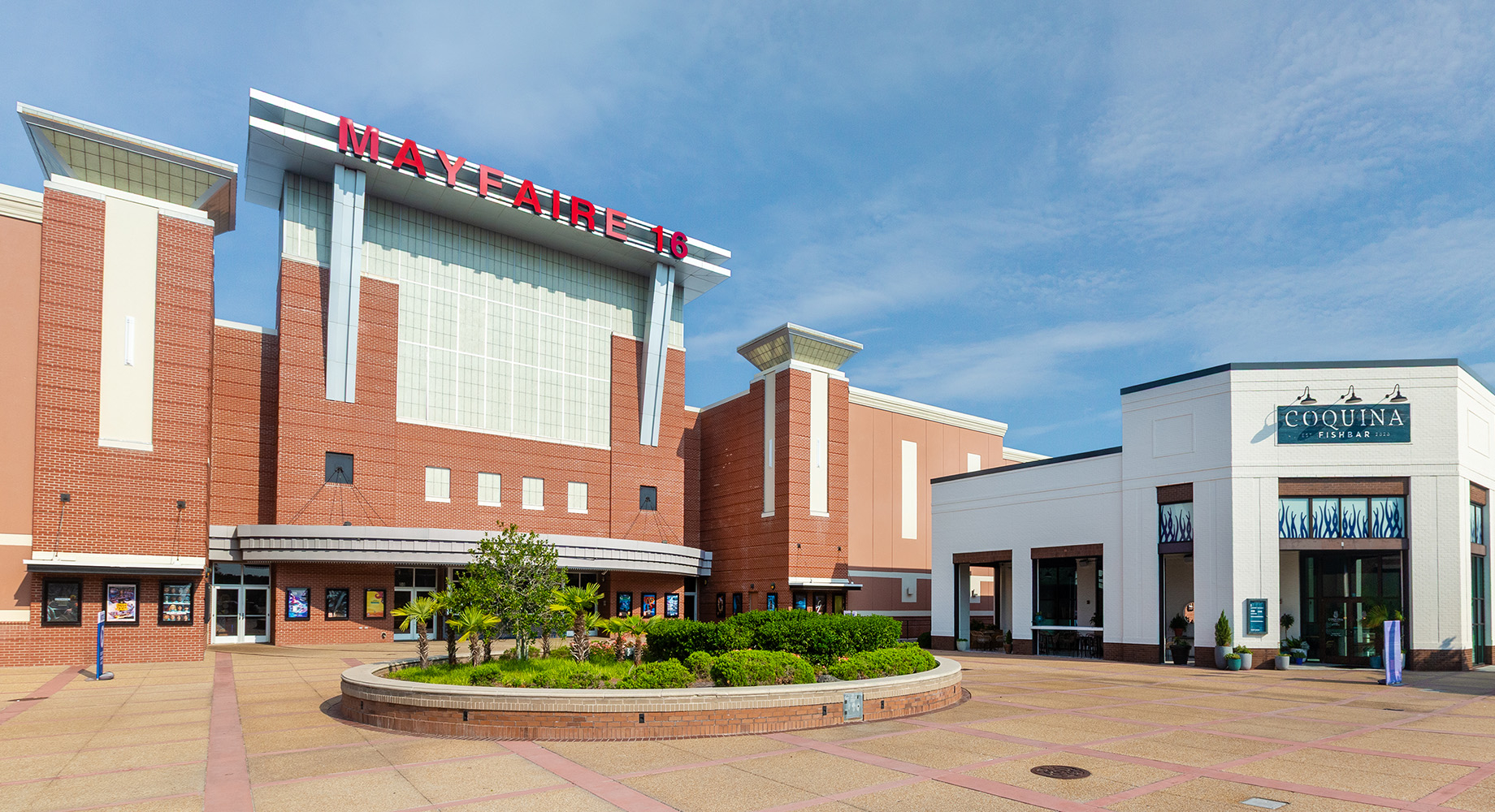
Blockbusters such as “The Odyssey” and “Spider-Man: Brand New Day” are driving record traffic to U.S. movie theaters. Pictured: The Regal Mayfaire Stadium 16 and IMAX at CBL’s Mayfaire Town Center in Wilmington, North Carolina. Photo courtesy of CBL
The Moviegoing Experience Extends Beyond the Screen
The right approach to design and marketing can help theater owners and landlords make going to the movies even more of a draw for members of Gen Z and Gen Alpha, said MG2 principal Melissa Gonzalez, who founded and leads the architecture and design firm’s strategy and insights service, MG2 Advisory.
Earlier this year, MG2 Advisory published a 44-page, multisource deep dive into Gen Alpha trends: Young in Age, Mighty in Impact: Gen Alpha is Rewriting the Rules for Brands, which followed its earlier research on Gen Z.
MORE FROM ICSC: The Rise of the Gen Z Consumer
As Gonzalez sees it, younger generations prize tactile, immersive experiences that are powerful enough to pull them away from their usual distractions. They value the social dimension of shopping and moviegoing, she added, and often want to co-create and be part of the experience rather than just passively observe it. Those preferences, Gonzalez said, help explain the popularity of costume events and other fan activations based on the likes of “The Devil Wears Prada 2” and “Taylor Swift: The Official Release Party of a Showgirl.”
“The more engaging [landlords and theater owners] can make the experience, the better,” she said. “In the case of Gen Alpha, think about how to make sure your theater has an experience that the whole family will want to have together. Then once you leave, make sure there are other extensions of that around the shopping center or the mall.” She gives kudos to Netflix House for its street-facing character elements, eye-catching digital signage and other elements designed to make the building exterior function as a “drive-by billboard.”
Rather than static design, theater chains also could make greater use of features that can be reconfigured or “reskinned” based on popular films. That could mean things like:
• transforming the floor into a red carpet or replica Hollywood Walk of Fame
• setting up themed pop-up shops with sought-after merchandise like branded popcorn buckets
• using programmable lighting to match the mood and color of hit films
• bringing in digital photo booths that allow moviegoers to create images of themselves as characters in the film
“That doesn’t mean every theater needs to feel like a theme park,” Gonzalez said, “but how does it become more of an extension of what the film is so that people can be a part of it, co-create with it, and share? Those are all things you can’t do at home.”
Lebovitz added that landlords stand to benefit by collaborating with retailers on movie cross-promotions. He pointed to a Girls Night at the Movies event at CBL’s Sunrise Mall in Brownsville, Texas. The event gave attendees the opportunity to shop, gather with friends and watch a screening of Disney’s heavily cross-promoted “The Devil Wears Prada 2.”

CBL’s “The Devil Wears Prada 2” cross-promotion boosted sales for retailer Versona at Sunrise Mall in Brownsville, Texas. VIP club members shopped for brands linked to the film before attending a private screening. Photos courtesy of CBL
Women’s apparel store Versona “did significantly more business than they would have done otherwise, and then the group went to the movie after,” Lebovitz said. “It was a win-win for the retailer and the theater. We also did something around ‘Toy Story 5’ with Build-A-Bear. Different audience, but sales were 20% above their goal for the day.”
Cinerama Dome Revival Shows the Appeal of Destination Theaters
Creating a standout experience is certainly part of the strategic thinking behind plans to reopen and restore a Hollywood landmark: Cinerama Dome in Los Angeles. Sony Pictures Entertainment and subsidiary Alamo Drafthouse Cinema announced the move this past July. The theater opened in 1963 but, as noted by NPR, shuttered during COVID when its then-owner closed all 300 screens in its ArcLight Cinemas and Pacific Theatres portfolio, including the Cinerama Dome.
In a press release, SPE said the Cinerama Dome’s 86-foot-wide, curved screen was “engineered to immerse audiences in an extraordinary panoramic viewing experience.” The site of major premieres over the decades, the theater on Sunset Boulevard “helped pioneer a new era of large-format cinematic presentation and remains one of the most distinctive moviegoing environments ever created,” SPE said. Slated for completion in early 2028, the restoration will preserve aesthetic elements like the theater’s traditional concessions and exterior branding. SPE said it will reopen an adjacent 14-screen theater complex as an Alamo Drafthouse Cinema, with dine-in services, karaoke rooms and special events and programming.
The Dome is the kind of moviegoing destination that can win in today’s theater landscape, said JLL executive vice president and tenant-rep brokerage lead Kenneth Shishido. The veteran Los Angeles-based broker, whose clients include Alamo Drafthouse, has represented theater chains going back to the 1990s.
Too Much Theater Space Still Needs To Be Rightsized
New blockbusters aside, Shishido said, there are still too many theaters in the U.S. With no shortage of overly large cinema complexes, some theater companies also continue to face heavy debt loads that will soon come due. “The business is kind of at a crossroads.”
FROM THE C+CT ARCHIVE: Will Movie Theaters Make It?
Throughout the 1990s and into the 2000s, theater chains built ever-larger complexes, some with as many as 30 screens, Shishido noted. The demand seemed to justify the expansion. “You had at one point in Ontario, [California], an AMC and an Edwards Theater right across the street from each other,” he recalled. “One was a 22-plex and the other was a 30-plex, both megatheaters in their own right. They were two of the strongest movie theaters in the Inland Empire for years.”
Today, such sites can put landlords in a conundrum. “Let’s say it’s a 20- to 30-screen theater that is 100,000 to 200,000 square feet and tucked behind other buildings,” Shishido said. “You don’t really want to tear it down because then you have to find another user of that size that doesn’t need frontage. If you try to convert the building to another use, there is the cost of leveling floors and removing interior walls. It can be a very expensive proposition to replace a theater anchor, right?”
MORE FROM C+CT: Keeping Rent and Foot Traffic Flowing at Troubled Movie Theaters
Rightsizing in the movie theater industry will continue, Shishido predicted, as more operators run out the lease terms on their lowest-performing theaters, then close those locations.
Closures and consolidation ultimately could lead to a healthier industry in which the best-located theaters get the reinvestment they need to keep attracting moviegoers, Gen Z and Gen Alpha included, Shishido said. “If it’s still a good location, one of the operator’s competitors might take it because it’s cheaper to convert an existing theater than to build from ground up,” he noted. “Maybe you add reclining seats, make it a dine-in concept and spend enough on the conversions so that it’s worth it to do a new lease. Basically, you’re using that conversion to offer what is essentially a brand-new theater with all the bells and whistles that people expect these days.”
By Joel Groover
Contributor, Commerce + Communities Today