The Short Version
- Mass timber construction is gaining momentum as a sustainable, biophilic alternative to concrete and steel in retail and mixed-use projects.
- Early adopters include Apple’s Miami Worldcenter store, 619 Ponce in Atlanta’s Ponce City Market and the Sycamore & Oak retail pavilion in Washington, D.C.
- Innovations in engineered-wood systems, like CLT and mass plywood, are enabling flat-packed prototype stores and faster, lower-carbon delivery.
- A growing domestic supply chain is making mass timber more viable for larger-scale retail buildings.
- Retailers and shopping center developers must weigh aesthetics, cost, supply chain efficiency and durability when evaluating mass timber as an option.
Why Mass Timber Is Gaining Traction in Retail and Mixed-Use Development
Concrete and steel dominate retail construction, but some are bullish on the prospect of making retail and mixed-use buildings from the likes of Douglas fir, Colorado spruce and southern yellow pine. Chalk it up to advances in mass timber construction, which proponents say offers biophilic aesthetics, a smaller carbon footprint and efficient project delivery.
Wood is already part of the experience for shoppers at the Apple store at Miami Worldcenter and at the Sycamore & Oak retail pavilion in Washington, D.C., with its shops, restaurants, service tenants and performance space. And architects say retail and entertainment operators are exploring the viability of mass timber prototypes further.
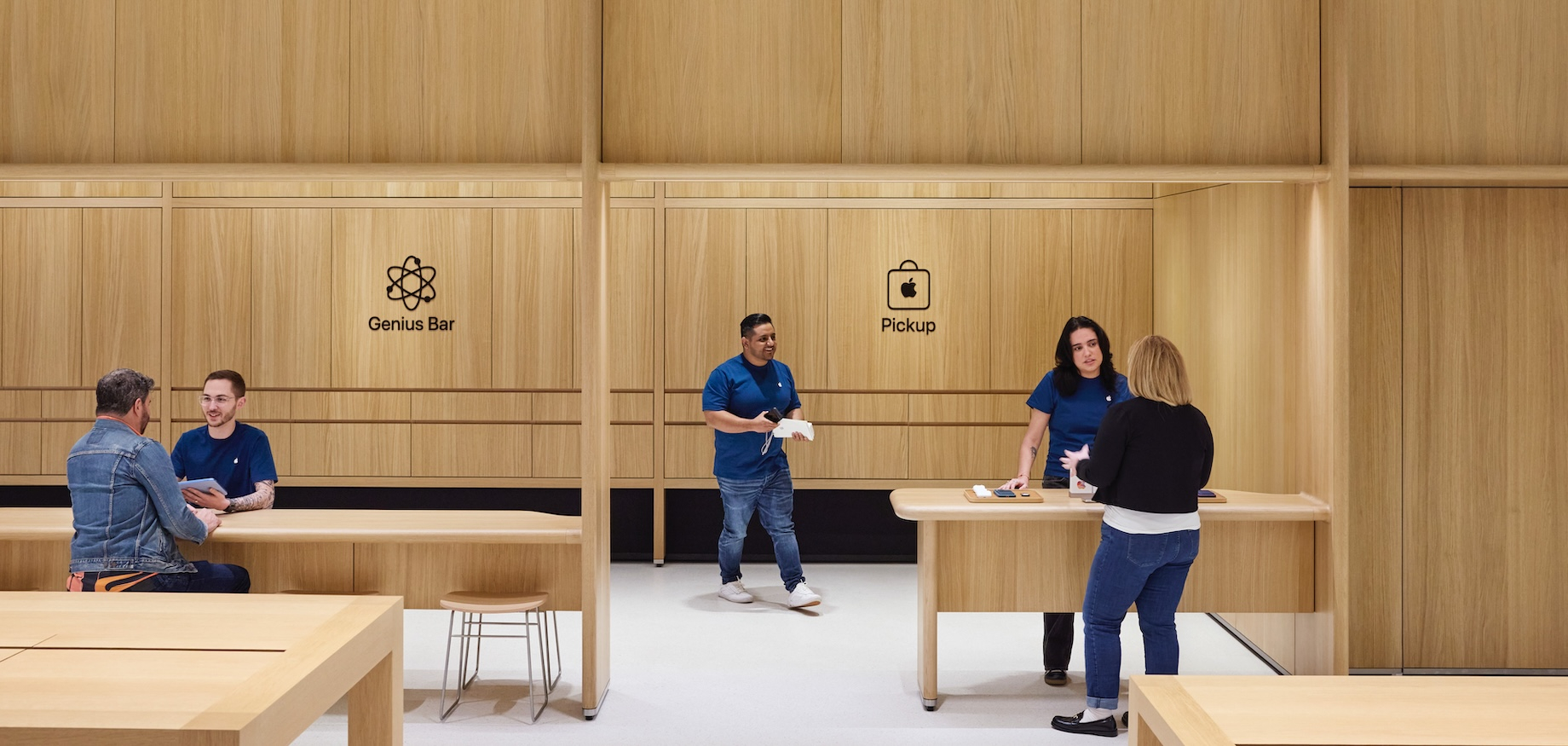
Built with regionally sourced mass timber and other carbon footprint-reducing materials, Apple Miami Worldcenter opened in January 2025. Photo courtesy of Apple
Mass Timber Today: Engineered Wood Scaled for Modern Buildings
Mass timber construction relies on engineered-wood panels, columns and beams — especially those made from glue-laminated timber, or glulam, and cross-laminated timber, or CLT — that often function like Lego bricks or Lincoln Logs in prefab building design and assembly. “Glulams have been around since the 19th century, and veneer products like plywood came around in the 1950s,” said architect Christian Schoewe, a principal at ZGF. “What we call mass timber today is really just gluing more of those things together to make them bigger, longer and stronger.”
Schoewe worked on the main-terminal expansion of Portland International Airport, Phase 1 of which opened last year and boasts a 9-acre, mass timber roof made from 3.5 million board feet of wood sourced locally from Oregon and Washington forests. With sustainability as a client priority, ZGF used glulam beams to eliminate the need for carbon-intensive steel. The firm relied on mass plywood panels for the roof diaphragm and smaller timbers for the skylight latticework. Holding up the 18 million-pound, 400,000-square-foot structure are 34 Y-shaped columns. Mass timber also features prominently in the design of shops and eateries in the expanded terminal. “We’re always finding a way to push the boundaries with wood,” Schoewe said.
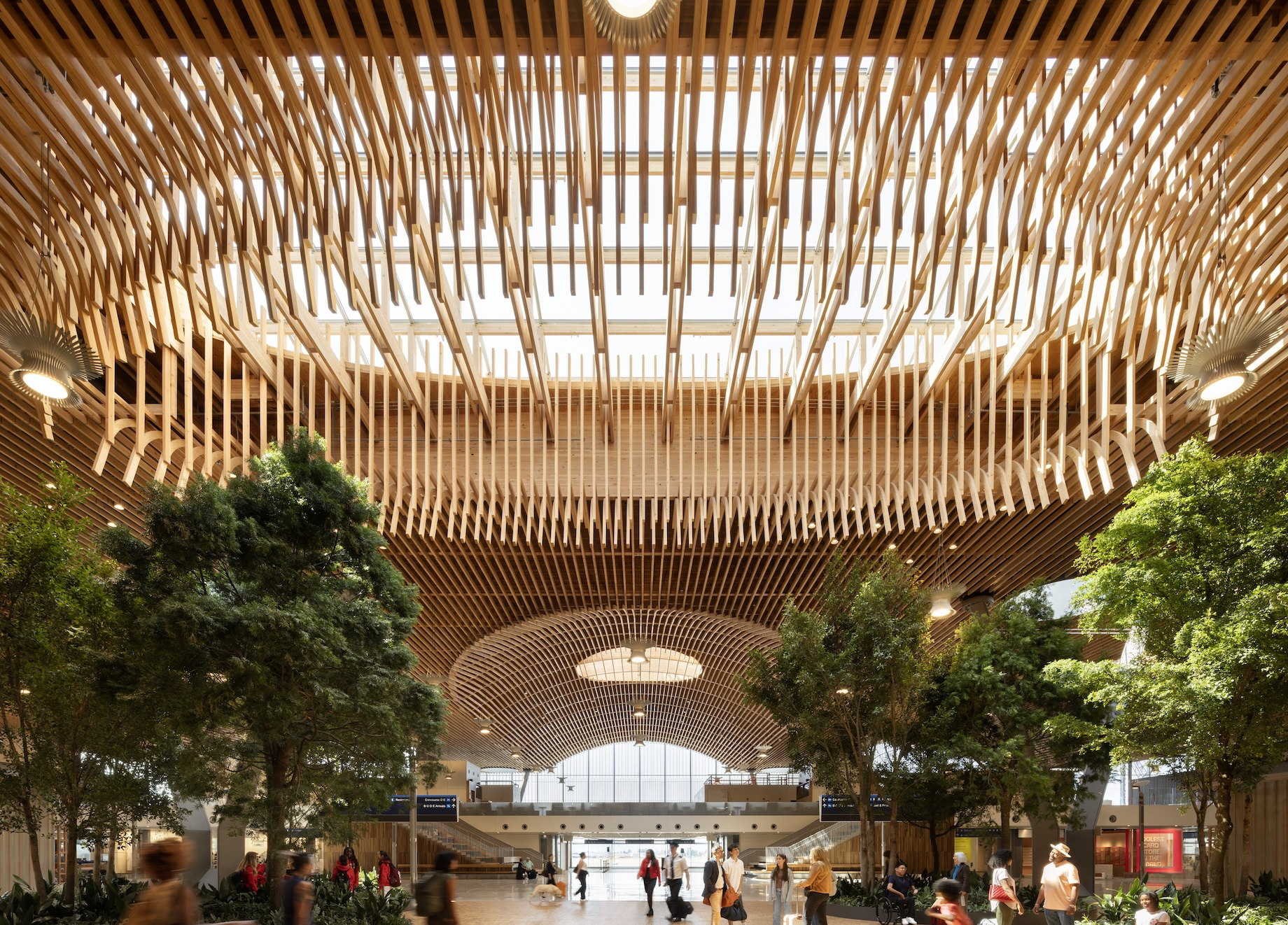
A mass timber roof soars over the main terminal expansion at Portland International Airport in Oregon. Photo courtesy of ZGF and by Ema Peter Photography
Mass Timber’s Rise Across Real Estate Sectors
Wood construction is on the upswing in U.S. commercial real estate. As of September, nonprofit WoodWorks counted 2,598 mass timber commercial and multifamily buildings in design or construction around the country, up from a few dozen in 2016.
Some retail examples are part of mixed-use projects with timber residential towers or offices. At Jamestown’s Ponce City Market in Atlanta’s Old Fourth Ward, columns, beams and floor slabs made of southern yellow pine enrich the experience at Pottery Barn, said Jamestown senior vice president of construction and development Alexandra Kirk, a trained architect. The store is on the ground floor of the new 619 Ponce, a 114,000-square-foot boutique office project that Jamestown says is Georgia’s first mass timber building to be constructed using a regional supply chain. “Pottery Barn was a great partner because they did not want to cover up any of the mass timber,” Kirk said. “As you look up in the ceiling, you see the beams and the underside of the CLT slab above. People feel the warmth and like being in the space. Sometimes they’ll comment: ‘Wow. It really smells like timber.’”
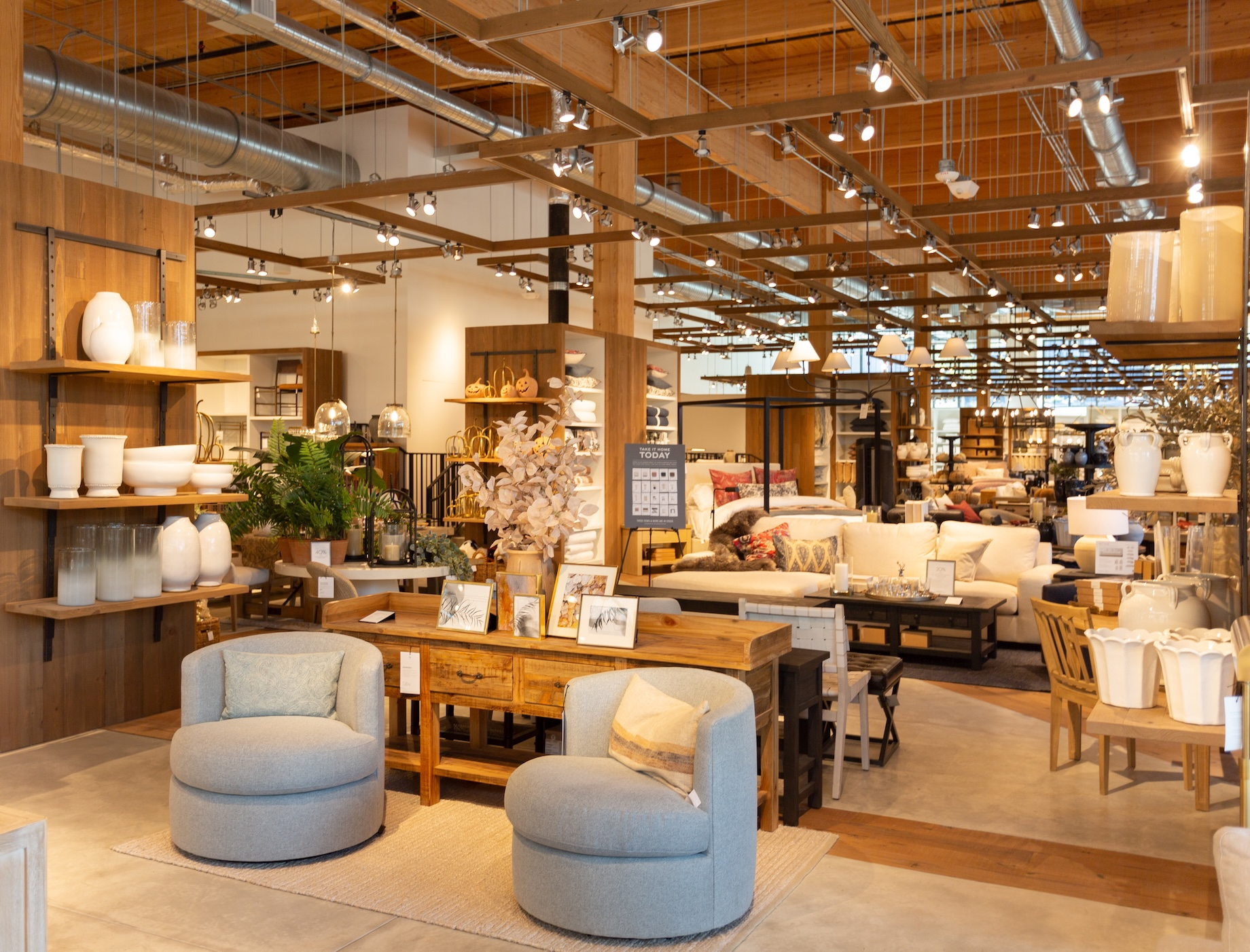
Mass timber construction creates an elevated atmosphere for Pottery Barn shoppers at Jamestown’s 619 Ponce in Atlanta. Photo courtesy of Jamestown and by Jared Dangremond
How Mass Timber Construction Can Support Retailer and Developer Goals
Aesthetics can make wood a natural fit for retail brands focused on sustainability, the outdoors or health and wellness. As Kirk sees it, mass timber also can support developers’ project goals. She noted that 619 Ponce sits next to Ponce City Market’s historical, red-brick building, which had been a Sears, Roebuck & Co. store and distribution center from the 1920s through the 1980s. “When you’re working with buildings that are adaptive reuse, they tend to have this grandeur and greatness that you want to complement rather than compete with,” Kirk said. “That was foremost on our minds.”
619 Ponce, which opened in summer 2024, commands above-market rents in part because of the premium experience created by mass timber, Kirk said. Careful and early planning, as well as the involvement of an engineering firm that specializes in timber construction, sped the project along. “We had a small team, a super-clean site, and it took about three months for that erection,” Kirk said. “In comparison, you’d probably be another 30 to 45 days if you were using concrete as your base structure.”
Sustainability was a priority for Jamestown, as well. Prior to building 619 Ponce, the company adopted 17 UN goals for sustainable development and committed to achieve net-zero operational carbon by 2050. Kirk noted that one of Jamestown’s investment arms owned thousands of acres of Georgia timberland, so 619 Ponce avoided importation of mass timber products from Canada or Europe.
Companies in Georgia, Alabama and Tennessee turned that timber into fabricated CLT panels with installed hardware. Construction crews at Ponce City Market put the pieces together. “We saw over a 60% reduction in carbon emissions when compared to a concrete structure of the same size in the same area,” Kirk said.
Prefab Mass Timber: Prototype Stores Built for Fast, Efficient Rollouts
Retailers looking to roll out stores quickly could benefit from prefab wood construction, said Tabberson Architects principal Bill Tabberson. His firm has designed a mass timber prototype for a new concept called Milo’s Market, which the architect likened to Trader Joe’s or Whole Foods for convenience retail. The founder of Milo’s Market is acquiring development sites around Indiana for freestanding properties.
Tabberson recently toured the Freres Engineered Wood plant in Lyons, Oregon, to discuss the logistics of making, essentially, a Lego set for the Milo’s Market prototype. Freres would use as the blocks its patented Mass Ply Panels. These MPP were also employed by ZGF for the PDX expansion. “A Milo’s store fabricated out of MPP structural components could be shipped flat-packed and then lifted into place with a crane on the jobsite,” Tabberson explained.
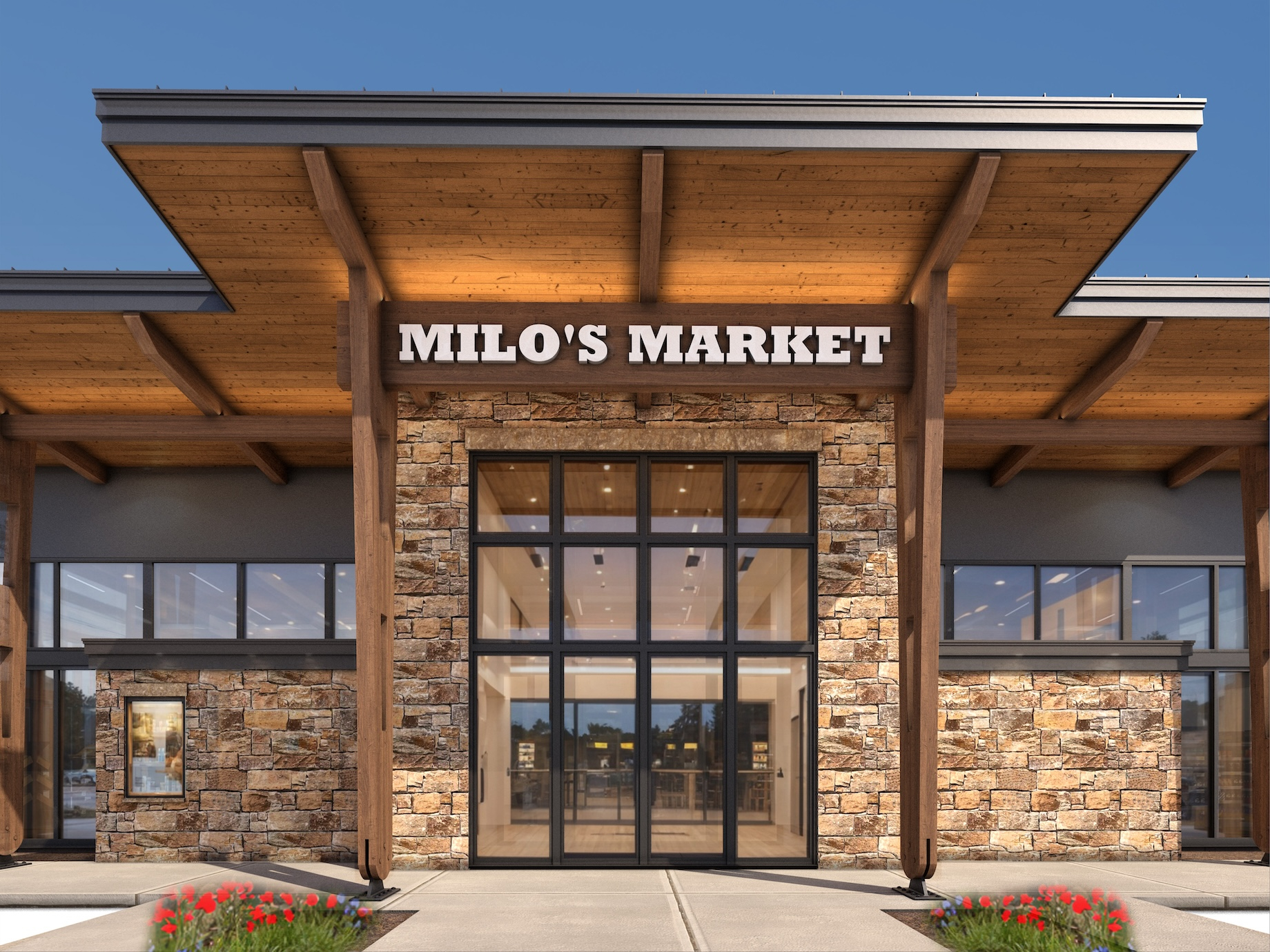
The upscale Milo’s Market aims to roll out a mass timber prototype that can be assembled on-site with a crane, said Tabberson Architects’ Bill Tabberson. Image courtesy of Tabberson Architects
The architect touted other advantages of Freres’ mass plywood products. “What we’re finding in pricing this year is that mass plywood comes in significantly less than CLTs,” he said. “Mass ply is aesthetically pleasing and incredibly strong. In terms of strength per square foot of cross section, it exceeds CLT by 10 or 15%.”
That strength gave Tabberson more flexibility in designing Milo’s Market. Instead of supporting the entrance canopy with thick columns on either side of the door, he was able to use elegant upside-down triangles that measure 15 inches close to the ground and 43 inches at the top. “It will make a huge splash and demonstrate that you can do something very different with mass plywood,” he said.
Mass Plywood in Adaptive Reuse Projects
Beyond prototypes, mass plywood is also showing its versatility in adaptive reuse. Dorman Construction project manager Jeff LaCava praised the material’s utility. The contractor just wrapped up his first mass timber project, the 6,000-square-foot adaptive reuse of a 1940s-era potato chip factory in Eugene, Oregon. The ground floor is occupied by ColdFire Brewing, and five two-story apartments sit above. Even the elevator cavern is made from Freres’ mass plywood.
“There were some architectural or structural challenges that we’ve had to work through in terms of fasteners and things, but the production rate is phenomenal,” LaCava said. Work that would have taken a standard framing crew a couple of weeks was finished in just a few days using a crane and MPPs with far less labor, he noted. Freres used CNC, or computer numerical control, machines to fabricate building components based on high-tech scans of the former factory. The pieces came together quickly on-site but took some work. “It’s a lot of screws,” LaCava said.
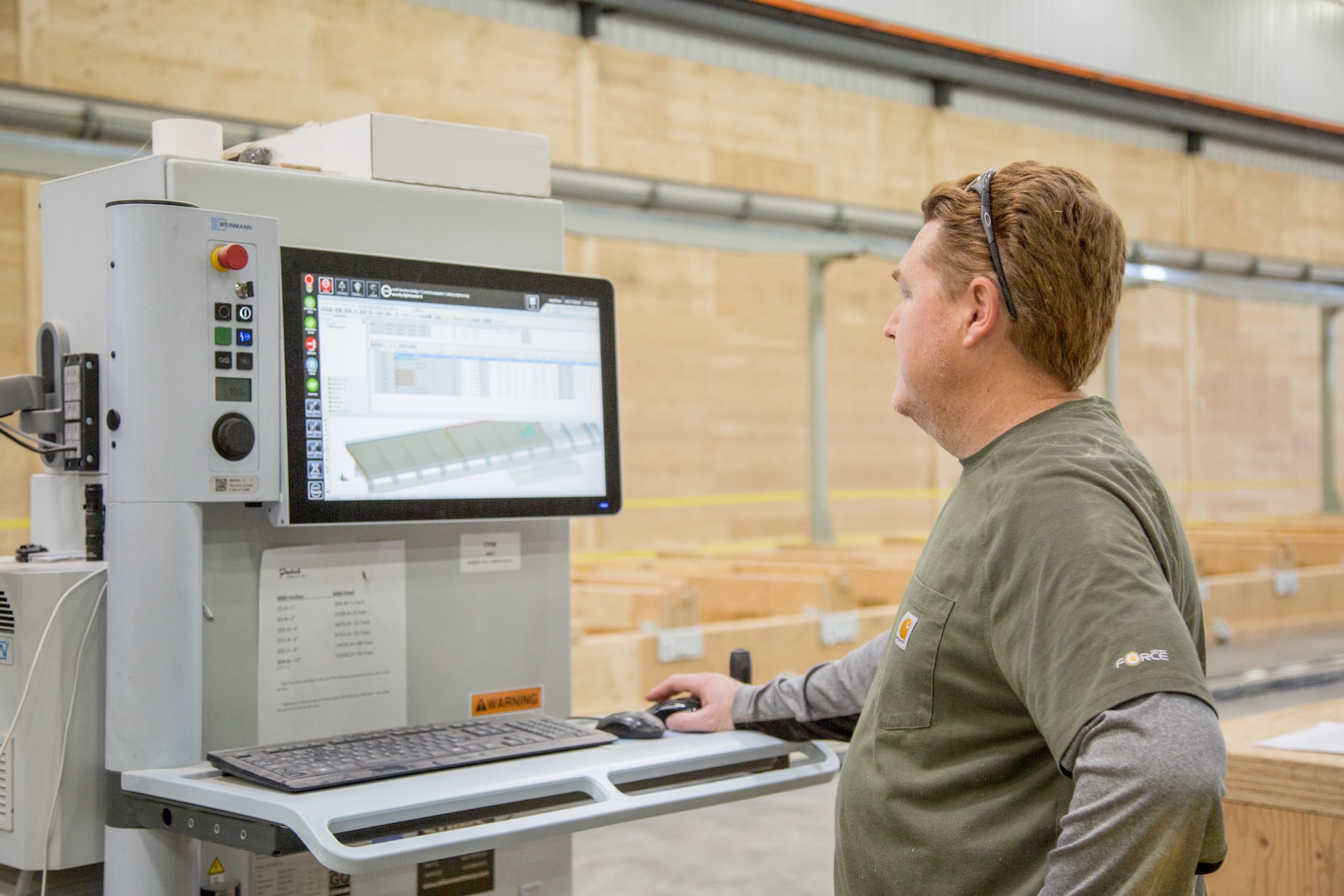
A worker operates a CNC, or computer numerical control machine, at Freres Engineered Wood in Lyons, Oregon. Photo courtesy of Freres and by Shanna Hall Photography
Mass Timber Scales Up as Supply Chains Expand
Most of architecture and design firm DLR Group’s mass timber projects are for large, one-off buildings whose economies of scale make wood construction easier to pencil, said principal Mark Giles. That includes its Hines’ T3 office concept, which refers to timber, transit and technology. Six are built, and five more are in various stages of design and construction. The first was the country’s largest mass timber building when it opened in Minneapolis’ North Loop in 2016. It also was the first U.S. multistory timber office to be built in about a century, according to DLR Group. “At that time, there were just very few mass timber buildings in the U.S., but the graph has just shot up,” noted DLR Group principal and design leader Stephen Cavanaugh.
The rising demand has led to supply chain improvements that reduce the need to import European or Canadian glulam or CLT products into the U.S. “More mills are being bought up by companies that want to make CLT, and we’re seeing more plants come online here domestically,” Cavanaugh said. “There’s been a big increase in domestic and North American engineered lumber.”
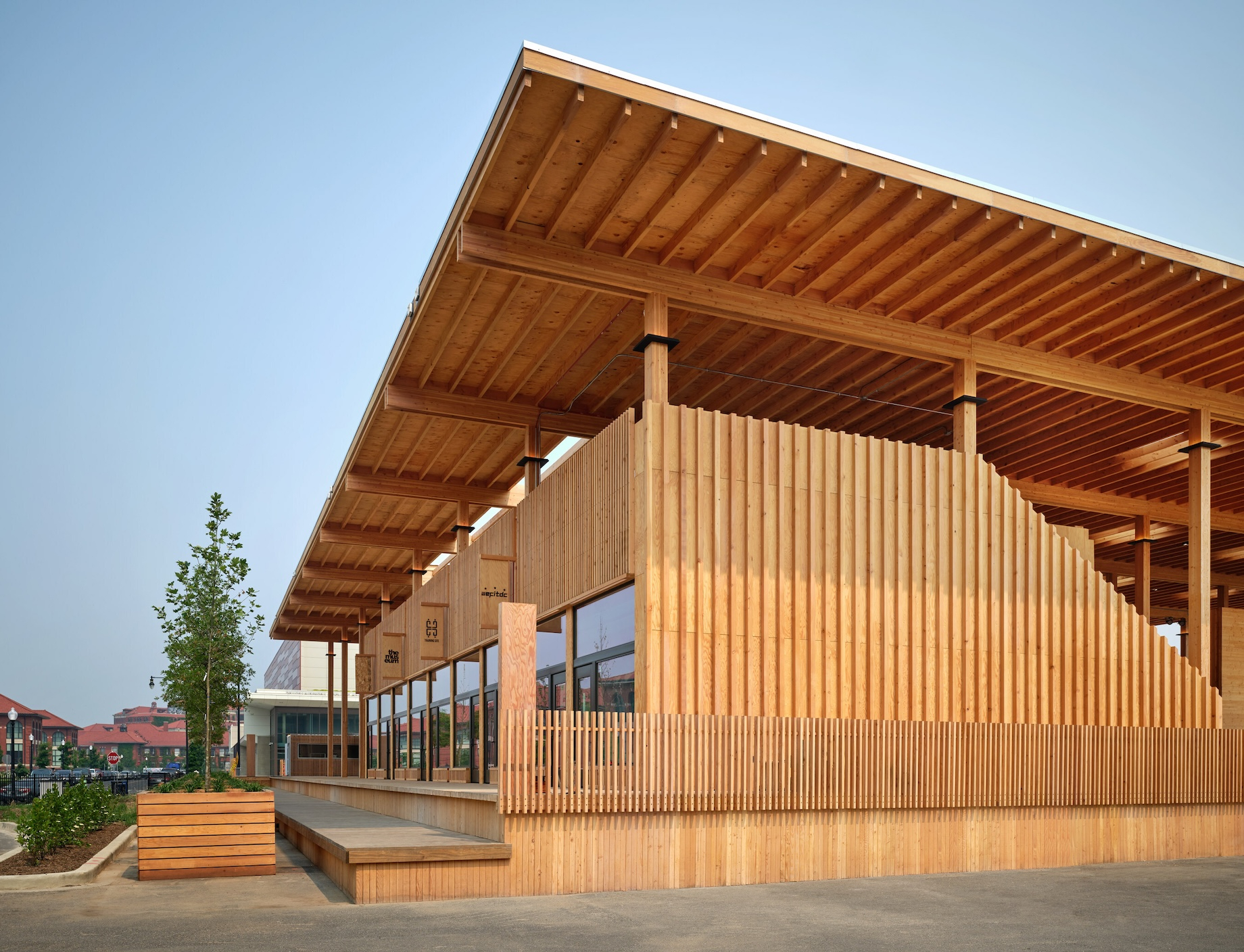
Wood houses shops, restaurants, service tenants and performance space in the retail pavilion at Sycamore & Oak in Washington, D.C.’s Congress Heights. Photo above and at top courtesy of Sycamore & Oak and by Dror Baldinger FAIA
Evaluating Mass Timber for Retailers and Shopping Centers
Giles said the decision to use mass timber remains a case-by-case consideration for retailers and shopping center developers, who must consider factors including:
- the importance of timber aesthetics and/or sustainability to the retailer or developer
- supply-chain efficiency for the engineered-wood products to be used
- the learning curve for designers, contractors and subcontractors involved
- municipal incentives tied to construction speed, sustainability or use of natural materials
The timing also has to be right. “I’ve been in discussion with a national retailer looking at a mass timber prototype, but the challenge is that they’ve already invested a lot of money in their standard prototype,” Giles said. “They’re also still backfilling old retail.”
Building whole shopping centers out of mass timber could require new thinking around how to preserve the aesthetic experience and prevent wear and tear, Giles added. “A typical small-shop building — it’s 60 feet deep with three or four tenants,” he said. “Mass timber’s adaptability supports flexible tenant turnover, but it requires owners to rethink the building’s role. The structure becomes more than just structural, it’s an integral part of the tenant’s aesthetic. To preserve this value, a tenant manual will need clear language guiding appropriate use and care.”
Schoewe said timber could be a fit for larger-box retailers like supermarkets and discount stores. He points to a ZGF-designed Amazon delivery station completed this year in Elkhart, Indiana. The 171,341-square-foot project served as a proof of concept for Amazon Logistics buildings that help support the company’s decarbonization goals. “Boxes like The Home Depot or Costco are a lot like Amazon distribution warehouses,” Schoewe noted, “and we have shown that there’s an economical way to construct buildings like this with mass timber.”
By Joel Groover
Contributor, Commerce + Communities Today