The Short Version
- Houston’s Grand Parkway and Charlotte’s I-485 beltway illustrate how major highway expansions can redirect traffic and open new areas to residential and commercial development.
- Developers often look to get ahead of population growth, but timing matters: Building too early can mean insufficient demand, while moving too late can mean missing the strongest sites.
- New interchanges can shift retail activity and change which locations are most attractive to retailers and other users.
- Baker Katz’s Jason Baker and The Providence Group’s Darren Wood discuss what other markets can learn from Houston and Charlotte as they plan around major road projects.
What Houston and Charlotte Reveal About Growth Along New Highway Corridors
Highway expansions can reshape regions and traffic patterns, fueling residential and commercial growth as their paths unfurl. Commerce + Communities Today contributing editor Beth Mattson-Teig recently talked with Baker Katz principal Jason Baker and The Providence Group owner Darren Wood about Houston’s Grand Parkway, whose first section opened in 1994 and whose expansion remains ongoing, and Charlotte, North Carolina’s Beltway, which expanded in phases from 1988 through 2015. They discussed the impact of highway expansion, how developers can make the most of the resulting demand and takeaways for those working in other metros with major highway projects.

Baker Katz’s Jason Baker, at left, and Providence Group’s Darren Wood, at right Photos courtesy of Baker Katz and Providence Group
Jason, tell us about the highway loop projects underway and proposed in Houston.
Jason Baker: Since COVID, Houston has added almost 800,000 people to the metro, which now includes about 10 counties and 8,800 square miles. The biggest thing to happen in Houston in the last 50 years is the evolution of the Grand Parkway, or State Highway 99, [a 184-mile toll highway designed to be the third outer loop around Greater Houston]. If you look at the meaningful new development happening anywhere within those 10 counties, most of it is a direct result of the Grand Parkway being built. It’s been a major impetus for new development, including new single-family, multifamily, rent-to-own, retail and industrial. The development activity has been incredible, and it’s happening in all four quadrants of the city.
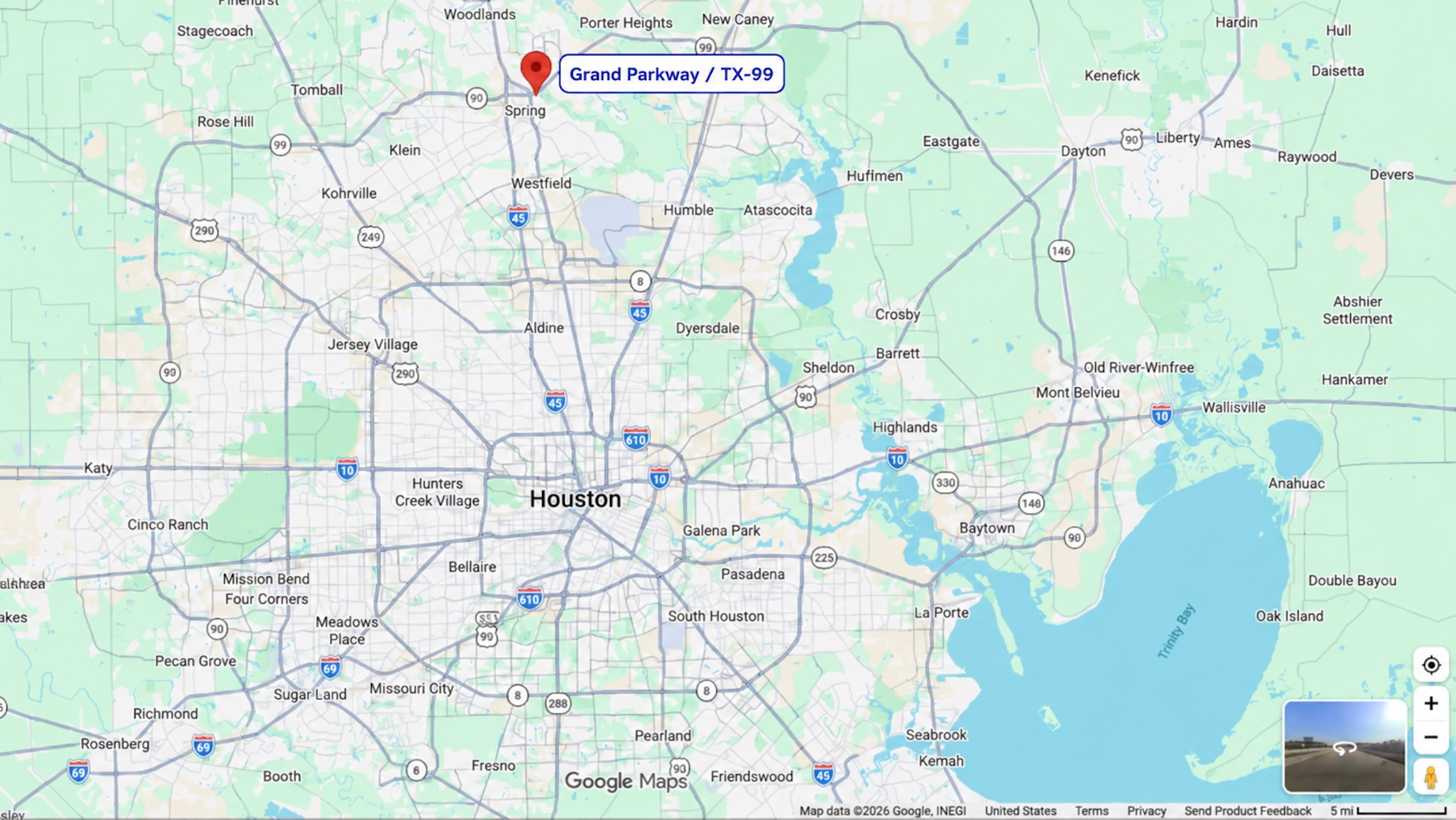
Grand Parkway, whose expansion is ongoing, is designed to be the third outer loop around Greater Houston.
How impactful are these changes likely to be for Houston?
Baker: I’ll give you a great example. North of Houston about 30 miles is The Woodlands. It is widely considered to be one of the best master-planned communities in the country, and it’s certainly one of the most prestigious in Greater Houston. There are now more people flowing into The Woodlands to go to work than there are people leaving for work. So the traffic flows in and out of The Woodlands have changed dramatically, and I credit a lot of that to the Grand Parkway. And arteries connected to that loop have been like gasoline on the growth in our suburbs, which is really the story here.
“If you look at the meaningful new development happening anywhere within those 10 counties, most of it is a direct result of the Grand Parkway being built.”
Darren, what about the beltway in North Carolina?
Darren Wood: When I decided to move to Charlotte 30 years ago, they had just started construction on the southern leg of the I-485 outer loop, [which helped spur the development of the major upscale master-planned community] Ballantyne. Over the next 15 to 20 years, the entire circle was built around the city that joined I-85 [to the north] and I-77 [to the south]. When you look at how people pick where they’re going to live, most still need to go to work, so that road infrastructure to get to wherever their office is very important. When you look at Raleigh and Charlotte, most of their growth has been around the beltways. You had the spokes coming out from the center that were the first part, but then the circle that connected those large roads had a huge impact — and a big impact on the tax base.
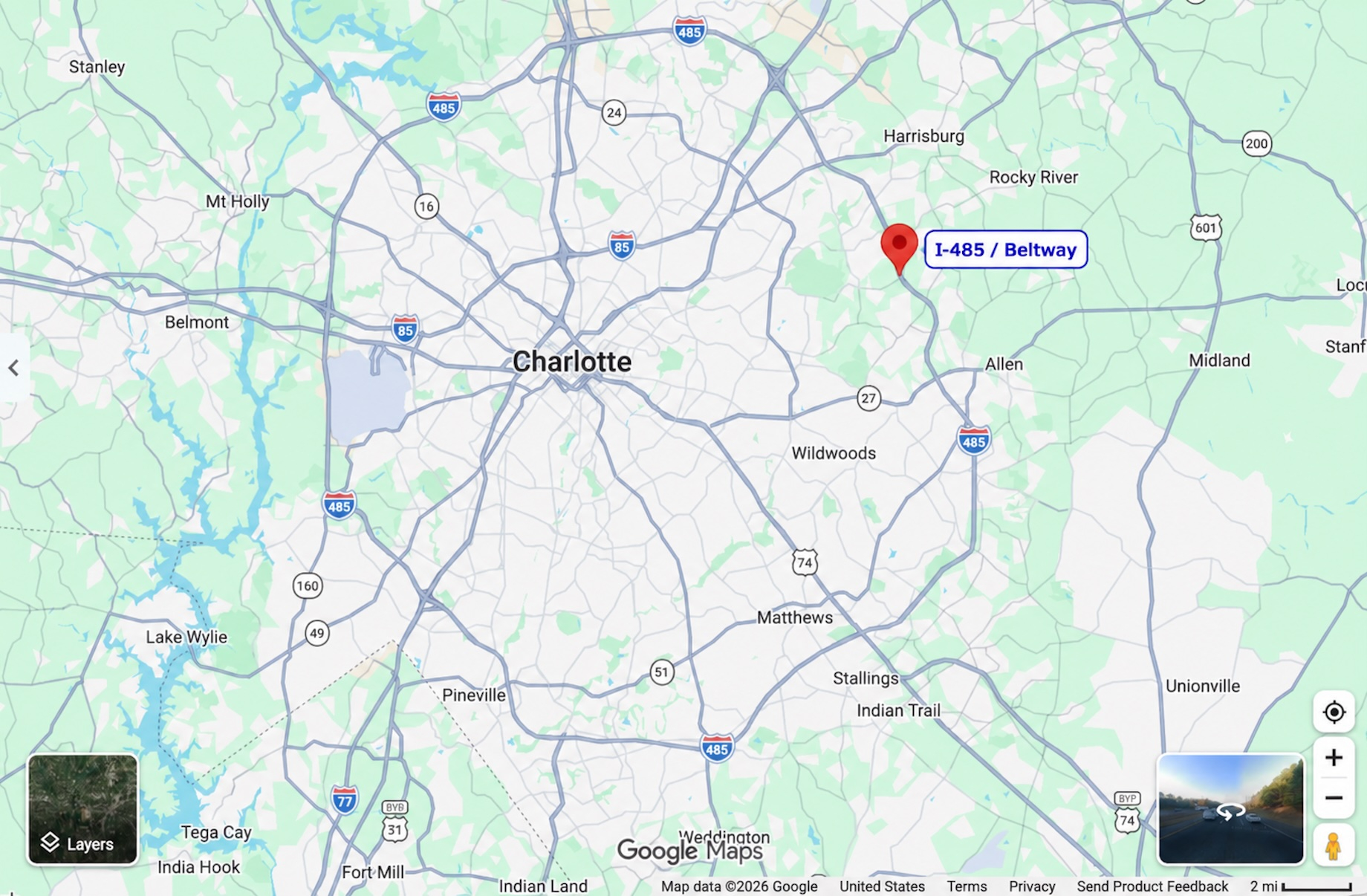
Charlotte, North Carolina's I-485 beltway was completed in 2015.
“Developers are trying to get ahead of the [residential and big-box retail] growth. If you’re trying to build in the middle of it, you might have missed your opportunity.”
How does the Marketplaces Industry approach highway expansions?
Baker: Grocery or large-format discounters like Walmart and Target and some of the other supporting retailers like Burlington and Ross are constantly trying to mine for opportunities in high-growth areas. Developers are trying to get ahead of the growth. If you’re trying to build in the middle of it, you might have missed your opportunity. When you think about all of the new single-family residential that’s coming online in the Houston metro, the bulk of it is happening around or just outside the Grand Parkway. About 75% to 80% of the new construction in the Houston metro was happening in conjunction with the extension of the Grand Parkway. You have to credit the extension of the Grand Parkway and other road construction as the reason this has become a desirable area to develop.
MORE FROM ICSC: Fast-Growing Exurbs Are Becoming Retail’s Next Growth Markets
What are the biggest challenges for highway-related developments?
Baker: With all the new road systems and new access points and all the land that can still be developed, a site can become less desirable. The extension of the Grand Parkway across U.S. Highway 290, what we call our Northwest Freeway, shifted traffic flows. A critical intersection that fed into everything happening in Northwest Houston was at the corner of Spring Cypress and Highway 290. If you looked at that intersection and all the retailers and the traffic, you would think there’s just no way that the bull’s-eye moves. The reality is that with the extension of just one road system that created a new intersection to the north, the bull’s-eye has shifted about three miles farther. That doesn’t make the real estate at that first intersection less valuable; it just means that there’s a prettier shiny penny where retailers are relocating or new retailers and users coming into the market are now interested in locating.
Wood: Developers need the traffic to flow because they need to make it easier for people to get in and out. What can hurt you is if you’re the second project in and there’s another project you’re competing with that has better access.
So what’s the timing of building out residential and commercial around these highway expansions? I imagine it takes decades.
Wood: In a normal market, development happens over decades, 20 years. But if you’re adding 2,000 homes a year, it adds up pretty quick. The land closest to the interchange gets developed first, and then developers work their way farther out. Ballantyne was the first on Charlotte’s outer belt, and now there are 40,000 to 50,000 homes that have been built along the highway between Ballantyne and Sun City on U.S. Highway 521, which is about 9 miles.
How do you get the timing right so you’re not too far ahead or too far behind and miss an opportunity?
Baker: Demand is really everything. You can have a great location and a really good basis in your land, but if the population is not there, there’s almost nothing you can do to attract retailers. For retailers or developers, a location has to have the projected sales that can support their investment.
Are lessons emerging that other cities can take away for their growth?
Baker: Houston has more retail per capita than maybe any other major market in the country. We just can’t help ourselves; it’s much easier to develop here than in other parts of the country, and we’ve gone really hog wild over the years. In the early 2000s, we were adding more retail than the market needed. You asked what other cities could take from what Houston is doing, but I hope developers have learned to remain cautious and disciplined and not just throw a ton of new retail on the ground. I’m excited for what’s going on in Houston across the board in every quadrant; there are some exceptional projects coming out of the ground. I just hope we show some restraint in the coming years. Higher construction costs and where interest rates appear to be going could be what [forces developers to be more disciplined].
Is there some irony that we’re talking about highway expansion in an era where the emphasis has shifted to mass transit and transit-oriented developments?
Wood: Americans still love their cars. The average daily number of riders on the light rail in Charlotte is about 27,000. The road that runs parallel to the light rail, South Boulevard, carries 28,000 cars per day. From someone who grew up in England, they’re not the fast trains that you have in Europe and they’re not as frequent. One good thing that has happened is that as Charlotte has grown on the outside of the outer belt, a lot of the land on the inside of I-485 has been recycled with adaptive reuse. The mills have been rebuilt or reimagined into different things, such as retail, restaurants, residential and food halls. When you make these big road improvements, it does affect things, but if you don’t completely handicap the real estate that you have on the inside, you can avoid some of the turmoil that can happen.
By Beth Mattson-Teig
Contributor, Commerce + Communities Today