The Short Version
- At ICSC NEW YORK 2025, leaders said convenience remains a major driver of consumer behavior, shaping retail formats and site selection.
- Starbucks, CBRE and Cushman & Wakefield executives emphasized the demand for frictionless, convenience-first retail experiences.
- EV charging stations boost traffic, attract high-income shoppers and create a scalable business line.
- Madisonville, Kentucky, showcased how proactive recruitment secured a new $30M retail center with big-name tenants like Aldi, Hobby Lobby and more.
Insights Driving Retail Strategy Forward From ICSC NEW YORK
Among the subjects highlighted during ICSC NEW YORK sessions on Dec. 10 and 11 were convenience-oriented retail, electric vehicle charging stations at retail centers and city efforts to recruit retailers.
Convenience Remains a Priority for Consumers
As U.S. consumers continue easing back into work-in-the-office mode, they’re craving convenience, and CBRE executive vice president Cassie Durand expects convenience to be a significant focus in retail real estate for the “foreseeable future.” Angele Robinson-Gaylord, senior vice president of store development and design in the Americas for Starbucks and 2025 ICSC chair, echoed Durand’s viewpoint. “Convenience still remains a very strong driver of customer behavior,” she said. Acknowledging that “convenience is part of the experience,” Cushman & Wakefield president of Americas retail services Barrie Scardina said consumers are looking for “frictionless” retail interactions that ease the purchase process. When you order a drink at a coffeehouse, for instance, you expect it to be ready when you reach the drive-thru window, Scardina said.
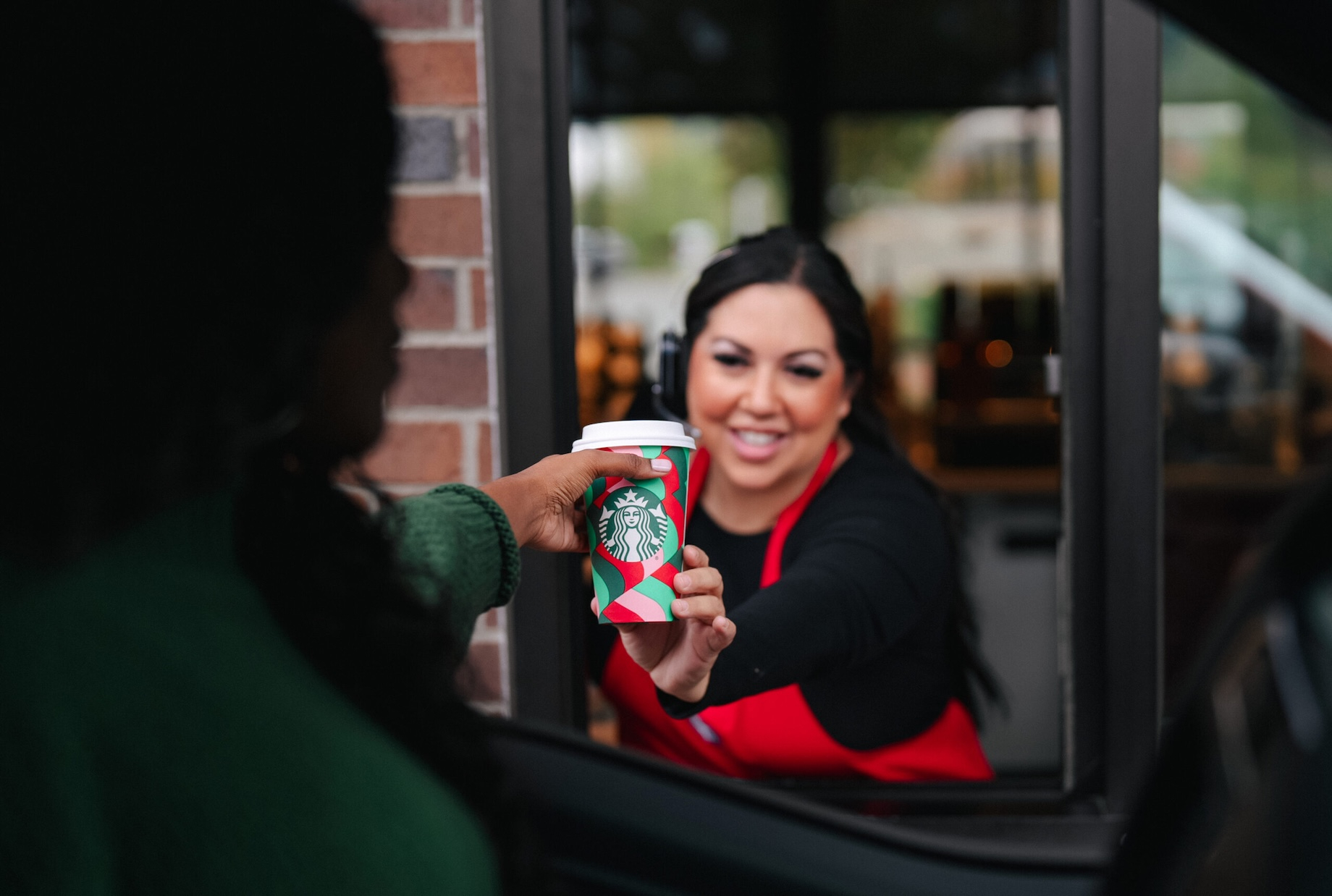
Starbucks drive-thru Photo above and at top courtesy of Starbucks
The Now and Future of Convenience Stores report published in July by NielsenIQ underpins remarks by the three panelists. It noted that shoppers “now prioritize access, immediacy and experience more than ever.” According to the report, 96% of U.S. shoppers visited a c-store, a format at the heart of convenience-oriented retail, at least twice in 2024.
While consumers generally demand convenience, they’re also eager to make in-person connections in post-pandemic America, panelists said. Robinson-Gaylord said Starbucks aims to strike a balance between convenience and connection. However, Durand said, not just any in-person environment will please consumers. “Given the accessibility that omnichannel provides the consumer, the [in-real-life] experience needs to be that much tighter and that much more convenient, and as a result of that, we’re seeing massive impacts on real estate,” she said.
Durand noted that unique, premium experiences can be designed for destination-oriented retail, “but if you’re a commodity, that’s not the case.” She continued: “You need to be on the path of travel for the consumer, and so the demand to be front and center is significantly higher [in convenience-oriented retail] than an amazing sauna or an immersive experience.
EV Charging: Traffic Driver and Revenue Stream
Electric vehicle charging stations are more than an amenity for shoppers at Simon properties. During a Dec. 10 session at ICSC NEW YORK, Simon vice president of business development Daniel Segal said they represent a scalable business for Simon and other retail property owners. “We want to … create a place where the shoppers that happen to be driving EVs can bring their vehicles to the centers and they can go and dine and shop and recharge,” he said. “And when I say recharge, I mean recharge their vehicles but also recharge themselves.”
Simon has collaborated with Electrify America, which operates a hyperspeed EV charging network, since 2018. The partnership recently reached a milestone: 500 chargers across 105 charging stations.
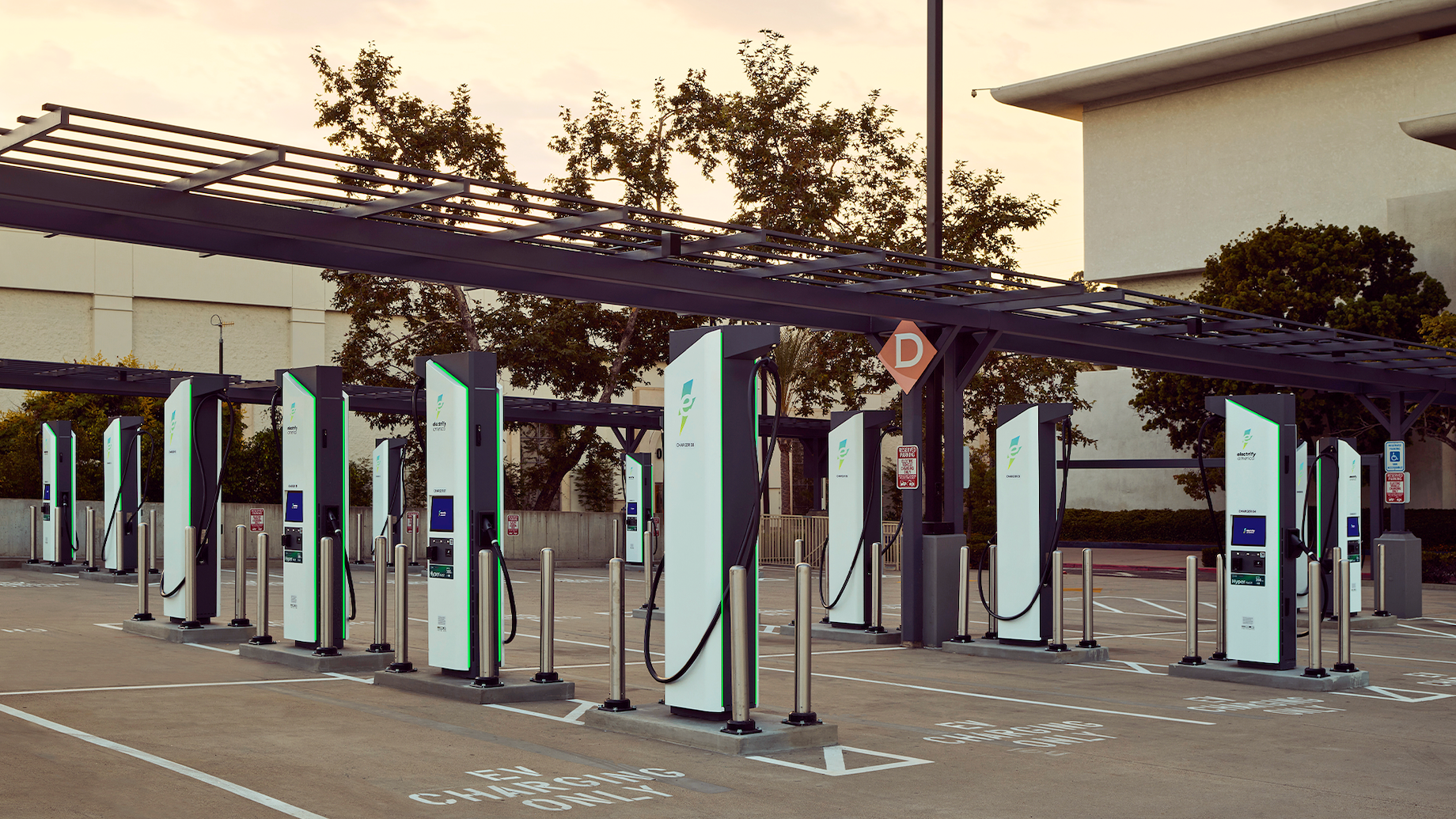
Simon hosts Electrify America electric vehicle charging stations at properties in 27 states and two Canadian provinces. Photo courtesy of Electrify America
Another panelist, Common Ground managing partner Nate Nickerson, said large-scale EV charging boosts shopping visits for landlords like Simon and attracts consumers with hefty incomes. A 2025 survey conducted by EV research and advocacy group Plug In America found 50% of EV drivers in the U.S. had annual household incomes ranging from $100,001 to $250,000. Nickerson, whose company develops mixed-use projects, said that because tenant performance is the “lifeblood” of his business, anything that lifts performance, such as EV charging stations, contributes to long-term value. “To me, the beauty of [EV charging] is that it doesn’t compete with retail and restaurant tenants,” said Nickerson. “It’s sort of a win-win. You get to attract customers without creating competition.”
How Madisonville, Kentucky, Landed National Retailers Through Proactive Recruitment
As of July 2024, a little over 19,500 people lived in the city of Madisonville, located in coal-mining country in Western Kentucky. Retailers like Bealls, CVS, Dollar General, Kroger, Lowe’s and Walgreens cater to local shoppers. Now, other big-name retailers are entering the market, thanks to Madisonville government and business leaders who weren’t content to sit back and wait for more retailers to notice the market. Instead, they’ve been proactive with retail recruitment, Deputy City Administrator Brad Long said during a Dec. 11 session at ICSC NEW YORK. This push has paid off in the form of a new, $30 million retail center. “Fresh doesn’t happen automatically, so if you want your community to thrive and be fresh and be vibrant, you’re going to have to go out and get it,” he said.
Local leaders emphasize to retailers and developers that Madisonville is a regional health care and manufacturing hub whose population triples during the daytime, according to Long. Such facts reveal a different story about Madisonville than a Google search presents, he said. Leaders armed with such details have been wooing retailers and other businesses for four or five years, he said. Many of these conversations involve real estate developers, too. Thus, Madisonville’s first Aldi and first Hobby Lobby are among the marquee tenants at the new 155,000-square-foot Madisonville Town Center. The city of Madisonville teamed up with Brewer Development Group to build the center, according to WBKO. The project was announced in 2022, and construction got underway the following year, World Construction Network reported.
With Madisonsville Town Center as a sort of launching pad, local leaders also lured the 7 Brew chain of drive-thru coffee shops to the city. Madisonville’s 7 Brew location opened this year near the city’s lone Lowe’s store. Long said Madisonville landed the 7 Brew deal at the ICSC@SOUTHEAST event in Atlanta, a 5.5-hour drive from Madisonville. “We were able to get preliminary approval for all their plans and permits on our drive home from Atlanta,” said Long, boasting that the city “can turn a permit faster than any other city that you work with.”
By John Egan
Contributor, Commerce + Communities Today