With hold periods shrinking and consumer behavior evolving, major institutional investors in retail real estate are recalibrating. At ICSC LAS VEGAS, Blackstone principal Elena Clarfield and Nuveen Real Estate global head of retail Katie Grissom laid out how the two heavy hitters are approaching acquisitions, underwriting and hold periods in a K-shaped economy. The two shared their insights on a panel titled Capital Raising & Underwriting: From New Acquisitions to Recapitalizations.
Blackstone Is Still Betting on Retail as Data Centers Draw CRE Capital
Data centers and AI infrastructure command an increasingly gigantic level of attention in today’s commercial real estate market, but asset management giant Blackstone is hardly ignoring retail. Globally, data centers alone accounted for more than $580 billion in investments last year, up 27% from 2024, according to Colliers’ 2026 Data Center Marketplace Report.
Just as hordes of other investors are doing, alternative asset manager Blackstone is pouring billions of dollars into data centers and AI infrastructure, including its recent $5 billion investment in a new joint venture with Google. But while Blackstone is betting aggressively on data centers and AI, retail real estate remains a high-priority investment target for the company, particularly in the U.S., according to Clarfield.
Blackstone already controls a $10 billion retail real estate portfolio in the Americas and is committed to growing it, she said. Perform Properties is the primary home of Blackstone’s retail investments. “The vast majority of our retail holdings are necessity-based grocery-anchored retail, which we feel good about even in a downturn. And then on the other hand, we have high-end luxury retail in New York City’s SoHo that’s doing quite well because the economy is K-shaped today.” Clarfield explained that go-private deals “are really Blackstone’s bread and butter.” That includes two recent Blackstone acquisitions in retail: a $4 billion deal for Retail Opportunity Investments Corp. and a $2.3 billion deal for Alexander & Baldwin.
Shorter Hold Periods Are Reshaping Retail Real Estate Investment
Goodbye to the 10-year hold on real estate investments, including those in retail. That was among the points of consensus during the panel. Five years is the new norm for hold periods, said Grissom, with three years increasingly applying to transitional assets. “Returns don’t count unless you crystallize them — and damn, have I learned that,” said Grissom, who oversees a $25 billion retail portfolio.
Decreasing hold periods aren’t attributable only to the current interest rate environment, she said. Rather, rapid changes in consumer behavior and retail are driving a new standard for holding investment properties. For example, Grissom cited figures indicating that five years ago, just 7% of the population had downloaded a food delivery app, compared with 50% who now use a food delivery app each week.
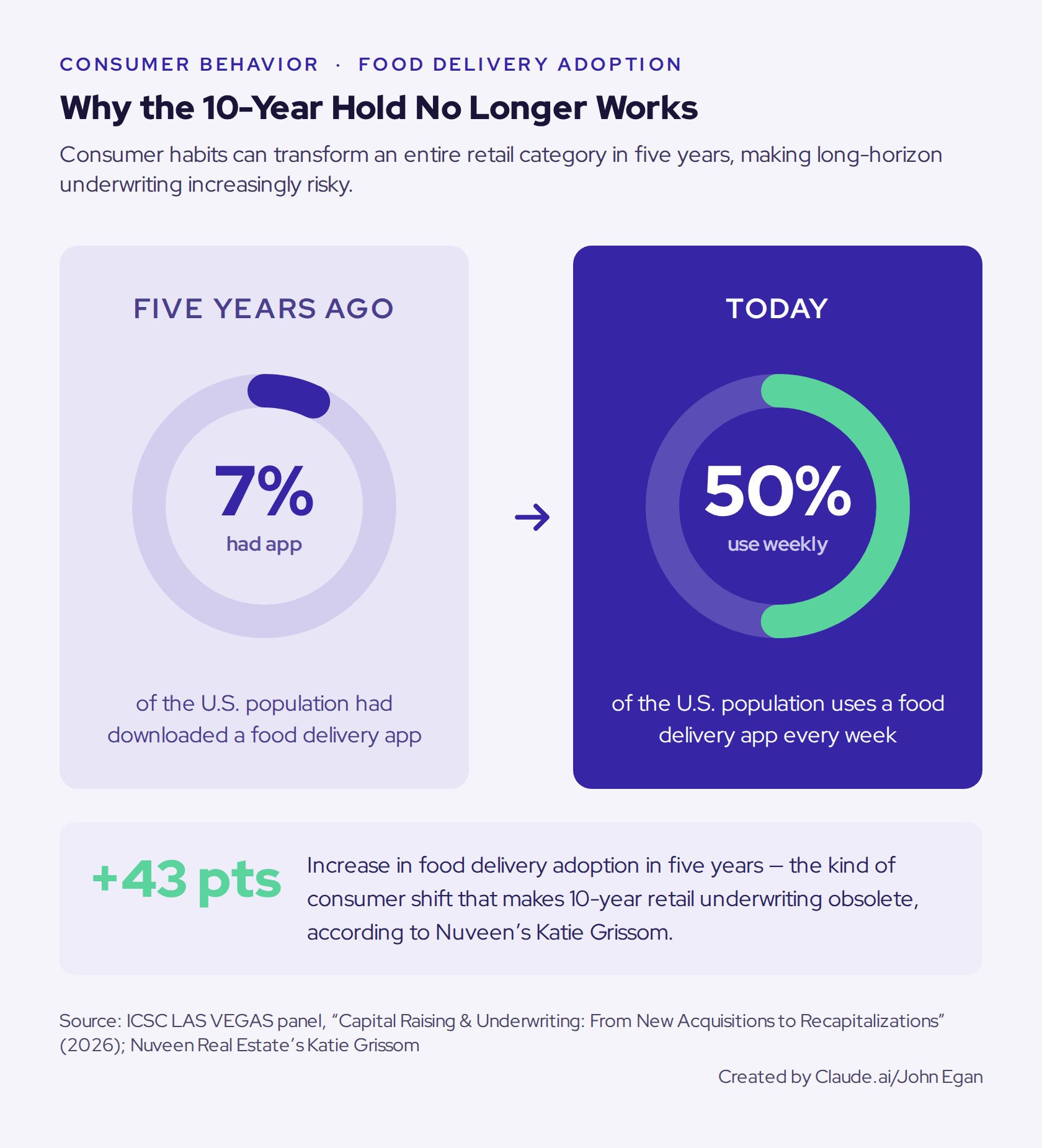
That sort of consumer shift makes the 10-year hold much riskier, Grissom said. Blackstone is among investors moving away from 10-year holds, according to Clarfield. The asset manager typically underwrites opportunistic-fund deals for five years, she said, and for an average of three to five years for individual asset sales within portfolios.
By John Egan
Contributor, Commerce + Communities Today