The Short Version
- MRI Software’s Carla Hinson says retail real estate professionals increasingly want AI tools that help them interpret data and make decisions, rather than simply automate tasks or reduce costs.
- MRI’s Agora Intelligence uses AI to surface potential risks and opportunities across real estate data, while Agora Orchestrator can initiate actions with guardrails and human review.
- Hinson sees opportunities for AI to connect operational and financial data with foot traffic and other metrics, helping owners identify potential tenant issues and assess property performance.
MRI Software’s Carla Hinson on Moving Beyond Dashboards With AI
Retail real estate has never lacked data. Owners and operators have long collected information on rents, leases, tenant sales and property performance. Newer metrics track foot traffic, demographics and consumer behavior, too. But what good is the information if you don’t know what to do with it? For MRI Software, the next frontier is helping real estate professionals turn vast amounts of real estate data into actionable insights.
MRI vice president of North America solutions and innovation Carla Hinson has spent more than 26 years in retail real estate tech. Early in her career, she pulled information from numerous systems into databases simply to make the information usable. Today, the challenge is almost the opposite: So much information is available that professionals need technology to help determine what matters.
Retail real estate is particularly complex, combining intricate financial requirements like rent and tenant sales with less tangible factors like shopper behavior and consumers’ experience at a property. MRI Software’s offerings address both sides of the equation: Its Property Management X suite supports owners and operators, while ProLease serves occupiers. MRI OnLocation for Footfall Analytics adds insights into factors like pedestrian and vehicular traffic and demographics.
Now, MRI’s Agora, which launched in June, brings operational, leasing and performance data together, using AI to identify opportunities and risks. As Hinson describes it in a Q&A with Commerce + Communities Today contributing editor Halley Bondy, the goal is to move from reporting what happened to anticipating what comes next — and helping real estate professionals act on those insights.

MRI Software’s Carla Hinson said AI can help real estate owners turn growing volumes of data into informed decisions. Photo courtesy of MRI Software
What are retail real estate professionals asking technology providers for today that they weren’t a few years ago?
We’ve gone from “What can AI do?” to “How can AI help me make better decisions?” When AI first came out, much of the conversation focused on cost savings. What I’ve seen change is the question of how to free up the humans to do what humans do really well: judgment, context, ethics and relationships. It’s not about replacing humans. It’s about how AI can work with my team to get results so I can make better decisions faster.
Where do you see AI having the biggest impact on retail real estate?
It’s about getting to the data to help drive the next action. With dashboards, you have to know what question to ask. When you layer intelligence over that data, the system surfaces things you may not even realize were there. The opportunity is getting those signals out early enough that people can act on them. For example, maybe a retail tenant has been a little late on its rent, its sales are dropping or its foot traffic is steady but its capture rate is falling. Those can all be indicators that an owner might want to look at ahead of a renewal. That gives the owner a chance to step in and help, and the tenant can use the same information to see whether changes it’s making are working. [Previously], dashboards were really reporting on what’s already happened. With AI, you can say: “It’s these three properties where this is happening,” and isolate the problem earlier. That’s a much more proactive world.
How is technology helping retail property owners connect operational and financial performance with the customer experience?
Retail is one of the most complex asset classes. Percentage rent and [common area maintenance] make the accounting side complex. Those things are still extremely important, but then you’ve got the experience side. After COVID, when we all learned we could order anything and have it delivered to our door, it took a little more to get us out there. So we’re adding another dimension: How do you measure the experience? With MRI OnLocation for Footfall Analytics, we can measure foot and vehicular traffic, capture rates [of how many people walk by versus enter] and demographics. More recently, we’ve been bringing all that operational and accounting data together with the experiential data. That’s where MRI Agora comes in.
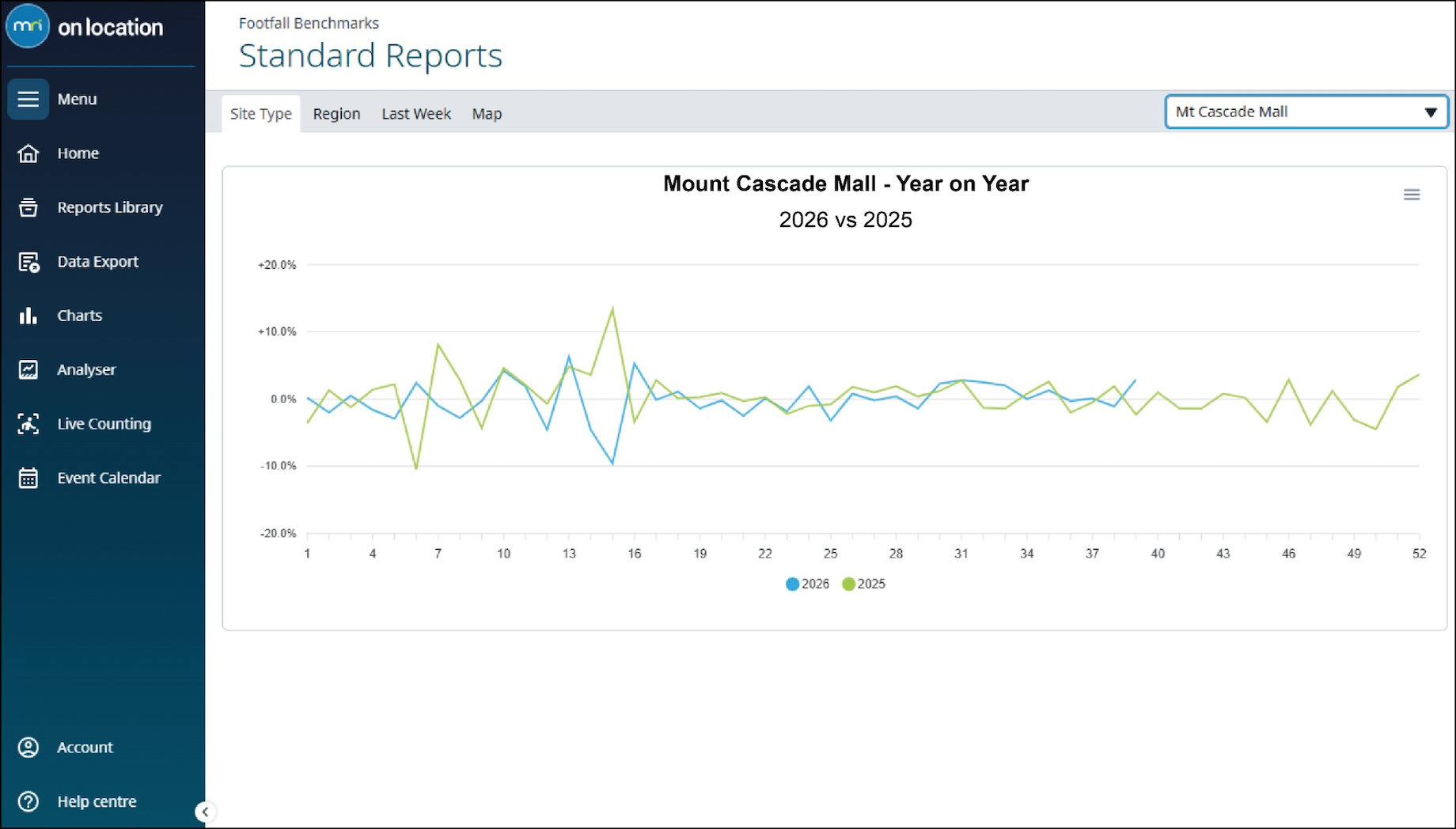
MRI’s OnLocation for Footfall Analytics tracks foot traffic at a shopping center, such as this year-over-year comparison for the fictionalized Mount Cascade Mall, helping owners spot shifts early enough to act. Image courtesy of MRI Software
Agora comprises two offerings: Intelligence and Orchestrator. What problem is the Agora suite designed to solve?
Real estate has never been short of data. The question has been whether we could get to it and understand it. Agora Intelligence layers AI across data from different places and raises what we’re calling “signals,” meaning an opportunity or a risk you might want to look at. It understands the context of your data and then gives you actions you may want to take. That’s fundamentally different from the dashboards and reports that told you what had happened. From there, Agora Orchestrator, our agentic workflow offering, can kick off those actions with the right guardrails and human review.
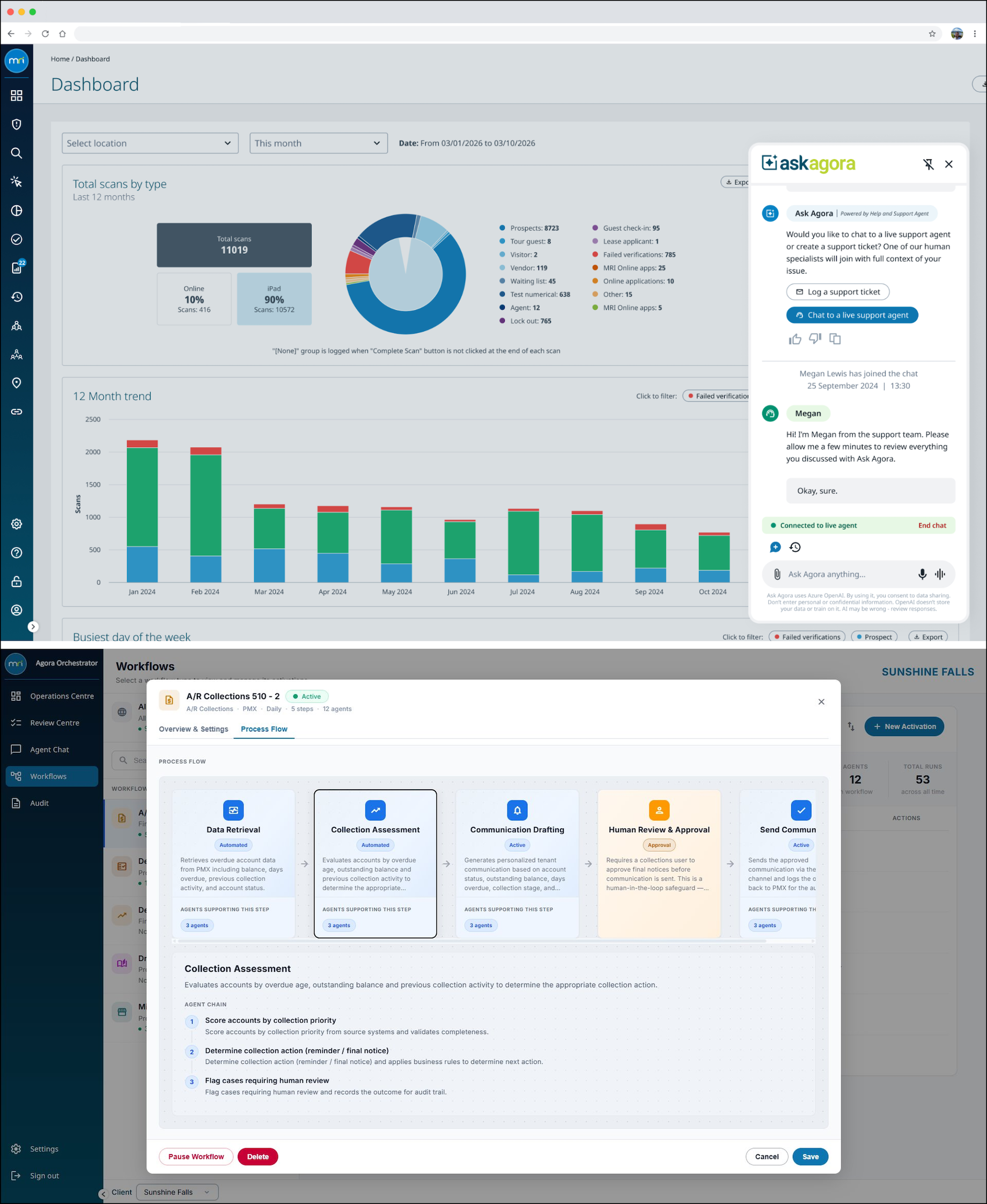
MRI’s Agora Intelligence dashboard, at top, uses AI to identify risks and opportunities in property data, and Agora Orchestrator, at bottom, can initiate actions based on those signals, with guardrails and human review. The Orchestrator screenshot features a fictionalized property. Images courtesy of MRI Software
Where are the biggest technology opportunities over the next few years?
The operational and accounting functions are table stakes; they have to keep working well. What’s interesting is how AI changes those workflows, but we have to be careful not to confuse automation with AI. Accounting is deterministic. There’s a right answer. AI is probabilistic.
The real opportunity is to reimagine the workflow rather than just automate every step. If five people spend three hours a week going through a report, the question shouldn’t just be how to create it faster. It’s: “Do I even need the report anymore? Do I need the three-hour meeting?” If agents are continuously surfacing issues and next actions, maybe you don’t need to meet weekly. We’re just starting to see people open their minds to that.
Is there anything that could impede the industry’s technology evolution?
It’s always going to be about data. If you’ve got bad data, AI isn’t going to fix that, and it can make assumptions or fill gaps. But we also need to rethink what “bad data” means. There may be data that wasn’t captured historically because we weren’t asking today’s questions, so I wouldn’t stall everything waiting for perfect data. We don’t have it, and the definition of perfect may be dated.
“It’s always going to be about data. If you’ve got bad data, AI isn’t going to fix that, and it can make assumptions or fill gaps.”
What’s next for MRI’s retail platform?
We’ll keep focusing on foot traffic, vehicular traffic and demographics, meaning what’s truly happening at the location. I also think we’ll see a lot more agents handling operational work, such as collecting sales figures from tenants. And we’ll continue focusing on signals in the data. We’re just touching the surface. It wouldn’t surprise me if within a year we have metrics measuring success that we haven’t even thought of yet. For retail, short-term leases, kiosks and pop-ups are particularly interesting. Combined with the need for experiential retail, how quickly can retailers see whether a kiosk is helping? Because those leases are short-term, retailers can change course quickly, and I think we’ll get a lot more metrics there.
MORE FROM C+CT: Specialty Leasing Is Expanding in Scope, Strategy and Revenue Potential
Ultimately, the opportunity is to move from data to intelligence to action. Retail leasing math isn’t generic. CAM isn’t generic. The real opportunity isn’t simply applying AI to real estate. It’s combining AI with decades of real estate knowledge and the data real estate organizations already have. The organizations that can connect that data, trust it and turn it into action will make decisions faster and with greater confidence.
By Halley Bondy
Contributor, Commerce + Communities Today