In two weeks, New Jersey will become the tenth state to enforce a statewide ban on single-use plastic bags as legislation (NJ SB 864) signed by Governor Phil Murphy (D) nearly 18 months ago finally takes effect. Starting May 4, most retail stores and food service businesses in New Jersey will no longer be able to make single-use plastic or paper carryout bags available for customers.
The delay on banning plastic bags in New Jersey was a common story throughout the pandemic. California and Washington temporarily paused their plastic bag bans citing concerns from the spread of the virus to the extra burdens the bans would place on small businesses. Now that pandemic restrictions have been lifted, states and cities are resuming efforts to ban disposable plastic bags.
Plastic bag bans have been a main goal for environmental policy advocates in Democratic-controlled states and cities for some time. California enacted the first statewide ban on plastic bags in 2014 following a series of local bans from San Francisco and Los Angeles. Meanwhile, Republican-controlled states – citing the effects bag bans place on working families and low-income individuals – have tried to combat these policies through preemptive measures that prohibit localities from enacting their own plastic bag bans.
Currently, nine states – California, Connecticut, Delaware, Hawaii, Maine, New York, Oregon, Washington and Vermont – have a ban on single-use plastic bags in effect, according to the National Conference of State Legislatures (NCSL). While Hawaii did not enact a statewide ban on plastic bags, each of the state’s four main islands has one in effect. Customers in Virginia and the District of Columbia are both charged a five cent fee for using single-use plastic bags at checkout. Additional local bans are in place where the state legislature hasn’t preempted action, notably in various localities in Illinois and Pennsylvania and in coastal jurisdictions in Massachusetts, Rhode Island and South Carolina.
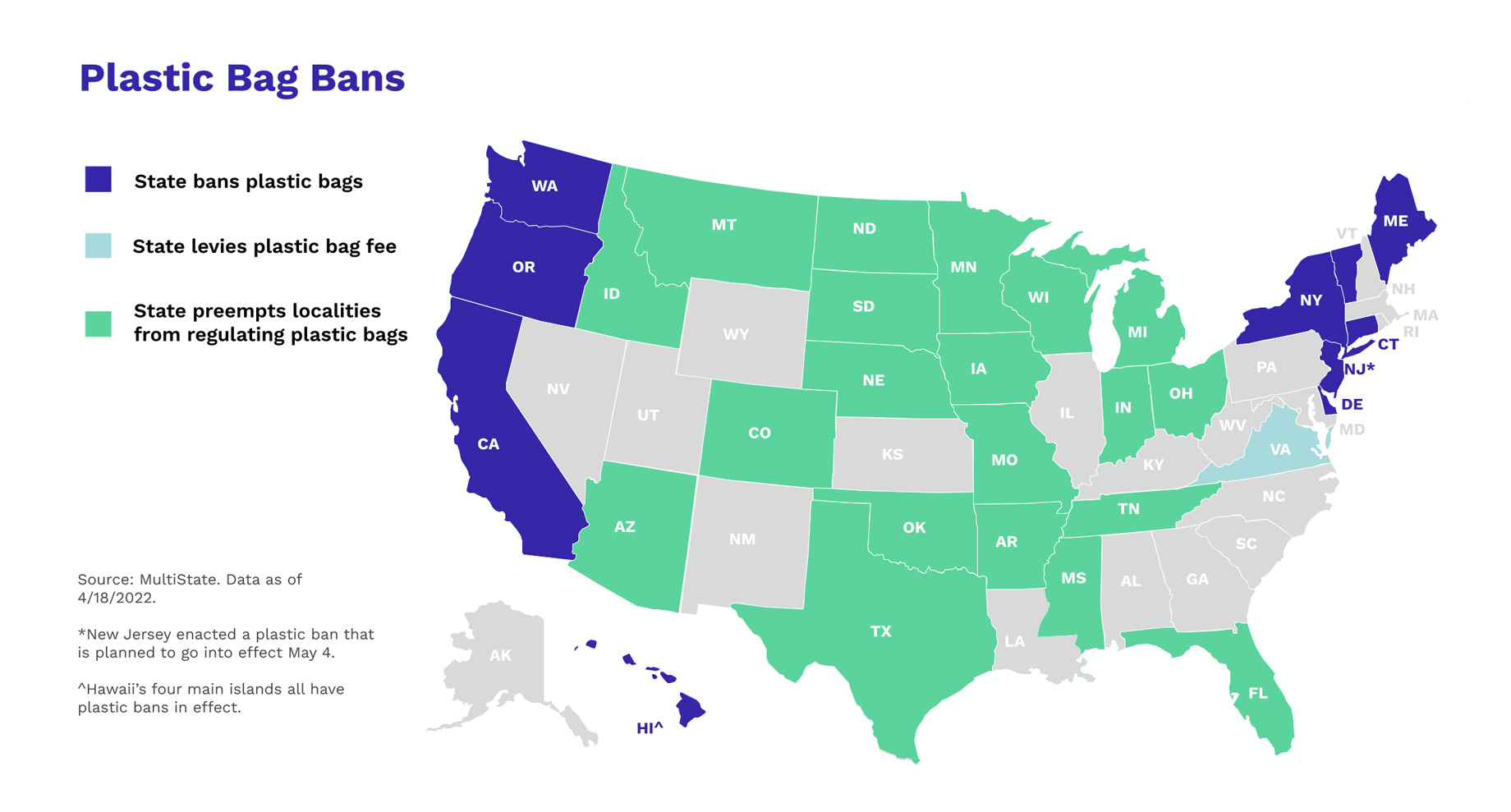
In 2022, at least 40 bills have been introduced in 16 states related to plastic bag bans. These bills fall into distinct categories:
- Preempting localities from enacting a plastic bag ban. In twenty states, lawmakers have enacted legislation preempting local governments from enacting ordinances that ban plastic bags. Ohio became the latest state to preempt cities from implementing a bag ban with the enactment of OH HB 110. There is only one pending bill this session in Louisiana (LA SB 155) to preempt local activity.
- Imposing a fee for using single-use plastic bags. Rather than banning plastic bans, these bills would levy a fee for single-use plastic bags similar to legislation enacted in Virginia and D.C. Legislation in Arizona (AZ HB 2833) would not only impose fees for plastic bags but also single-use straws, food containers and cups. And pending legislation in Iowa (IA HF 320) would charge manufacturers five cents for each single-use bag sold in the state. Since both bills are sponsored by a member in the minority party, it is unlikely to see them advance this session.
- Banning single-use plastic bags. These bills prohibit retail stores from providing single-use plastic bags for customers. Legislation in Rhode Island (RI SB 2446) banning plastic bags recently advanced out of the House. Kentucky, Minnesota and Massachusetts also have active legislation on this topic: KY HB 189, MN HF 2232, MA HB 869, MA HB 992, MA HB 902, MA SB 579 and MA SB 525.
- Repealing existing local preemption laws. In states that currently preempt cities from banning plastic bans, legislation in five states – Arizona (AZ SB 1103), Florida (FL HB 6113, FL SB 1900, & FL HB 6063), Idaho (ID HB 4615), Missouri (MO HB 2457) and Wisconsin (WI SB 349 & WI AB 342) – seeks to repeal existing preemption legislation. The Florida, Idaho and Wisconsin legislatures have already adjourned for the year and the bills in Arizona and Missouri are unlikely to advance in Republican-controlled legislatures.