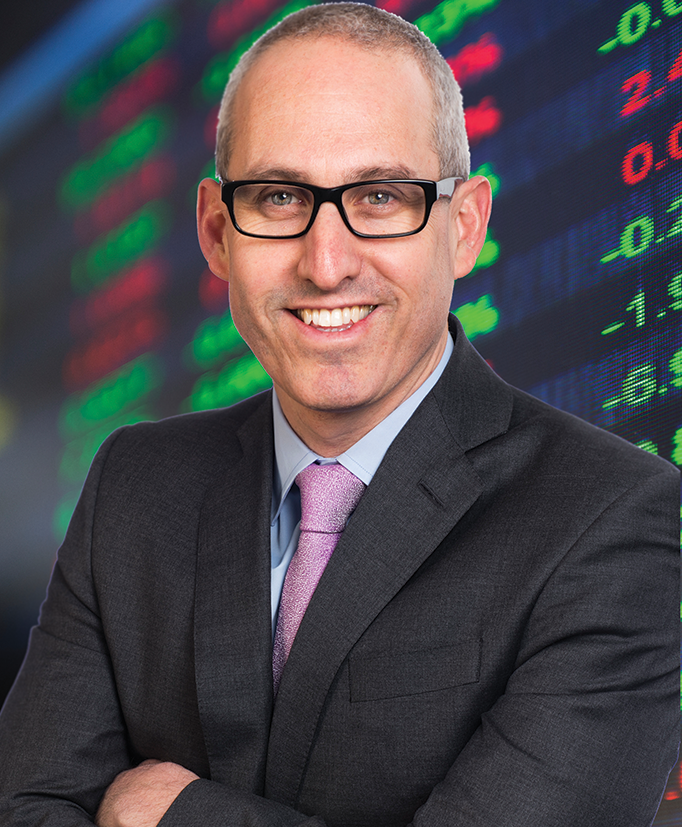
Matt Ostrower really loves to shop. For the 45-year-old CFO of Equity One, this is no mere hobby — it is a calling. “Believe me, a lot of guys are not as into shopping as I am!” quipped Ostrower, a former Wall Street research analyst who roughly a year ago became executive vice president, CFO and treasurer of this publicly trade REIT that owns, develops and operates shopping centers in a multibillion-dollar portfolio. “I’m good on the real estate side and the location side, but I’m not a retail operator,” said Ostrower with a trace of humility and perhaps some relief. This is at once both an exciting and a terrifying time for retailers, he says. “Their business models are changing now more than they have in the last 50 years.”
Matthew L. Ostrower grew up in San Antonio and completed a bachelor’s degree in American history at Tufts University, after which he earned a dual master’s in real estate and city planning from the Massachusetts Institute of Technology. “It’s the core of who I am: cities, real estate development, urban development and architecture,” he said. “Those are all things that I’ve been fascinated with since I was very young.” Ostrower counts himself fortunate because being CFO of a real estate company has been his long-term dream. Besides, he said, retail has “always been the most interesting sector for me — and it’s in New York!”
Ostrower’s enthusiasm and abilities impressed Equity One CEO David Lukes enough to move him to bring Ostrower on board last March. “Matt brings a diverse skill set to our company, including extensive experience in the public real estate markets and a deep understanding of effective capital allocation and balance-sheet management,” said Lukes. And he will advance the company’s efforts to create value through leasing, development and redevelopment within the firm’s urban-focused portfolio, Lukes added.
Ostrower says he clicked with Lukes immediately when he interviewed for the job. “This business model that I’m so excited about is David Lukes’ brainchild,” he said. “He is the visionary: The idea that redevelopment would be the key to long-term sustainable growth — that’s his idea, and I couldn’t be more excited to be helping him bring that dream to reality.”
Equity One’s investment strategy is focused on properties with anchors that are nearing the end of their original lease terms and are “ready for a rebirth,” as the company website says. Equity One wants to reinvigorate properties whose sustainable design is generally mixed-use in nature. In the process, the executives say, Equity One hopes to become the most profitable owner-operator of shopping real estate in some of the most affluent areas of the country. With a total equity market capitalization of $4 billion, Equity One’s assets are concentrated in Los Angeles, New York City, San Francisco and South Florida, but it also has significant holdings in the Greater Boston area and Atlanta. All told, the company has a presence in nine states.
“By real estate standards we are a large company, but by public company standards we’re pretty small,” said Ostrower. At year-end 2015 the Equity One portfolio comprised 126 properties: 115 retail (13 of which are undergoing development or redevelopment) and five nonretail — totaling 12.6 million square feet of gross leasable area — plus six land parcels. Its retail occupancy rate, excluding those centers undergoing work, was 96 percent. Equity One also has joint interests in six retail properties and two office buildings, totaling 1.4 million square feet of gross leasable area.
“Our scale is big enough to make us efficient,” said Ostrower, “but we’re not so big that we dilute the impact of our reinvestment activity.” Reinvesting in its properties is the key to Equity One’s success, Ostrower says. “Buying assets was the traditional model for most public real estate companies, but assets have gotten to be very expensive. We have what I would call an outsized redevelopment opportunity, and I think you’ll see over the next five years that that is where everyone is going.”
The current value of projects in the Equity One redevelopment pipeline is about $1 billion, but Ostrower says he would rather tout the average base rent per square foot of the properties, which is close to $20 per square foot. “Many of our peers are in the mid-to-low teens, so that’s a very big difference.”
Another important benchmark he cites is population density. “We have many more, and much wealthier, people around our properties than most of our peers have around theirs,” he said. According to Equity One’s own analysis, average household income in those areas is $101,000; the comparable household figure for most other REITs, is $60,000, he says.
After graduate school, Ostrower was portfolio manager of the Pioneer Real Estate Shares mutual fund. “The minute I set foot in the corporate real estate world, it was immediately clear to me that a CFO role would be ideal for me,” he said. In July 2000 he became an analyst in Morgan Stanley’s equity research department, where he was responsible for coverage of retail REITs, publishing research opinions and investment recommendations. In 2006 he assumed leadership of the REIT research group and began covering a wider range of companies. When the recession hit in 2008, Ostrower left Morgan Stanley to work with William Gerrity — whom he calls “a great real estate investor” — to help found Gerrity Group, a real estate investment group focused on retail assets on the West Coast. In time he returned to Morgan Stanley and went to work in London for five years as associate director of research for Europe. “It was a great job, and I enjoyed it, but I knew that I always wanted to come back to real estate.”
Ostrower is a chartered financial analyst and sits on the board of Ramco-Gershenson Property Trust, a public REIT, and also of the Morgan Stanley International Foundation. “Publicly traded real estate will only expand over time,” he said. “Public markets are the ideal way to hold real estate assets.” A REIT handles both investors and real estate the right way, he says.
Ostrower asserts that the future of retailing will involve some sort of a hybrid, convergent model. He concedes that it remains unclear what the template will look like, however, as even Amazon.com is opening actual retail sites.
What he most enjoys about his role at Equity One, he says, is that by combining his passion for shopping and his curiosity about retail, he is always on the lookout for the next development. “If I hear of something interesting, I go out and look at it,” he said. “You’ve got to go and, as they say, kick the bricks. You’ve got to see what’s actually happening and what the experience is really like and get a gauge of whether it’s going to be successful or not.”