The Short Version
- As international tourism to the U.S. slows, domestic shoppers and travelers are helping support sales and traffic at some retail centers, including luxury shopping destinations and Tanger outlet centers.
- Tourism Economics forecasts a 0.7% decline in inbound visits to the U.S. in 2026 and $42.6 billion in lost travel spending over 2025 and 2026, compared with what would have been spent had the U.S. maintained its 2024 share of global spending.
- Tanger reports strong demand from domestic tourists and local shoppers at its outlet centers, while increased arrivals from Mexico and South America offer bright spots amid the broader international tourism slowdown.
- Despite near-term challenges, Tourism Economics projects a 3.3% rebound in inbound visits to the U.S. in 2027 and nearly 50% growth in global international travel spending between 2025 and 2030.
Domestic Shoppers Help Sustain Retail Centers Amid Declining Inbound Tourism
Fewer international tourists are flocking to the U.S. this year, a trend that emerged in 2025. Despite the dip, plenty of retail centers are doing just fine thanks to beneficial shifts in domestic shopping and travel, observers say.
Odyssey Retail Advisors principal Rick Strauss said one of those shifts is reduced reliance on global visitors at some top-tier luxury malls and high streets in major cities like New York and Washington. He traces this adaptation to the COVID-era tourism collapse. “National tourism was the first to come back,” he said. “International tourism was slow to rebound.”
Spending by affluent local and regional shoppers has made the difference — and then some — for luxury-heavy retail mixes, as at Hines’ open-air and mixed-use CityCenterDC in Washington, D.C., Strauss said. Global tourists once accounted for about a third of annual sales but now make up less than 20%, according to the veteran retail adviser. “There’s much heavier traffic from the region and a heavier balance of national tourism than international tourism,” he said. “Sales have literally, on a per-square-foot basis, doubled to more than $2,000 since 2019.”
Inbound Tourism Slowdown Could Cost the U.S. Billions in Travel Spending
The U.S. is now on track to lose $42.6 billion in inbound travel spending for 2025 and 2026, said Aran Ryan, director of industry studies for Tourism Economics, a division of Oxford Economics. That’s relative to dollars that would have been spent if the U.S. had maintained its 9.5% share of 2024 world spending throughout that two-year period.
In an October note to subscribers, Ryan said his firm now forecasts a 0.7% decline in inbound visits in 2026, down from an earlier prediction, published this past June, of 2.4% growth for the year. “The downgrade reflects declining arrivals in recent months, weak sentiment, geopolitical headwinds including the Middle East conflict and higher airfares,” the economist wrote.
Tourism Economics’ forecast points to a second consecutive year of declining inbound visits. Separately, overseas arrivals, a measure that excludes Canada and Mexico, fell 5.7% year over year through September. They declined 2.5% for all of 2025. As for Canada, Ryan wrote: “After last year’s strong pullback in Canadian overnight arrivals [of 20.9%], we now expect a further 3.3% decline in 2026, before the beginning of a recovery next year with 4.9% growth.”
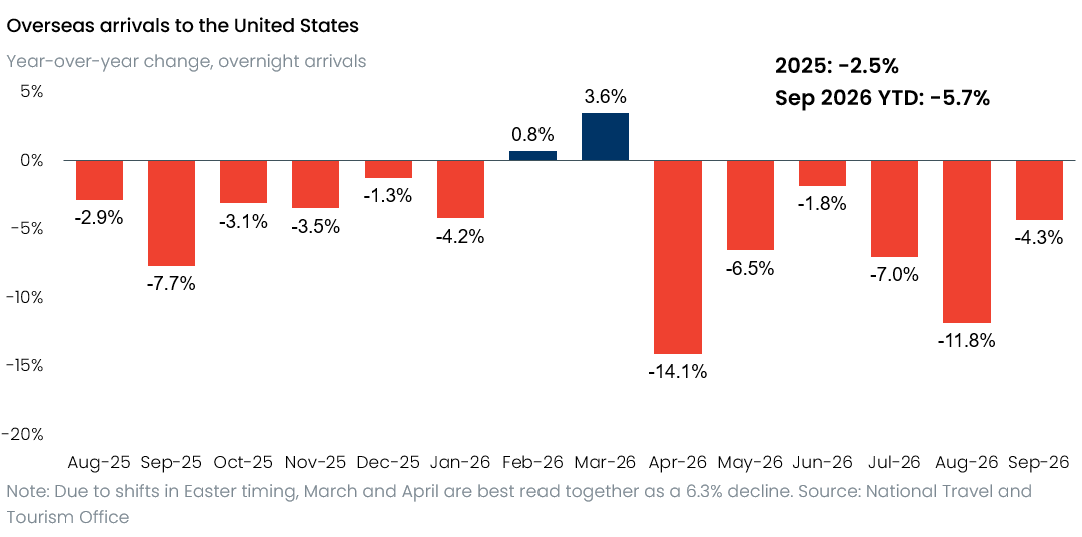
Graphic courtesy of Tourism Economics/Oxford Economics
In a September report, Weak Arrivals Impact U.S. Destinations, Ryan pointed to political rhetoric and trade tensions as the primary drivers: “The Trump Administration has implemented policies affecting travel, such as entry bans affecting 39 countries, a visa bond program, and increased entry fees.” The report also cited a July survey by Longwoods International in which 56% of Canadians surveyed indicated that “U.S. government policies, trade practices and political statements” were making them less likely to visit.
According to the report, “land trips tended to get cut the most,” and border states like North Dakota, Vermont and Idaho faced the sharpest declines. While land arrivals from Canada to the U.S. increased temporarily earlier this year, tensions picked up again in August after a new round of tariffs between the two countries. “The Canadian pullback keeps surprising me, just to see those sustained behavior shifts,” Ryan said. “It’s significant.”
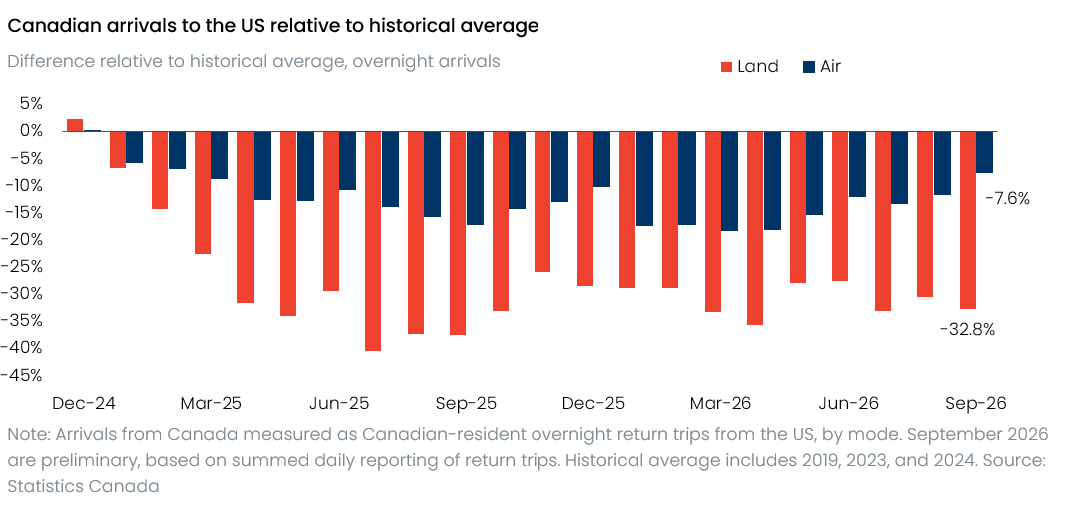
Graphic courtesy of Tourism Economics/Oxford Economics
Domestic Tourists and Local Shoppers Support Tanger’s Outlet Centers
Keepers of specific portfolios need to consider factors beyond big-picture stats on inbound travel. Domestic tourists and local shoppers play a huge role in the performance of Tanger’s portfolio, said executive vice president and COO Leslie Swanson. The REIT’s 38 outlet centers and four open-air lifestyle centers in the U.S. and Canada total nearly 17 million square feet and about 3,000 stores.
Swanson pointed to Tanger’s outlets in Branson, Missouri; Sevierville, Tennessee, in the Great Smoky Mountains; Daytona Beach, Florida; and South Carolina’s Hilton Head and Myrtle Beach. Located near major entertainment hubs and attractions, these Tanger properties are in fast-growing markets where international tourists are only part of the overall mix. Over the past six years, Swanson noted, Tanger has strengthened its relationships with local shoppers, including new retirees and owners of second homes, in such destinations. “Although these markets are tourist centers, they really have strong local populations,” she said. “In Myrtle Beach, for instance, the cost of living is so reasonable … so it’s a really good mix of shoppers for us: transplants, tourists as well as locals.”

Strong domestic tourism and fast-growing residential populations support the performance of Tanger outlets near entertainment hubs and tourist attractions, including Tanger’s Sevierville, Tennessee, outlet center in the foothills of the Great Smoky Mountains near family-friendly attractions like Dollywood. Photo by APG Photo & Video and courtesy of Tanger
Tanger’s same-center net operating income increased 3.5% year over year in the second quarter from $103.3 million to $106.9 million. For the first half of 2026, it rose 3.1% year over year to $207.4 million. For the 12 months that ended June 30, same-center average tenant sales rose 5.2% year over year from $465 to $489 per square foot. “We had a remarkably strong summer season,” Swanson said. “We really saw a stronger domestic traveler.”
That doesn’t mean all outlets are completely insulated from the ebbs and flows of inbound visitors, particularly in markets near international borders. “The border is growing now, but a little bit less than the rest of the portfolio,” Simon president, CEO and COO Eli Simon said on an Aug. 4 earnings call. “This impacts the outlets more … just given that we have more outlets on the borders than full price,” he added.
Visitors From Mexico and South America Buck Broader Tourism Decline
The September report from Tourism Economics highlights a bright spot: increased arrivals from both Mexico and South America, though Ryan has not seen concrete data on what is driving the upswing.
Year-to-date arrivals from Mexico for the first six months of 2026 rose 14.6% year over year, building on 6.4% growth from the first half of 2024 to the first half of 2025. State-level estimates are available only for the full year 2025, when New Mexico and Arizona each saw 7.6% increases in visitors from Mexico, and Texas and California posted 7.5% gains, according to the report.
The Commerce Department’s National Travel and Tourism Office indicated that overseas arrivals to the U.S. from South America rose 3.8% from January through August compared with the same period last year. Arrivals from Western Europe fell 8.8%, and arrivals from Africa fell 21.4%. “We expect arrivals from Mexico to increase strongly this year, providing a welcome positive trend,” Ryan wrote.
Tourism Economics said New York, Miami and Orlando, Florida, topped U.S. cities for South American overnight visitors in 2025, followed by Los Angeles, Las Vegas and Washington, D.C. Per the September report, arrivals from World Cup participants Colombia and Ecuador increased by approximately 94,000 and 48,000, respectively, from January through August compared with the same period last year, including strong gains in June and July, when the tournament was held.

Tanger has outlet centers in eight of the 11 cities that hosted this year’s FIFA World Cup, and the landlord saw higher traffic from global tourists during the tournament, including these Ecuador fans during a World Cup event at Tanger Kansas City at Legends. Tourism Economics reported approximately 48,000 additional arrivals from Ecuador for January through August compared with a year prior. That included particularly strong gains during the tournament months of June and July. Photo courtesy of Tanger
For Odyssey’s Strauss, the uptick in visits from Mexico and South America underscores the complexity of inbound travel patterns. Pockets of strength, he noted, can emerge amid a broader slump, and the source of visitors to different markets and centers can shift. Strauss cited Honolulu’s Kalākaua Avenue, dubbed the Rodeo Drive of the Pacific. “Historically, it has been heavily influenced by Japanese tourism and the strength or weakness of the yen,” Strauss said. “An influx of shoppers from South Korea, Australia and the United States has helped to offset some of the softness in visits to the east of Hawaii by Japanese customers.” In the same way, he said, parts of Florida “are seeing fewer European tourists but a strengthening of new affluent residents and South American customers.”
Tourism Economics Projects U.S. Inbound Travel Recovery in 2027
In his note to subscribers, Ryan said Tourism Economics now anticipates 3.3% growth in inbound arrivals in 2027. “We expect a stronger backdrop for international long-haul travel globally will help support resumed growth,” he wrote, and he expects that in the absence of further developments, relations between Canada and the U.S. will improve, with the potential for a return to prior patterns of crossborder travel.
Longer term, Ryan bets on a significant rebound in inbound visits from around the world, in part because people continue to prioritize travel. “They are placing a lot of importance on these experiences, and we’re seeing continuing demand for luxury and premiumization,” Ryan told C+CT. “The airlines keep saying they have plenty of people who are willing to pay for more expensive seats. That piece of the market seems very strong.”
Indeed, travelers from Europe, South America and Asia continue to crisscross the globe. “Real incomes and wealth are rising, and more households each year reach income levels that support long-haul travel,” Ryan observed. “We expect a close-to-50% increase in spending by international travelers globally between 2025 and 2030.”
By Joel Groover
Contributor, Commerce + Communities Today