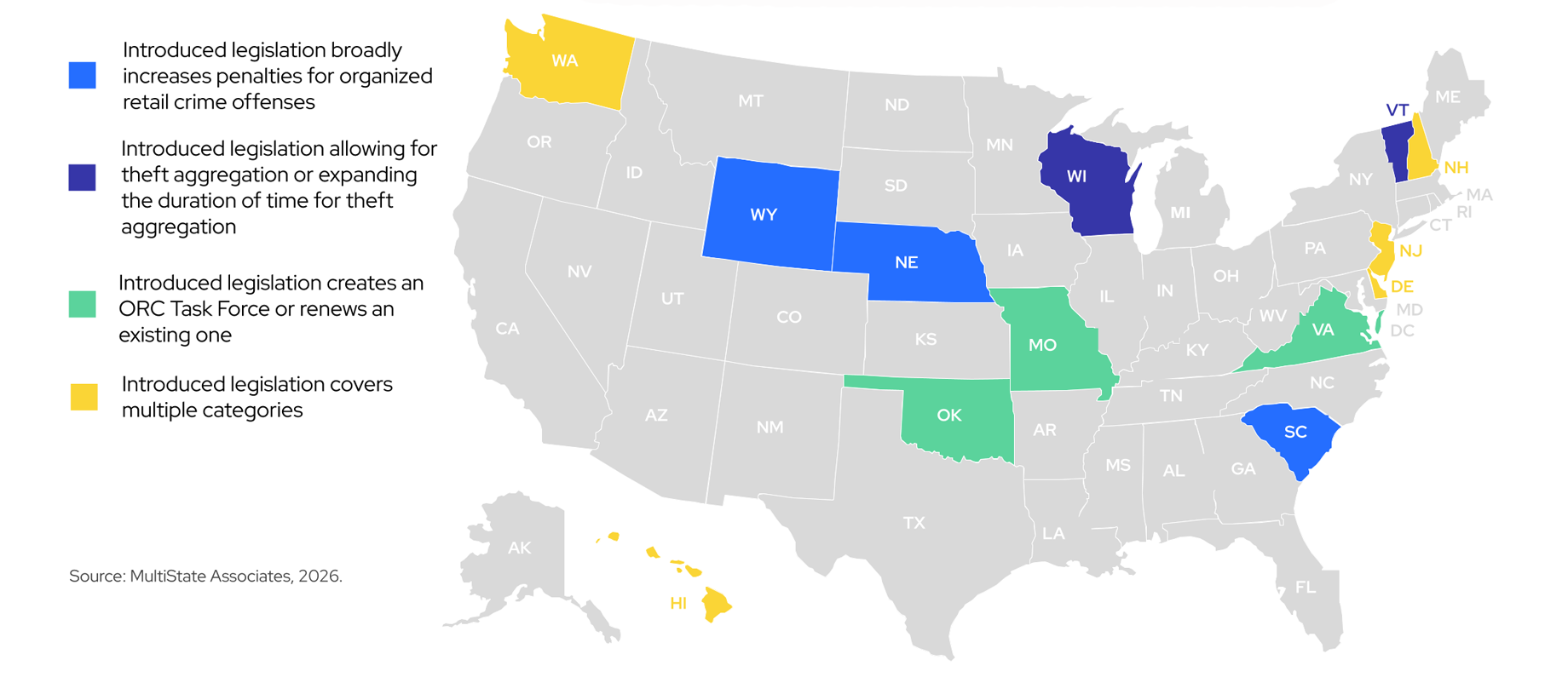
As states kick off their 2026 legislative sessions, measures to curb the spread of organized retail crime (ORC) remain a top priority for lawmakers, law enforcement and retailers. Thirteen states (Delaware, Hawaii, Nebraska, New Hampshire, New Jersey, Missouri, Oklahoma, South Carolina, Vermont, Virginia, Washington, Wisconsin and Wyoming) already have 22 active bills aimed at ORC that have either been introduced or carried over from last year’s sessions. While most proposals broadly increase penalties or allow for multiple thefts to be added together into one offense, state lawmakers are introducing more targeted measures aimed at crime leaders and repeat offenders.
Most sentencing proposals target repeat offenders and ORC leaders
Harsher sentencing standards for retail theft offenders have become a mainstay for ORC bills in recent years. Of the 11 bills introduced this year, four bills specifically call for tougher punishment for repeat offenders (HI HB 1914, NE LB 1079, SC SB 76 and WY SF 7), while another four bills (NH HB 1670, HI HB 144, HI HB 1759 and SC SB 76) target offenders who lead and fund ORC gangs or recruit members to participate in thefts. South Carolina’s SB 76 covers multiple areas with mandatory prison sentences for theft offenders, bans on recruiting gang members and tough penalties for repeat offenders.
The time window in theft aggregation proposals keeps growing
Bills allowing law enforcement to aggregate thefts across jurisdictions have been a key policy to help prosecutors convict offenders for the total value stolen rather than the amount stolen at each location. Previously theft aggregation laws gave prosecutors a 60- or 90-day period to charge thieves with the total goods stolen. Now, more states are expanding that time window to 180 days…and sometimes even longer.
States such as Florida, Kansas and New Jersey have expanded aggregation windows up to one year. Bills in Wisconsin (WI AB 89), New Hampshire (NH HB 1670) and Vermont (VT SB 168) would allow aggregation up to 180 days, while Washington’s SB 5347 pushes the window up to a year and New Jersey’s SB 1041 up to two years. Legislation introduced in Delaware (DE HB 276), however, would go one step further and allow for aggregation regardless of the time duration.
States commit to continuing ORC Task Forces
Statewide ORC Task Forces have played a critical role in working with business and community stakeholders to coordinate crackdowns with local law enforcement agencies. As of January 2026, 17 states have established an ORC Task Force within their Attorney General's office to investigate and prosecute suspects involved in organized retail crimes. For 2026, legislation in Hawaii (HI HB 1759) looks to create an ORC Task Force, and in Missouri (MO HB 2648) would create the Organized Retail Theft Coordination Center within the Department of Public Safety.
Meanwhile, several states are considering bills that would provide additional funding to keep task forces operational. Lawmakers in Oklahoma (OK SB 1462) and Delaware (DE SCR 130) introduced bills to extend their respective ORC Task Forces. And, in Virginia, lawmakers included ORC language in both budget bills (VA SB 30 and VA HB 30) that set aside funds for an organized retail crime database.
2026 Organized Retail Crime Legislation