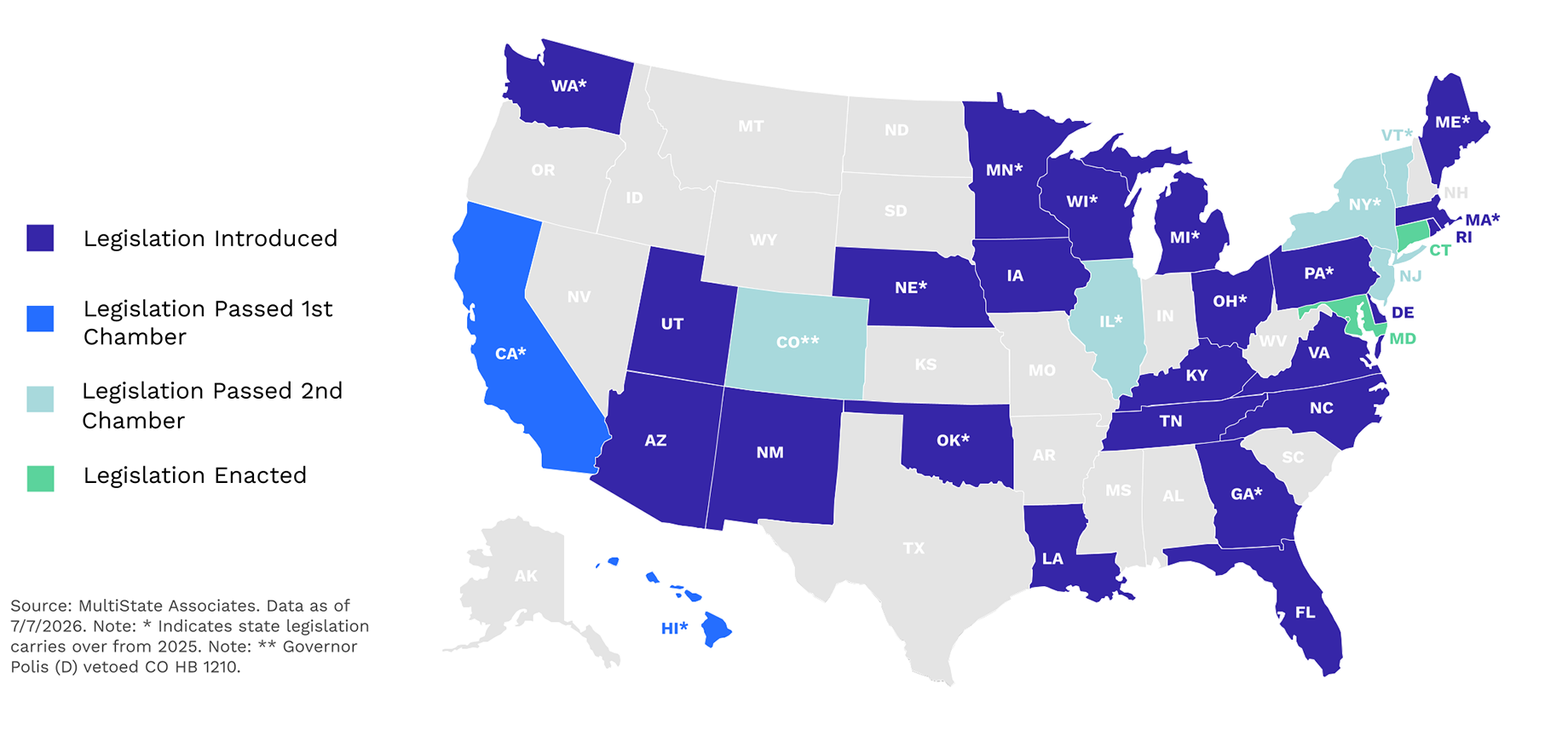
Connecticut (CT HB 5563 and CT SB 4) joined Maryland (MD HB 895) as the second state this year to pass surveillance pricing legislation, signaling that this issue is likely to be on lawmakers' agendas in 2027.
Connecticut lawmakers took a broad approach to ban surveillance pricing, with the law applying to retail sellers, including retail food establishments, as well as third-party delivery services. Beginning July 1, 2027, these entities will be barred from setting a customized price for a good or service based on a consumer's personal data. Businesses that engage in this practice for reasons unrelated to offering an online discount must disclose on any online advertisement, label, display or offering that pricing was influenced by personal data.
Connecticut's law clarifies that common pricing factors, such as geographic location, delivery costs, timing, supply and demand, pricing errors and network outages, do not constitute surveillance pricing. Notably, Connecticut’s law differs from Maryland’s by explicitly protecting group discounts (e.g., special pricing for students, veterans, seniors, teachers) and voluntary loyalty programs while Maryland lawmakers removed a similar provision through amendments before enactment.
Meanwhile, New Jersey’s Fair Price Protection Act, NJ A 4085, would ban surveillance pricing for groceries, while exempting discounts, promotional prices or loyalty program benefits. Recent amendments to the legislation established a one-year moratorium on new uses of electronic shelf labels (ESLs) and required a study of their potential impact on surveillance pricing. The legislation passed both chambers on June 30 and now heads to Governor Mikie Sherrill’s (D) desk. Once officially delivered to the Governor, she will have 45 days to take action on the bill.
Similarly, New York lawmakers passed companion surveillance pricing bills, NY S 8623 and NY A 9349, just before their adjournment deadline. These bills prohibit surveillance pricing based on a consumer's personal data and require entities using automated, non-personal pricing systems to disclose that use and the categories of inputs that influence the price. As with bills in other states, New York’s bills exempt loyalty or membership programs. Attorney General Letitia James, a vocal pricing advocate, urged lawmakers to pass the bills. The legislation was sent to Governor Kathy Hochul’s (D) desk, where she will have 30 days to take action.
In Colorado, Governor Jared Polis (D) vetoed CO HB 1210 on June 2. If enacted, the measure would have placed restrictions on engaging in individualized price setting and individualized wage setting. In his veto letter, Polis acknowledged that lawmakers were well-intentioned; however, “Instead of specifically defining and targeting unethical conduct and practices, the bill takes a broader approach to capture any technology that incidentally influences a price or wage amount.” The veto message highlights a recurring point of contention in pricing legislation: the risk of unintentionally applying restrictions that limit retailers' ability to lower prices and offer discounts. Polis stated that “many Coloradans won’t get discounts on items they buy if [he] were to sign this.”
Lastly, the California Senate amended a surveillance pricing bill, CA AB 2564, by striking the civil penalty provisions and clarifying that a retailer offering a discounted price does not qualify as surveillance pricing. The bill has been ordered to a third reading in the Senate, and the California legislature is not expected to adjourn until August 31.
Pricing Legislation as of July 2026