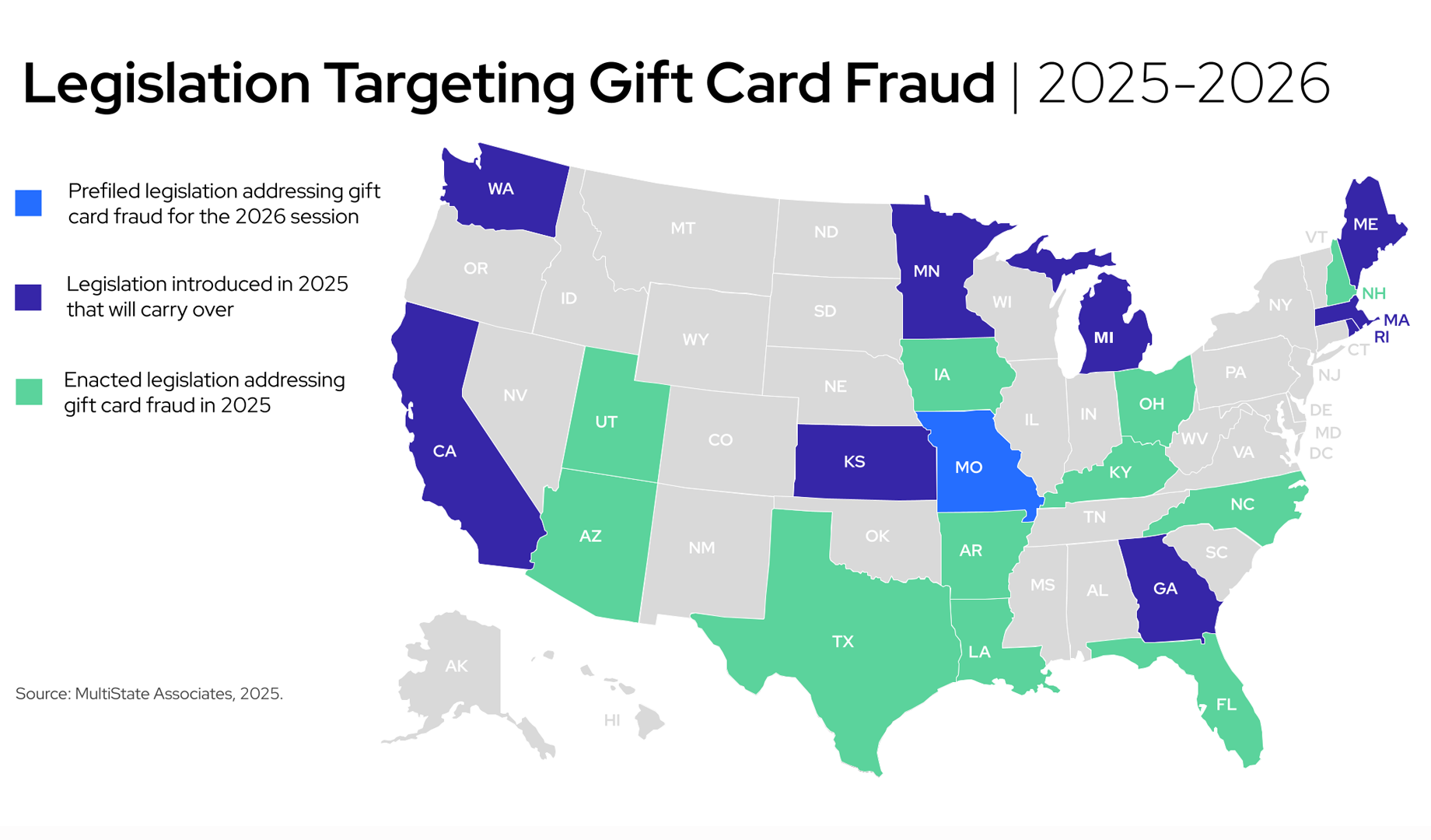
This year, lawmakers in 11 states – Arizona, Arkansas, Florida, Iowa, Kentucky, Louisiana, New Hampshire, North Carolina, Ohio, Texas and Utah – enacted laws that create the offense of gift card fraud.
In a typical gift card fraud case, criminals steal unactivated gift cards from store displays, scan the activation codes with special software then return the cards to the store. Once a consumer buys and activates a card, the thief can quickly access and steal the funds. Stolen gift cards without value present a challenge for prosecutors since thieves can steal large quantities of unactivated gift cards and face little punishment.
Looking ahead to 2026, lawmakers in Kansas (SB 84) and Maine (LD 1773) also have gift card fraud bills awaiting executive approval, while the Georgia Senate is expected to take up gift card fraud legislation (HB 447) that ran out of time for passage.
In Massachusetts, retailers and gift card manufacturers have advocated for bills that set penalties for accessing gift cards without the owner's consent (HB 1611) and amending existing law to set penalties for defrauding, tampering or altering a gift card (SB 1209). In Michigan, the Senate is still considering two bills passed this year in the House (HB 4599 and HB 4598) that would add gift card fraud to Michigan's Organized Retail Crime Act.
Also, in a show of bipartisan support, the Council of State Governments' (CSG) Shared State Legislation (SSL) Committee voted in favor of including Kentucky’s SB 130 as part of their 2026 volume of Shared State Legislation. Members of the Committee noted that bills like Kentucky's are part of a greater effort by state lawmakers to combat organized retail crime.
For more information, contact gpp@icsc.com.