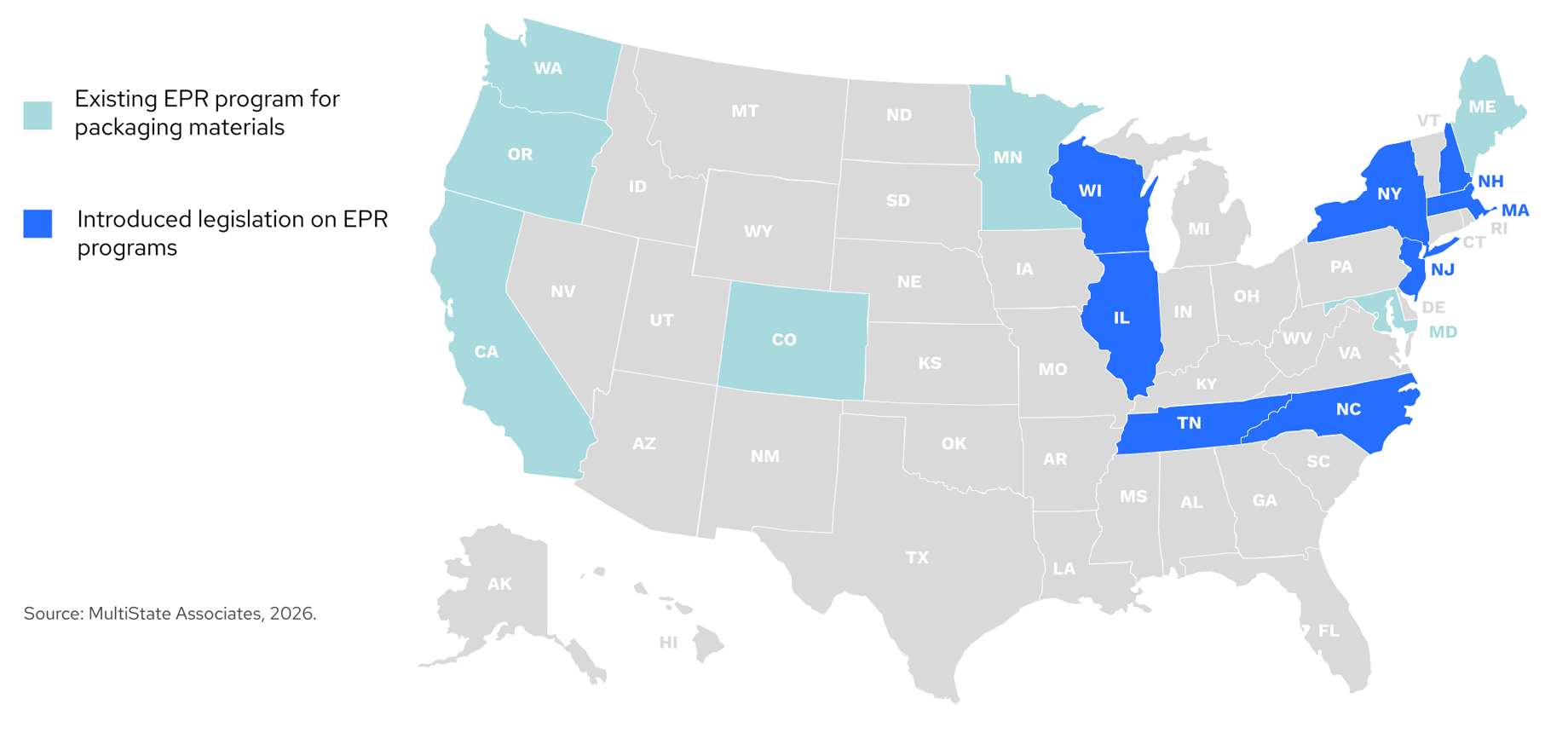
With the start of a new legislative session, state lawmakers continue to show interest in legislation related to extended producer responsibility (EPR) programs for packaging materials. This year, lawmakers in 13 states have introduced 33 bills related to EPR packaging programs. States such as Washington, New Jersey and New York have introduced large, comprehensive EPR legislation.
EPR programs have been a popular solution to managing the end-of-life of consumer packaging materials. Seven states (California, Colorado, Maine, Maryland, Minnesota, Oregon and Washington) have enacted comprehensive EPR packaging laws. Under most EPR packaging programs, producers and sellers of packaging materials pay fees into a designated producer responsibility organization (PRO) as a way to encourage the use of more sustainable packaging and invest in new recycling processes that promote circularity. EPR programs are designed to shift the responsibility and cost burden of recycling away from state and local governments to private industry.
In California, rulemaking is continuing for a packaging EPR law enacted in 2022 (CA SB 54). On January 29, CalRecycle opened a second 15-day comment period, which closes on February 13. This is the second time CalRecycle has undergone a rulemaking process for its EPR law after Governor Gavin Newsom (D) directed CalRecycle to restart the process following a series of missed deadlines and concerns about costs for businesses and consumers. In California, there is no specified time period for issuing proposed rules; however, the law establishing this program requires the EPR program to begin by January 1, 2027, so final rules are likely to be issued sometime this year. Oregon’s packaging EPR law has faced recent litigation with the National Association of Wholesaler-Distributors securing a preliminary injunction, arguing the law is unconstitutional as it applies to them. A pretrial conference is scheduled for July 1, with a trial set to begin July 13.
New Jersey lawmakers are considering an EPR proposal that follows a similar model to what other states have adopted. The pair of proposed bills (A 3744 and S 673) would require packaging producers to join a PRO and submit a needs assessment of the state’s existing recycling and solid waste regulations and infrastructure. A unique feature of New Jersey’s measure would require producers to meet specific targets, including reducing single-use plastic packaging by 50% over 10 years, and prohibiting the sale of packaging that contains certain toxic substances, including PFAS. An alternative Senate bill (S 614) being considered would require packaging producers to develop a packaging product stewardship program.
In Massachusetts, the legislature is considering legislation introduced last year. Alongside that legislation, the Massachusetts EPR Commission recently released its final report with study results on EPR programs. Ultimately, the Commission determined that it will establish a Solid Waste Advisory Committee to further investigate packaging EPR and recommended the legislature appropriate funds to conduct a statewide needs assessment, making the legislation looking to enact full EPR unlikely to move this cycle.
Washington lawmakers are looking to expand their EPR program to require producers of textiles and apparel to join and fund a PRO. A bill in the Senate (SB 6174) would require PROs to develop plans for the safe and proper management of textiles and apparel, as well as prohibit retailers and online marketplaces from selling products from producers who are not in compliance with the program. Meanwhile, House lawmakers are considering legislation, HB 1420, with a similar goal to require producers of textiles and apparel to join a single textile apparel coordinating organization (TACO) by 2027. Several business groups, including the Washington Retail Association and the Association of Washington Businesses, testified against SB 6174 and raised concerns addressing the overall complexities of implementing a textile EPR program.
And finally, New York lawmakers are continuing to consider packaging EPR legislation that passed the Senate last year, but not the Assembly (NY AB 1749/SB 1464), as well as a competing packaging EPR bill (NY AB 6191/SB 5062) that did not see much movement last year. This is the second time the New York Senate has passed packaging EPR legislation that ultimately did not receive a vote in the Assembly, but the bill is likely to receive renewed consideration this year.
Extended Producer Responsibility (EPR) for Packaging - 2026