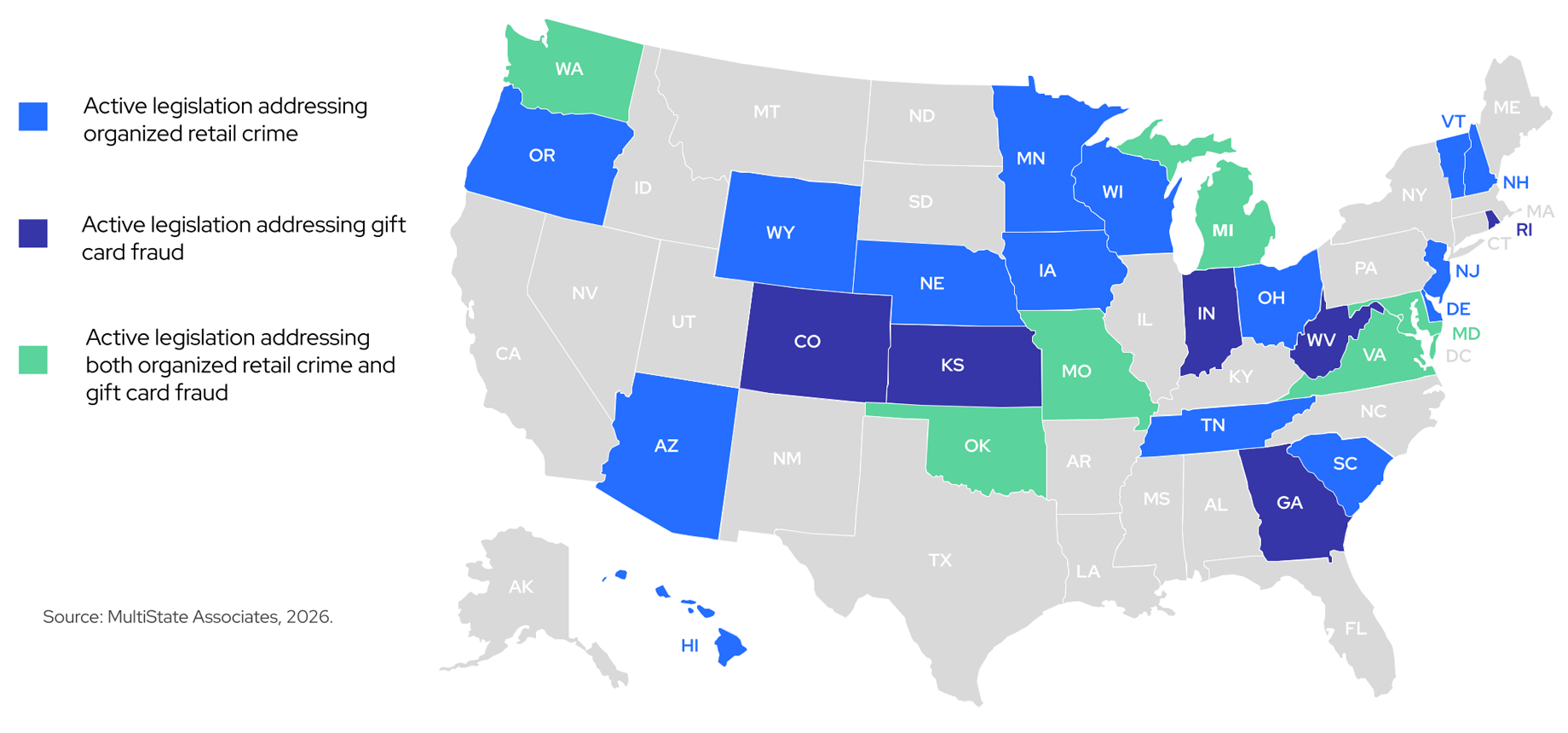
As the 2026 legislative session reaches its two-month mark, lawmakers are continuing to work to curb organized retail crime (ORC) by targeting thieves who access and use money from stolen gift cards.
In typical gift card fraud cases, organized retail thieves steal unactivated gift cards from store displays and tamper with them before returning them to the store. Once a consumer buys and activates the card, the thief can quickly access the funds through sophisticated technological means. Stolen gift cards without value present a challenge for prosecutors since thieves can steal large quantities of unactivated gift cards and face little punishment.
Earlier this month, Kansas Governor Laura Kelly (D) signed HB 2347, which adds gift cards to the list of financial cards a prosecutor can charge individuals with illegally obtaining money, goods, or services. This bill was carried over from the 2025 legislative session.
Kansas is now the twelfth state to adopt a law that allows prosecutors to charge thieves for stealing gift cards with the intended purpose of draining the money once customers buy them in stores. In January 2025, Ohio Governor Mike DeWine (R) signed the nation’s first gift card fraud bill into law, which created the model for ten other states.
Lawmakers in Virginia are advancing two bills (HB 662 and SB 444) that have passed out of their respective legislative chambers. Both bills would create a prosecutorial framework for gift card crimes and have been making their way through the General Assembly unopposed. Meanwhile, a similar bill in West Virginia (HB 2990) has passed out of the House and is on its way to the Senate. Gift card legislation could also see movement in the coming weeks in Georgia, Maryland, Michigan, Oklahoma, Missouri and Maine.
Additional ORC Legislation
Legislation aimed at preventing theft across multiple jurisdictions has been a key priority for both retailers and law enforcement. The Wyoming Senate has passed two bills that would establish harsher sentencing standards for criminals crossing jurisdictional lines. Senate File 7 would increase the maximum penalty for theft of property valued under $1,000, as well as lower the threshold for a felony theft charge for repeat offenders. While Senate File 8 would create the offense of traveling across county or state lines to commit additional crimes or conceal proceeds or property obtained.
Last year, six states enacted legislation expanding the time window for theft aggregation, allowing prosecutors to target organized operations that spread thefts over longer periods.
Notably, Oregon House lawmakers passed HB 4041 last week, which, unlike most retail crime bills, would increase both the monetary threshold used to determine the offense level for theft and the aggregate threshold for the value of the property. This is a bill now heads to the Senate.
ORC Legislation