The Short Version
- Shopping centers are using Instagram not just to promote events and tenants but to shape how customers understand and experience their properties.
- Reston Town Center in Virginia shifted from retailer-supplied posts to original lifestyle content, helping its Instagram account gain about 1,000 followers within 90 days.
- California’s Santana Row treats Instagram as both a marketing and customer-service channel, while Jamestown builds each property’s social strategy around its individual identity.
- Pacific Retail Capital Partners gives local teams flexibility while using content calendars to support specific tenants and other business priorities.
The Social Feed Becomes Part of the Place
Alex Young was walking her dog when she ran into a neighbor and asked what she was doing that weekend. The neighbor, unaware that Young worked for Reston Town Center owner BXP, said she was considering taking her family to the property after seeing its holiday events promotions. “She was like: ‘Their social media is really getting me,’” recalled Young, vice president of regional marketing. And that’s exactly what Reston Town Center had been trying to do: use social media not simply to promote what was happening at the property but to make people want to be part of it.
Reston Town Center, Santana Row, Jamestown and Pacific Retail Capital Partners are taking different approaches to that goal, from investing in original content to building trust, reinforcing a property’s identity and supporting specific tenants. C+CT looks at what they’re doing on Instagram, a channel all four use and one whose visual format lends itself particularly well to showcasing a property’s architecture, restaurants, events and overall feel.
Take Control of the Property’s Story
Just a few years ago, the social media feed of Northern Virginia’s Reston Town Center relied almost entirely on content supplied by its retailers. That’s a tough way to represent a mixed-use destination with 580,000 square feet of retail and more than 150 annual events. The content varied in style and gave an uneven picture of the tenant mix. The biggest void, said BXP marketing manager Kelsey Youngblood, was events; the feed wasn’t fully capturing the property’s community programming and vibrancy.
BXP hired IRL Agency to manage its social media in January 2025. BXP sets the strategy, while IRL brings its knowledge of platform trends and what performs well. “Our team drives the strategy — we articulate what our goals are — and then they help us determine the best way to showcase the content,” Youngblood said. If Reston Town Center has 15 events coming up in a month, for example, IRL might package them into a monthly events guide and carousel. A restaurant opening might call for a behind-the-scenes reel featuring an interview with the owner.
The difference showed up quickly: The former hodgepodge of text-heavy graphics, as Youngblood described it, gave way to lifestyle content and original imagery. BXP also learned what resonates: Pets perform particularly well, as do food, cocktails, live music and posts about upcoming events. Informal videos in which an IRL team member interviews visitors or restaurant managers also have generated strong engagement, which Young attributed in part to the content’s authenticity and inside look at the property.
Within 90 days, the account gained roughly 1,000 followers. Attendance also rose at several landlord-produced events. The annual KidsFest, for example, doubled from 2,000 attendees in 2025 to 4,000 in 2026, while Animal Expedition, an annual family event centered on animals and pets, increased from 3,000 to 4,500.
BXP doesn’t credit social media alone for those gains, but the numbers offer another measure of performance beyond likes and followers.
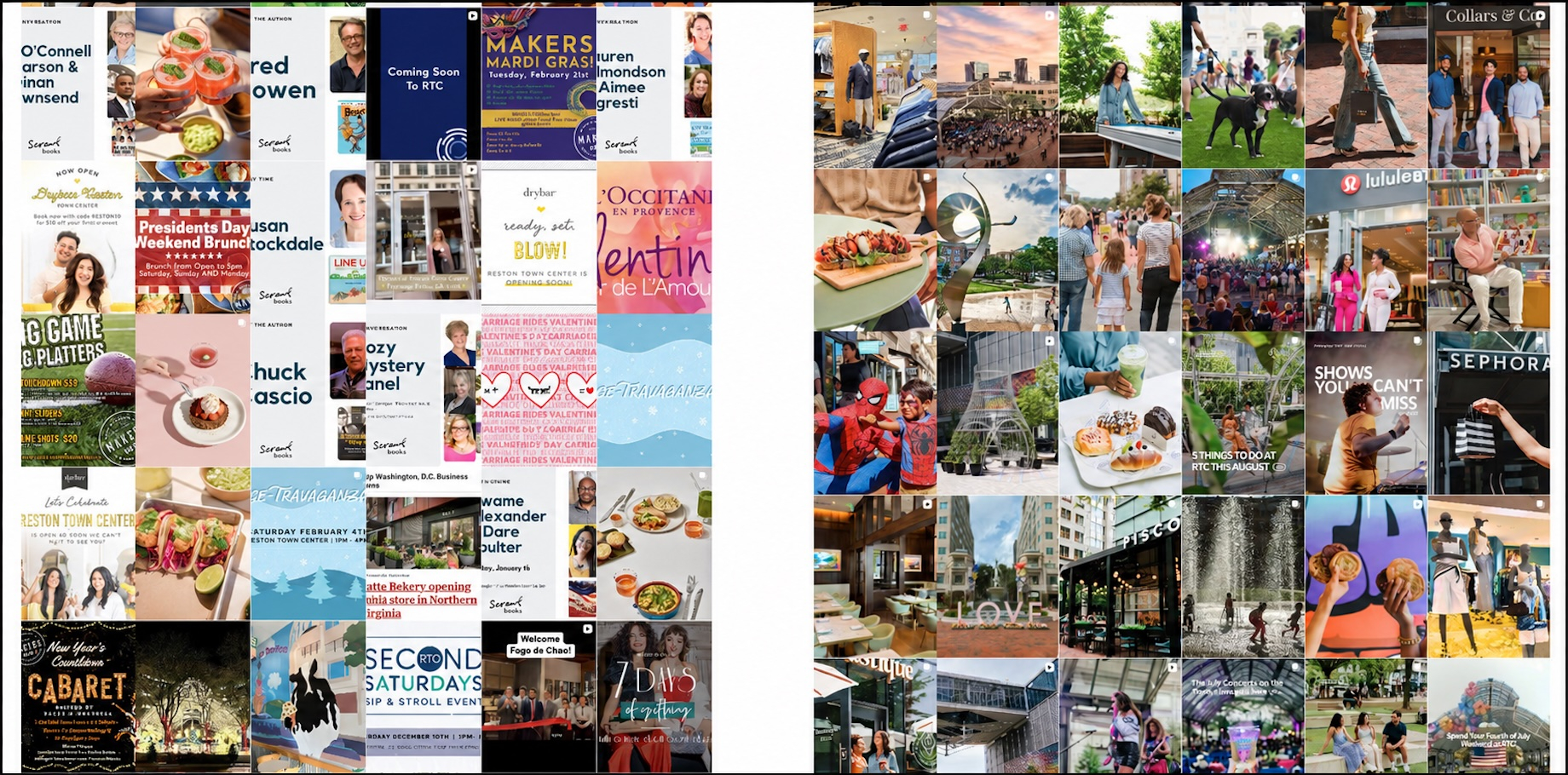
Before 2025, Reston Town Center’s Instagram feed relied heavily on promotional graphics, text and retailer-provided content. After BXP partnered with IRL, it shifted toward original lifestyle photography and video, pictured at right, with a greater focus on showing its events and the people experiencing them, a strategy that helped the account gain about 1,000 new followers within 90 days. Images courtesy of Reston Town Center
Become a Source Customers Trust
At Federal’s shopping, dining and residential property Santana Row in San Jose, California, social media has a straightforward job: Keep customers connected and make sure they’re among the first to know what’s happening at the property.
Much of its content is created in-house and on-site, with staff visiting restaurants, retailers and events to capture videos and photos in real time. “It is not an ad, so that really gives the experience of what Santana Row is like,” said Federal senior director of marketing Collette Navarrette.
The team responds to what’s happening at the property. A restaurant event that evening can become a post that morning or the following day; a seasonal menu or store opening might prompt staff to create a reel rather than simply reshare what the tenant posts. Navarrette described the property’s Instagram account as an “authentic, trusted source; a friend.” She described the reaction for which the team aims: “They said that this new restaurant opened, and I saw this sizzling reel on this appetizer. We’re going.”
Santana Row also extends its reach through partnerships with local influencers. For its September Taste the Row weekday lunch promotion, for example, about eight local influencers received meals from participating restaurants and shared content showcasing the food while tagging both the restaurant and Santana Row.
The arrangement gives restaurants, particularly independent operators without corporate marketing teams or digital agencies, another way to reach potential customers. “They’re looking for us on the ground as their marketing leads to really kind of help story-tell the experience of their store or restaurant,” Navarrette said.
Followers, meanwhile, treat the Santana Row Instagram account as a source of practical information, asking whether an event is free, when a store is opening or what’s happening that weekend. The team makes a point of responding quickly, turning social media into not just a marketing tool but also a real-time customer-service channel. That responsiveness, Navarrette said, builds trust and keeps customers coming back to the account for information.
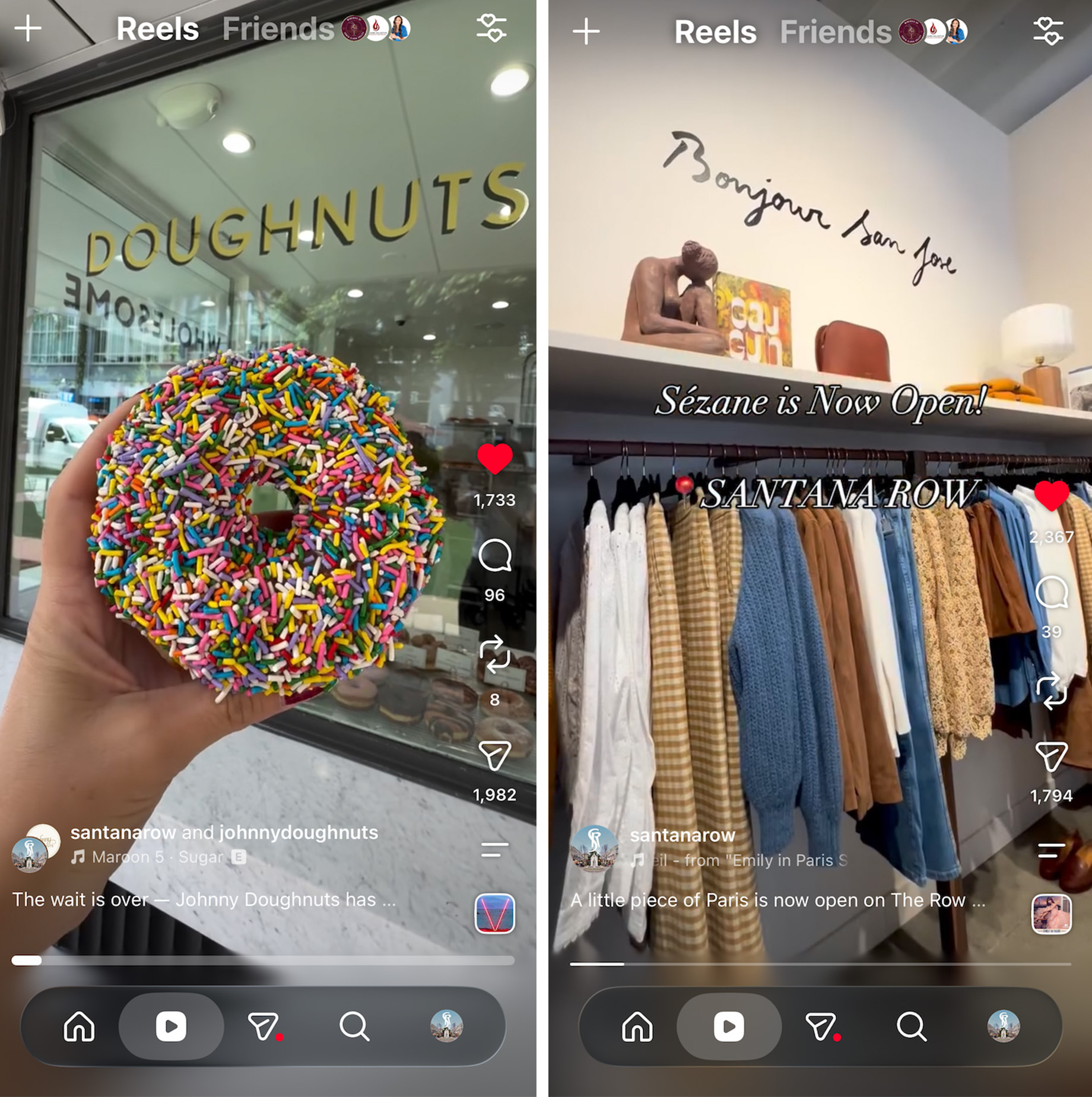
The May 27 Instagram Reel announcing Johnny Doughnuts’ opening is the Santana Row Instagram account’s top-performing food post of the year, drawing 147,000 views and 1,900 shares. “Food content is inherently visual,” said Collette Navarrette — senior director of marketing for Federal, which owns the property — adding that the video answered a question followers had been asking about when the doughnut shop would open and gained additional reach when Johnny Doughnuts reshared it to its profile. And Santana Row’s Feb. 28 reel announcing Sézane’s launch was its strongest store-opening post of the year, generating 114,000 views, 2,300 likes and 1,700 shares. “Sézane is a French brand that’s rarely available in the U.S.,” said Navarrette, noting that the opening attracted TikTok and Instagram fashion creators from across the country, extending interest beyond Santana Row’s local audience. Images courtesy of Santana Row
Build Around Each Property’s Identity
For Jamestown — which owns multiple properties in the U.S., Latin America and Europe — social strategy starts with the property itself rather than a prescribed number of posts, reels or stories. Each asset has its own brand guidelines governing photography, color, typography and tone of voice, and those elements carry through to the physical property, so what customers encounter online feels connected to what they experience when they arrive.
“We don’t want Chelsea Market [in New York City] to feel like Ponce City Market [in Atlanta],” said global head of creative and marketing Melita Issa.
The content similarly is property specific. At Jamestown’s historical buildings, for example, posts might pair archival and current imagery to tell the story of how a property and its surrounding community have evolved.
Jamestown uses the history of Groot Handelsgebouw as social media content, connecting the property’s origins in Rotterdam, Netherlands’ postwar reconstruction with the building people experience today. Putting past and present in context can help audiences feel more connected to and invested in the place. “People like to see the past and the present in context,” Issa said.
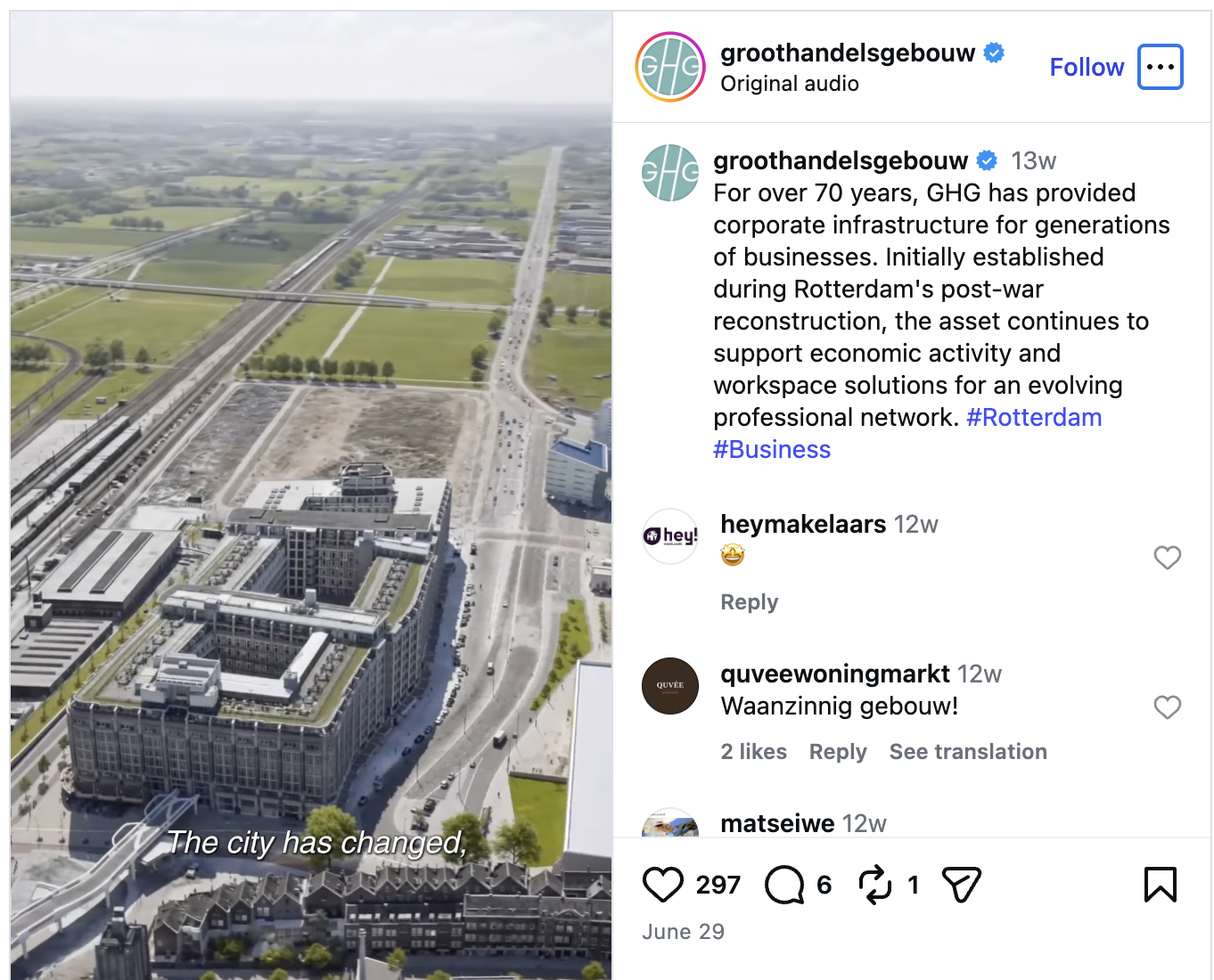
Jamestown uses social media to connect Groot Handelsgebouw’s origins in Rotterdam’s postwar reconstruction with the building people experience today, pairing its history with the present-day property. Click the photo above to watch the reel. Image courtesy of Jamestown/Groot Handelsgebouw
Tenant-related content, meanwhile, often focuses on the people behind the businesses — who they are, why they started their companies and what makes them distinctive — rather than simply announcing what’s there. The idea is to turn a property or tenant from something audiences simply see in their feeds into something they feel connected to and invested in. “It’s the storytelling,” Issa said.
Even the frequency of posts varies by property. A large, mixed-use asset with frequent store openings, events and public programming has more to talk about than an office-focused property with fewer public-facing activities. The goal isn’t to meet a portfolio-wide posting quota but to let what’s happening at each property determine the cadence.
For the same reason, Jamestown doesn’t chase every social media fad. “A trend might not resonate with the community that you’re serving,” Issa said. “It might get you lots of views and clicks, but that’s not the goal.”

Jamestown uses its properties’ social media channels to help audiences connect with the businesses at its properties. That can mean posting behind-the-scenes photos of the people making the food, such as this chef preparing hand-pulled noodles at Very Fresh Noodles in Manhattan’s Chelsea Market. Photo courtesy of Jamestown
Make the Content Calendar a Business Tool
At Pacific Retail Capital Partners, which has 24 million square feet under direct management in the U.S., corporate sets the social media strategy and guardrails, but on-site teams decide how to bring them to life at their properties. Corporate reviews content calendars, while local teams have the autonomy to respond to what’s happening in real time.
At Bridgewater Commons in New Jersey, for example, the team didn’t simply repost Alo’s national marketing when the retailer opened a store. Instead, the property’s team created its own content showing the store design, merchandise and location, giving followers a property-specific look at what they would actually encounter when they visited.
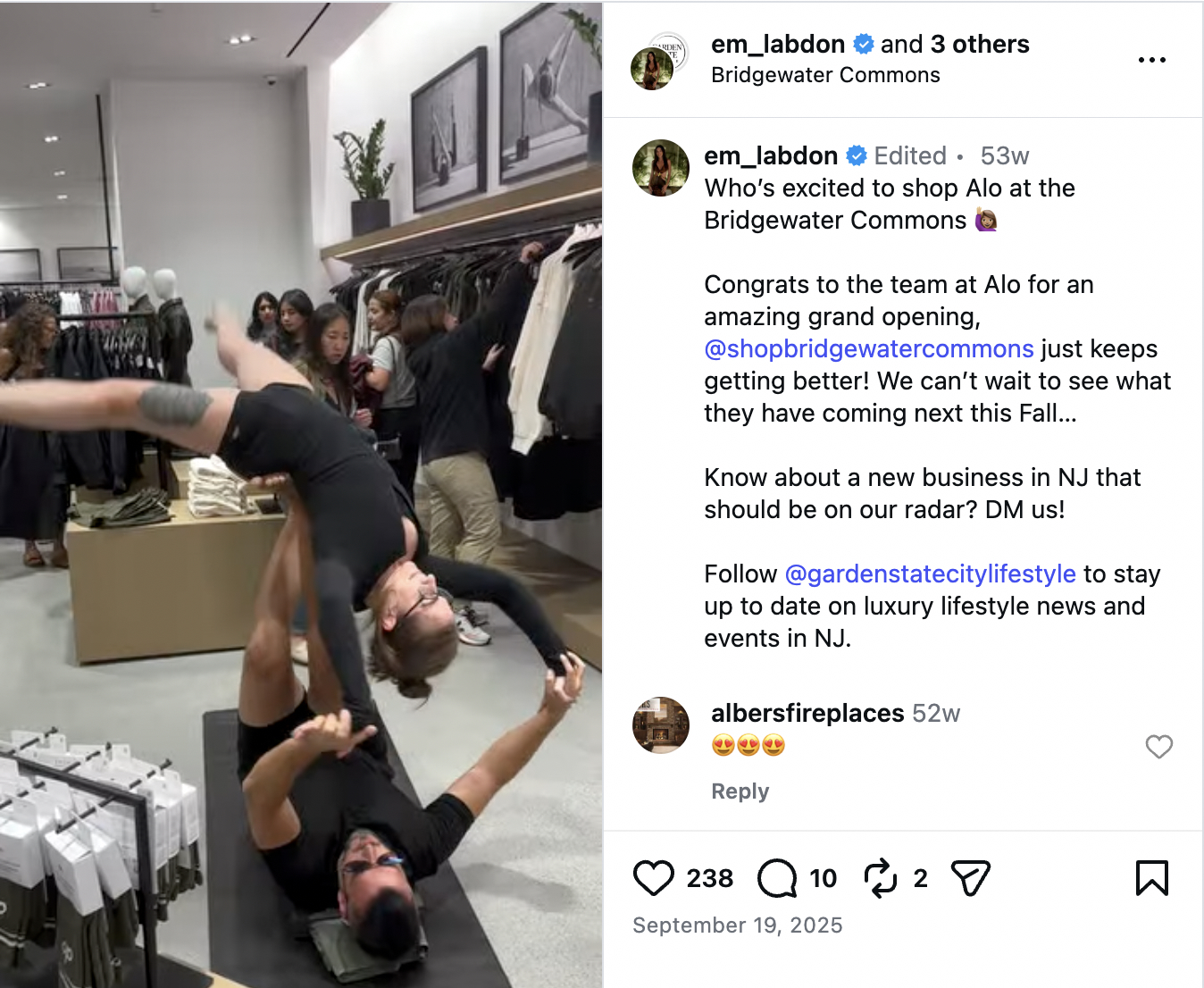
At Bridgewater Commons in New Jersey, the property team created its own Instagram Reel for Alo’s store opening, giving followers a closer look at the store design, merchandise and location rather than simply reposting the retailer’s national marketing. Click the photo above to watch the reel. Image courtesy of Pacific Retail Capital Partners/@em_labdon
Because the on-site team is in regular contact with tenants and knows what’s happening at the center, it also can identify openings, events and other moments worth highlighting — and create content around them quickly. Those local relationships create opportunities a top-down strategy might miss.
The approach has paid off: Bridgewater Commons’ Instagram following has grown about 500% since PRCP acquired the property in 2023, said vice president of marketing for the East Coast Marissa McCarren.
But local autonomy doesn’t mean posting whatever happens to be available. With properties that can have more than 140 tenants, PRCP identifies “focus tenants” it wants to support at particular moments, including retailers in critical measurement periods related to leases, and builds those priorities into monthly content calendars. “We need to make sure we do that in a systematic and organized manner,” said vice president of marketing for the Western region Marina Satoafaiga. The designation helps determine who receives attention “that month, that week, that day,” she said. A grand opening, sales period or other business need drives the social feed more than which retailers happen to provide content. The calendars remain “live, breathing documents,” leaving local marketing teams room to respond in real time.
That strategy also shaped social media and marketing for a name, image and likeness campaign at PRCP’s Franklin Park Mall in Toledo, Ohio. Among other initiatives, the campaign paired University of Toledo athletes with retailers that needed additional support during critical measurement periods.
MORE FROM C+CT: How Franklin Park Mall Partnered With Student-Athlete Celebrities To Boost Retail Performance

A guest captures content during a brunch event at Pacific Retail Capital Partners’ Plaza West Covina. The company gives on-site teams flexibility to turn local events and experiences into social media content tailored to their properties. Photo above and at top courtesy of Pacific Retail Capital Partners
Make the Feed an Extension of the Place
Reston Town Center takes greater control of its story. Santana Row builds its feed around trust. Jamestown lets each property’s identity set the pace. PRCP treats the content calendar as a business tool.
The tactics differ and often overlap. Either way, the idea is the same: A property’s social media feed should reflect the place, not just advertise it.
And sometimes the clearest sign it’s working comes from an earnest neighbor who’s excited about visiting a property and has no idea she’s talking to the person behind the social media strategy that sparked her interest.
By Rebecca Meiser
Contributor, Commerce + Communities Today