The Short Version
- Visional’s Center Demand Engine is designed to help shopping centers collect and organize tenant promotion data from fragmented sources.
- The platform uses AI-assisted data processing and an API to prepare promotion information for use across shopping center websites and other marketing channels.
- Visional says its underlying data operation collects information from more than 2,800 shopping centers, about 70,000 retail stores and roughly 6,000 brands.
- CDE is new to market and does not yet have paying shopping center users, while Visional also envisions future applications for its promotion data, including consumer discovery.
Closing the Gap Between Retailer Promotions and Shopping Center Marketing
Many shopping center marketing teams get only partial pictures of the sales, flash promotions and limited-time offers retailers constantly are launching at their properties. That’s a missed opportunity for landlords to inform consumers about the deals and promotions available to them. Helping shoppers discover more of what tenants offer can also boost engagement with the property and give customers more reasons to visit. “Consumers don’t know what’s going on, and that’s not good for anybody,” said Visional founder Darius Vasefi. “The shopping centers aren’t communicating completely. They’re only showing a fraction of promotions available. We’re trying to close that gap.”

Retailers regularly promote sales, discounts and limited-time offers across a range of channels, creating a steady stream of information for shopping center marketing teams to track and share. Visional’s Center Demand Engine is designed to help centers collect, organize and distribute those tenant promotions more efficiently.
Vasefi cited one shopping center that on one particular day boasted more than 100 retailers and 300 promotional offers while the property’s website advertised only 10 promotions. The discrepancy underscores that many centers — despite investing in websites, email marketing and digital engagement tools — still struggle to capture and promote the sales happening within their own walls. “The ones that are doing the best at the maximum list maybe 20 promotions,” said Vasefi. “They’re missing out on so much.”
He believes his start-up has a solution to help landlords connect consumers with local retail stores and their real-time offers. While his start-up does not yet have paying shopping center clients, the white space he has identified makes for an interesting study.
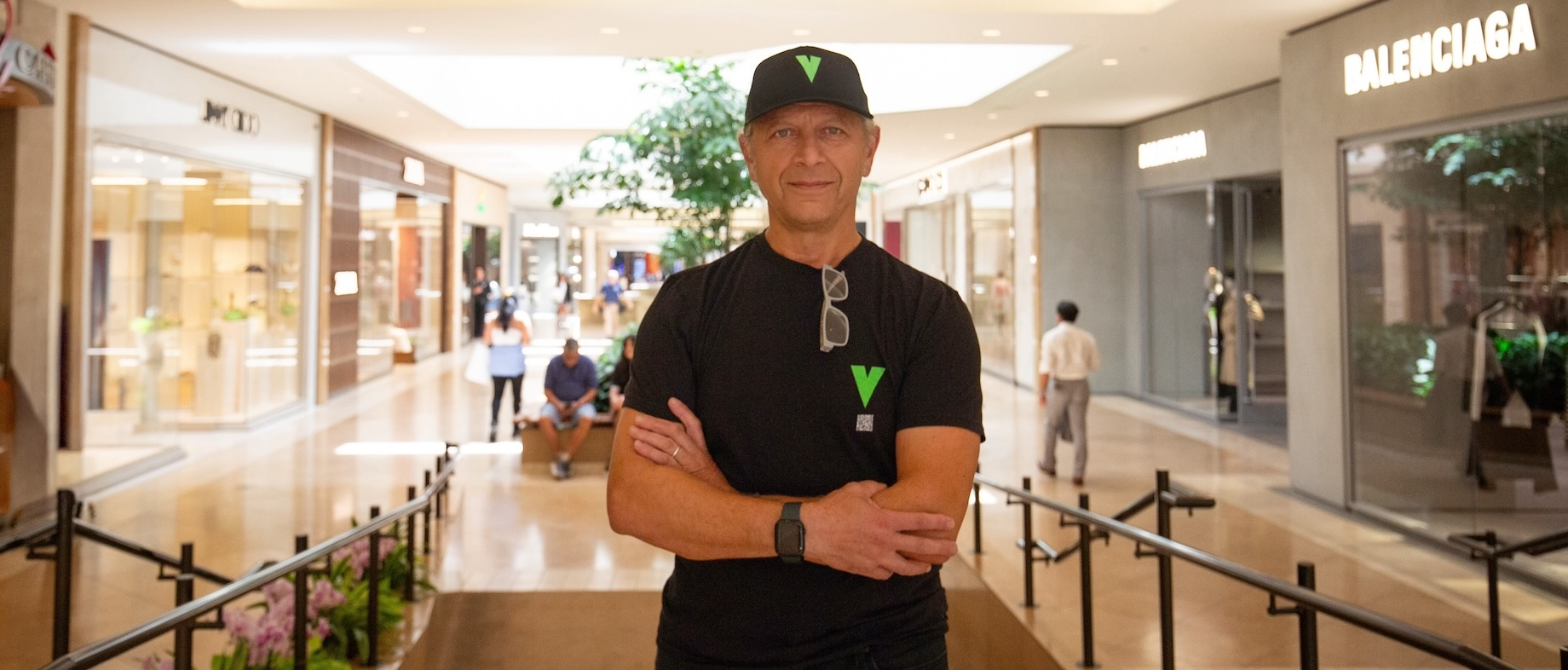
Visional founder Darius Vasefi aims to streamline labor-intensive marketing processes for shopping centers with the Center Demand Engine platform, which helps centers track store promotions and broadcast them to consumers. Photo by Amia Tadjalli
How Visional’s Earlier Technology Shaped Center Demand Engine
Before founding Visional, Vasefi spent more than 15 years working in retail technology, including roles at Accenture and Amazon, and helped launch Walmart Canada’s e-commerce platform.
Visional initially developed live-shopping software that helped retailers connect with customers through live streams. However, store employees lacked the time and resources to use the technology consistently, prompting Visional to shift toward a consumer-facing model with video created by its own people. That provided greater visibility into retail interactions and promotions, and Vasefi came to see such information as a product of its own. “Our data was valuable in more ways than our internal use,” he said.
Now, Visional has introduced Center Demand Engine, a platform that collects tenant promotions and distributes them to shopping center owners and operators. Marketing teams don’t solicit offers from retailers manually. Rather, CDE continuously gathers promotion data from multiple sources. The new-to-market tool does not yet have paying shopping center users, but the data it collects will flow through an API into properties’ websites, email platforms and other marketing tools.
Automating a Fragmented Promotion-Collection Process
The obstacle isn’t a shortage of information but rather the process of collecting it. Many shopping center marketing teams rely on emails, phone calls and tenant portals to stay informed about active promotions. While some landlords have built systems for retailers to submit their current offers, participation is inconsistent.
Plus, retail promotions are notoriously fragmented. One retailer may announce a sale to its customers through email and another through Instagram, while another updates only its website. Promotions frequently change and expire, making stale information nearly as problematic as missing information. “It’s very time-consuming and manual to run after each other for this information, and many store managers don’t have the time to use portals because they’re running their own businesses,” said Vasefi.
Visional collects information from more than 2,800 shopping centers, approximately 70,000 retail stores and roughly 6,000 brands. “The data comes from a range of places. We’re not dealing in last week’s promotions. Freshness is key in retail,” Vasefi said. “Most importantly, we’re going to take away all of the manual work and give [users] a clean set of data.”
Visional uses its proprietary agentic AI workflow to collect and aggregate data from public sources like retailer websites, promotion emails, digital advertisements, text messaging campaigns, social media, third-party sources and its own field agents. The AI agent then would organize, standardize and clean the information.
Delivering Promotion Data Across Marketing Channels
Visional’s API then allows promotion data to flow into shopping center websites and other marketing channels. The company believes automation will lessen the amount of time that property teams spend collecting, formatting and posting offers manually. “The API will be the most important part for centers to automate the process,” Vasefi said. “They can use it in their website automatically, and it can be deployed for their marketing. This is where centers will get the most value.”
The CDE dashboard, meanwhile, provides a visual interface that monitors activity per property. Tabs organize promotions by shopping center, allowing operators to quickly toggle among properties and review tenant promotions across an entire portfolio.
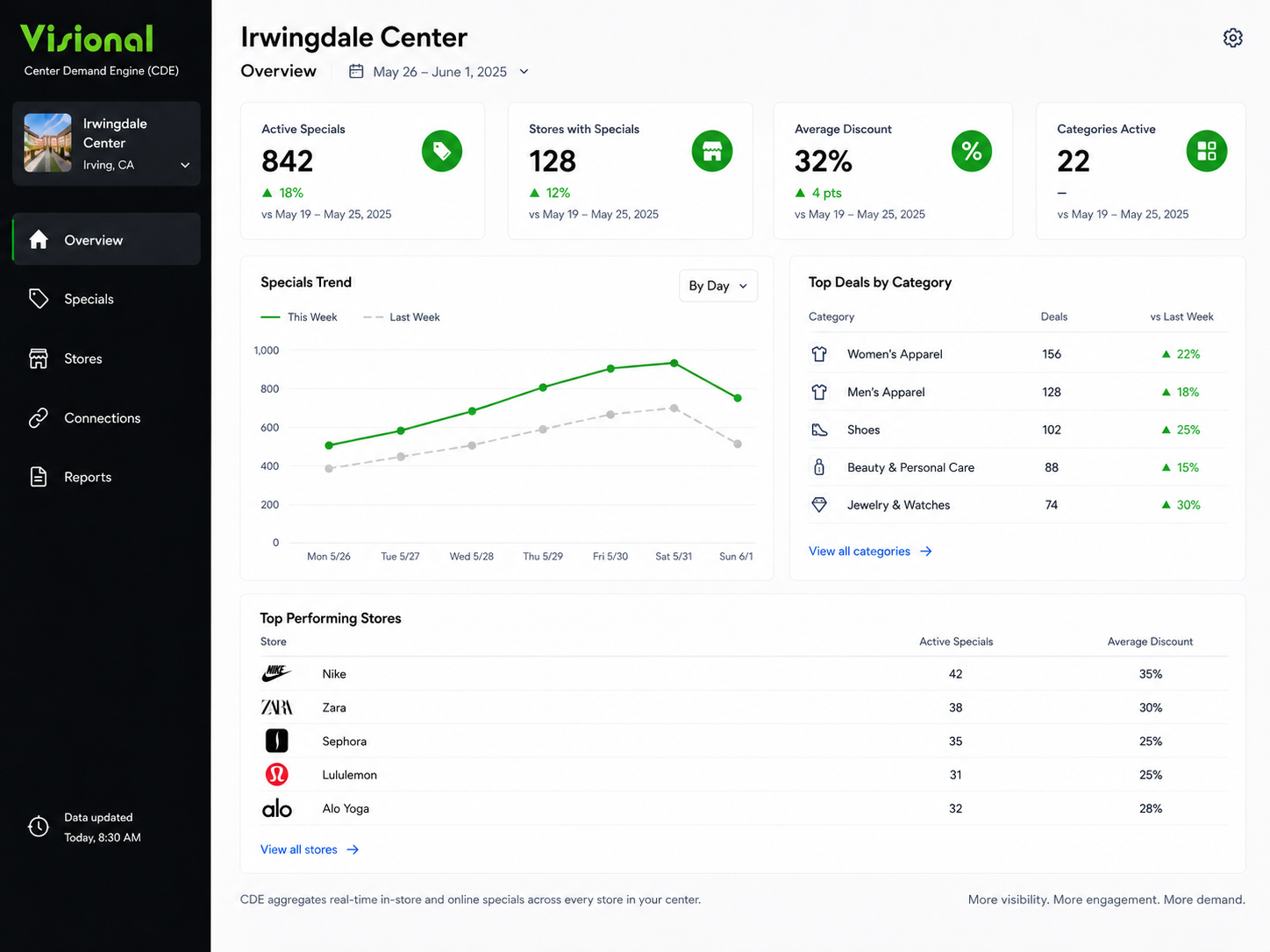
Visional’s Center Demand Engine dashboard, shown here with mock data, illustrates how a shopping center could review data like participating retailers; the number of active promotions; and upward and downward trends in the number of promotions per category, such as women’s apparel, shoes and beauty and personal care. Image courtesy of Visional
The company also plans to distribute the organized trend data through daily reports and business intelligence tools, which could give landlords multiple ways to integrate promotion data into existing workflows. These services would be offered to landlords on a subscription basis.
A Broader Vision for Promotion Data
Visional envisions building not just tech for landlords but also an app directly for consumers that provides a centralized place to browse active sales in their areas. Ultimately, Visional sees the promotion data it collects doing two things: supporting shopping center marketing and enabling consumer discovery. The goal is to make more promotions visible to shoppers and thus create additional opportunities for customer engagement and store visits. “Shopping centers are such an important spot in the local retail ecosystem,” Vasefi said. “Local commerce really needs more help.”
By Halley Bondy
Contributor, Commerce + Communities Today