The Short Version
- The FIFA World Cup is expected to bring $1.47 billion to the U.S. wholesale and retail sectors.
- Areas likely to see a lift include grocers, sporting goods, and experiential, entertainment and dining brands.
- Sporting goods giants Academy Sports and Dick’s expect higher same-store sales, as participation in soccer heats up.
- Other retailers and landlords are launching pop-ups, fan hubs, soccer-themed activations and watch parties.
- Restaurant-anchored World Cup Plaza near Dallas-Fort Worth, recently acquired by Whitestone REIT, is positioned to benefit from adjacency to Toyota Stadium, an official base camp for players and coaches.
Will Soccer Mania Translate Into Revenue for the Retail Sector?
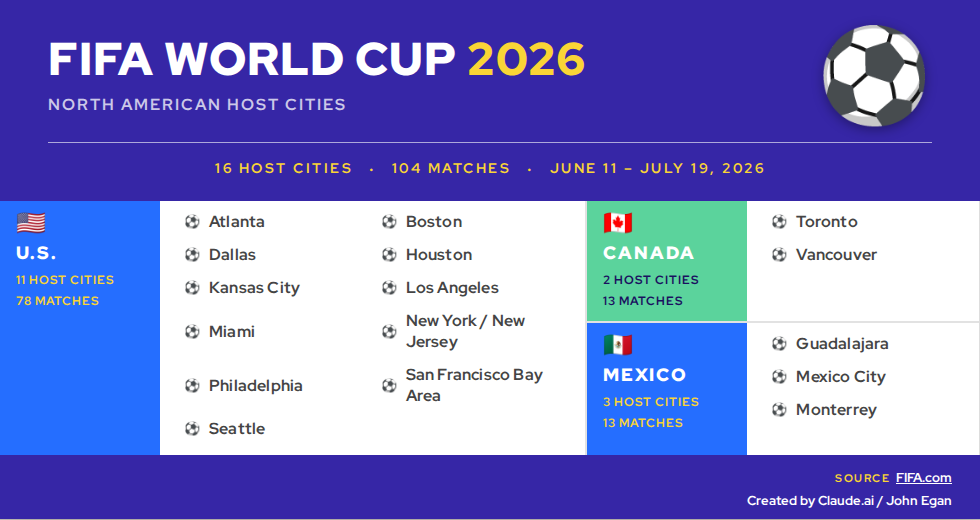
Retail landlords and retailers are gearing up for FIFA World Cup soccer matches across North America with a key goal in mind: Generate revenue with help from promotions, activations, fan fests and more. “This isn’t just a tournament; it’s a cultural event with a gravitational pull that touches sport, music, travel and identity,” global head of YouGov Sport Nicole Pike wrote in YouGov’s FIFA World Cup 2026 Global Brand Handbook. The 104 matches spread around the U.S., Canada and Mexico are projected to attract 6.5 million fans, and the U.S. wholesale and retail sectors are expected to enjoy a US$1.47 billion World Cup bump. That’s according to a 2025 analysis OpenEconomics conducted for both FIFA, the global governing body for soccer, and the World Trade Organization. The three-nation tournament kicks off Thursday, June 11, and ends July 19 — a 39-day shot at scoring financial points in the retail sector.
World Cup Hype Is Real, but Spending Could Be Uneven Across Retail
Despite the hype surrounding the tournament, Coresight Research head of global research and managing director of data-driven research John Mercer doesn’t expect the U.S. retail sector to reap a big windfall from the World Cup. “The big picture is that the FIFA World Cup will drive pockets of spending in retail but a substantial share of overall spending will bypass retail [and] redirect spending from one form of services to another,” he said. Placer.ai director of research Elizabeth Lafontaine said U.S. retailers could see a lift from purchases of goods for World Cup get-togethers. In addition, retail centers in host cities might notice spikes in spending thanks to out-of-market visitors. “Both of these opportunities, however, could potentially be offset by macroeconomic uncertainty among U.S. consumers who might exercise more caution around their spending this summer,” she said.
Grocers and sporting goods retailers stand to benefit the most from the World Cup, according to Lafontaine, from shoppers stocking up for World Cup celebrations to those hunting for World Cup merchandise. Mercer added consumer electronics retailers to the mix of potential World Cup winners. Lafontaine noted experiential, entertainment and dining brands also might generate more traffic during the tournament. “Visitors will look for other activities to take part in,” she said, “and retail destinations are well equipped to entice both domestic and international consumers.”
Whitestone Makes World Cup Bet With Purchase of Stadium-Adjacent Retail Center
Whitestone REIT has made perhaps the boldest retail move tied to the World Cup. Last November, Whitestone acquired restaurant-anchored World Cup Plaza in Frisco, a Dallas-Fort Worth suburb. The property is adjacent to Toyota Stadium, a 21,000-seat soccer and American football venue that will be an official World Cup base camp, primarily serving as a practice facility. Nearby Arlington’s AT&T Stadium, which is temporarily dubbed Dallas Stadium during the tournament, will host all nine of Dallas-Fort Worth’s World Cup matches. Whitestone CEO Dave Holeman said the REIT “opportunistically” bought the 90,391-square-foot World Cup Plaza, which was developed in 2007. “Not only does this center benefit from strong year-round traffic because of its prime location, but we are expecting a surge in visitors in 2026 because of the World Cup and the center’s proximity to Toyota Stadium,” he said. Retail tenants at World Cup Plaza include Blue Goose Cantina, The Green Gator sports bar and grill, Hikari Sushi & Grill, Lemma Coffee Co., Indian restaurant Rotate and Wells Fargo. More recently, in April, Ares Management Corp. agreed to buy Whitestone for US$1.7 billion.
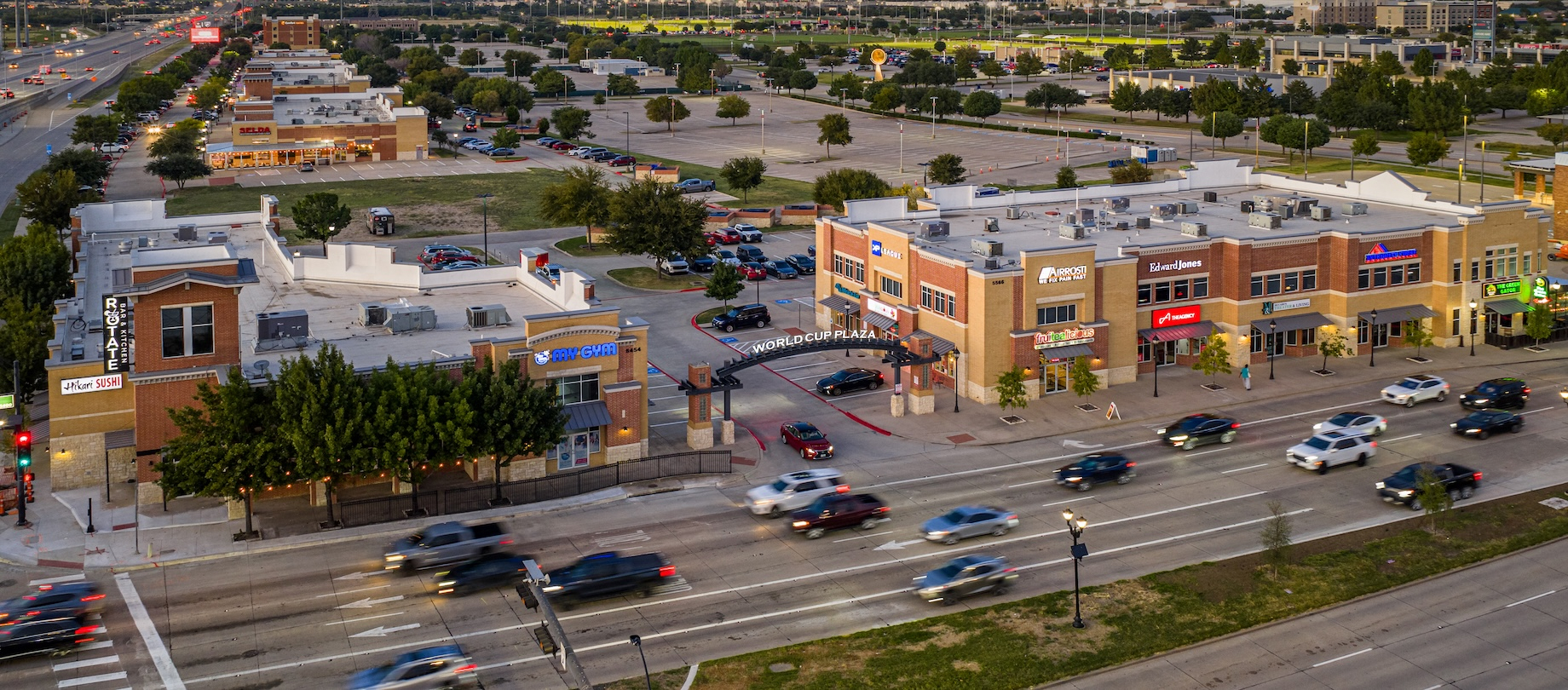
World Cup Plaza in Frisco, Texas, encompasses more than 90,000 square feet. Photo courtesy of Globe Newswire/Whitestone REIT
Pacific Retail, Related, Triple Five and South Florida’s Lincoln Road and Atlantic Village Hope To Turn World Cup Fever Into Foot Traffic
Whitestone isn’t the only retail landlord trying to capitalize on the World Cup.
Pacific Retail Capital Partners is staging its Where the World Unites campaign at 16 of its retail centers. These temporary fan hubs will provide soccer-themed experiences and promotions like watch parties, selfie and photo-op stations, penalty-kick simulators and fan contests. And in the New York City area, official World Cup supporter Related Cos. will host official World Cup merchandise stores and watch parties at Hudson Yards, The Shops at Columbus Circle and Bronx Terminal Market. East Rutherford, New Jersey will host eight matches, including the final on July 19.
Also in East Rutherford, the Triple Five-owned American Dream mall and entertainment complex is taking advantage of its proximity to MetLife Stadium, which is temporarily named New York New Jersey Stadium during the World Cup. The mall is throwing a 39-day World Cup celebration called Dream Fan Fest, featuring celebrity appearances, brand activations, concerts and viewing parties, according to New Jersey Business. “This is a once-in-a-generation opportunity for our region, and American Dream will be at the center of off-the-pitch activity,” said American Dream chief marketing officer Adam Petrick.
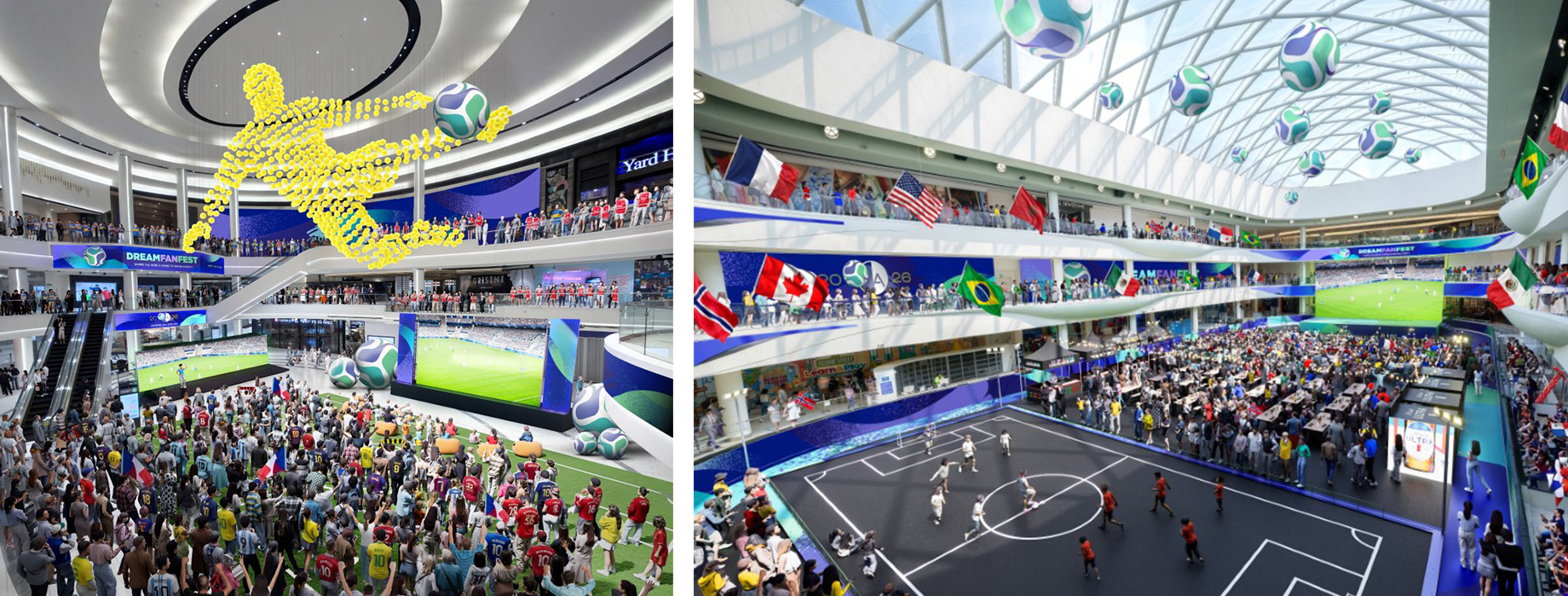
Dream Fan Fest at American Dream in East Rutherford, New Jersey — a city that also will host multiple FIFA World Cup matches, including the final — will include watch parties and a soccer arena. Images courtesy of American Dream
South Florida, meanwhile, is hosting seven matches, and two mixed-use districts in the area are transforming into World Cup “fan hubs” to drive foot traffic, extend dwell times and showcase tenants. In Miami Beach, the eight-block Lincoln Road district will feature watch parties for live matches, immersive activations, experiential pop-ups, sales of global soccer merchandise and dining specials. Soccer-focused retailers along Lincoln Road include Adidas, Culto Futbol, Nike Miami and Pelé Soccer.
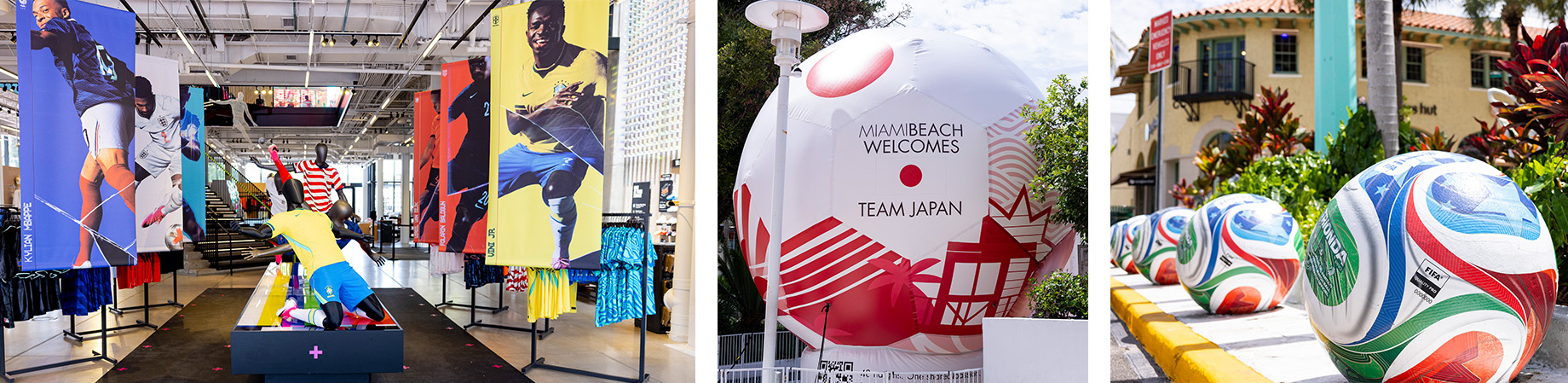
In Miami, one of the FIFA World Cup’s host cities, the Lincoln Road shopping district and tenants like Nike Miami, above left, and Pelé Soccer, at top, are prepared for the tournament and its visitors. Photos above and at top courtesy of Lincoln Road
Thirty miles north in Hallendale Beach, Atlantic Village will host watch parties, highlight 15 food-and-beverage tenants representing cuisines from eight World Cup countries, and offer a kids soccer clinic and other family-friendly activities. “Together, the two destinations speak to a broader retail trend: Landlords and districts are increasingly programming around major cultural moments to give consumers a reason to gather, linger and spend beyond traditional shopping or dining,” said a spokesperson for Lincoln Road and Atlantic Village.
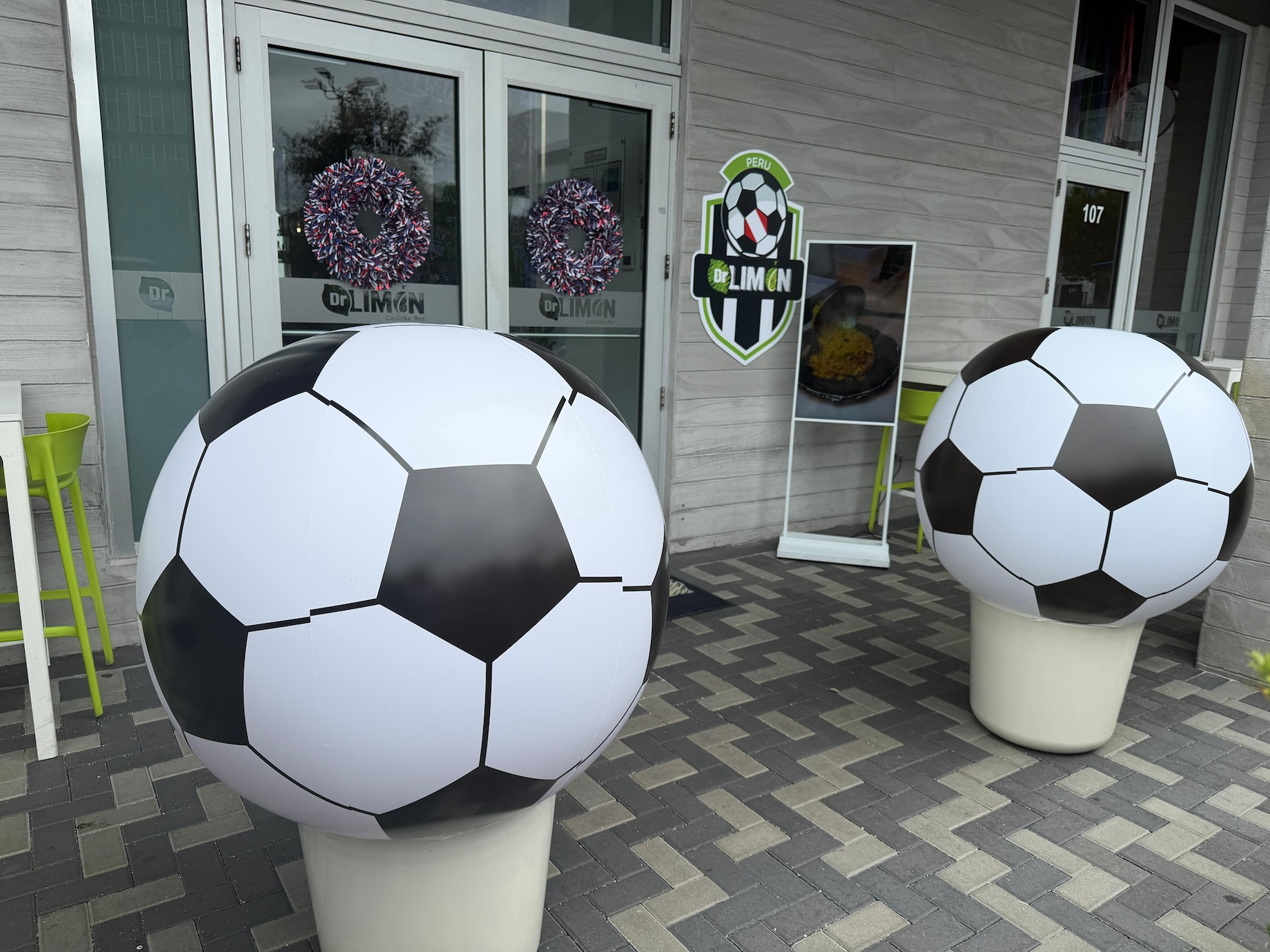
At Atlantic Village in Hallandale Beach, Florida, Peruvian restaurant Dr. Limon Ceviche Bar has dressed itself up for the World Cup. Photo courtesy of Atlantic Village
Sporting Goods Giants Expect a Lift in Same Store Sales
Retailers, too, are poised to benefit from World Cup spending.
Academy hopes for World Cup-fueled sales gains. And it’s in a good position to capitalize on the tournament: CEO Steve Lawrence said on a recent earnings call that about 30 World Cup matches will be played at venues in the company’s territory. As of Jan. 31, Academy operated more than 320 stores. “Longer term, we’ve seen events such as this drive increased participation in … soccer, which should help drive sales in our sporting goods business in the back half of the year and into 2027,” he said. Academy estimates the World Cup will lift this year’s same-store sales by 30 basis points, Lawrence said.
And Dick’s executive chair Ed Stack said on a recent earnings call that with major sporting events like the 2026 World Cup and the 2028 Summer Olympics in Los Angeles, “we’re entering one of the most exciting multiyear periods for [sports] in this country’s history, making it an incredibly powerful and compelling platform for consumer engagement today.” As of May 2, Dick’s operated nearly 3,400 stores under 11 banners. Driven largely by the World Cup, Dick’s expects higher same-store sales for the first half of fiscal year 2026, which started on Feb. 1, said executive vice president and CFO Navdeep Gupta. President and CEO Lauren Hobart added: “We’re feeling [the] excitement in North America going into the World Cup.”
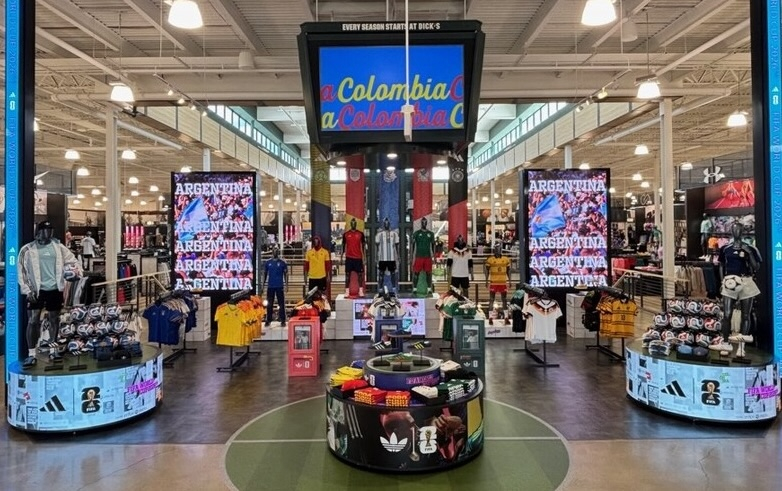
Dick’s Sporting Goods has set up World Cup displays to entice shoppers. Photo courtesy of PR Newswire/Dick’s Sporting Goods
By John Egan
Contributor, Commerce + Communities Today