The Short Version
- Retail landlords are gaining faster, deeper tenant insights — like retailer sales, financial health, credit risk, traffic and location analytics — accelerating leasing and asset management decisions.
- Tenant data platforms like RetailStat, Guesst, Placer.ai, CenterXY and CenterCheck are making sales reporting easier and tenant data more accessible, improving landlord-tenant collaboration.
- Landlords now can use conversational AI and large language models to analyze integrated datasets, identify business patterns, assess credit risk, evaluate expansion opportunities and generate actionable insights more quickly than with manual analysis.
- Data warehouses and business intelligence platforms enable proprietary tools, such as Brixmor’s co-tenancy analysis, to fuel smarter leasing strategies.
Tenant Data Is Coming Into Sharper Focus for Landlords
Retail chains and third-party platforms are handing landlords more AI- and analytics-ready data, a trend that is both accelerating deals and yielding new insights into tenant performance. “Fundamentally, well-known vendors still collect the same types of data — for example, shopper spend or POS transaction data,” said GGP vice president of information technology Derek Veren. “What’s changed is: They’re able to package and deliver that data in new ways.”
Platforms that built their businesses on landlord advisory and other hands-on work now offer data products that plug directly into landlords’ own systems. RetailStat, for example, uses an API to deliver retailer location analytics, financial health and credit risk to landlords and other clients. Guesst uses the same type of software-to-software link to pull in sales and rent data from tenant point-of-sale systems.
Some real estate tech platforms tout their use of the Model Context Protocol standard, which allows large language models to pull structured data from a company’s information feed, Veren said. “It’s fascinating that those conversations have shifted away from being largely informal to ‘Hey, we have a data feed, MCP and an API. We can funnel you the data,’” he said. “That never would have happened several years ago. The barrier to entry is so much lower, and everybody’s working together faster, which is great.”
Key to that speed is that landlords have put so much manual work in the rearview mirror, thanks to APIs, data integration and AI automation. “It used to be like ‘OK, here’s your Excel report’ or ‘Here’s your PDF.’ It could be a 20,000-row spreadsheet,” Veren said. “Our job was to bring in a data scientist, find an application and just figure out what to do with that file. It took a long time. By the end of it, the data might already be stale.”
Retail Tenant Data Platforms Are Getting Better by the Day
The volume and variety of data also continue to grow. For starters, Veren said, data efficiency is the norm for today’s crop of tech-savvy, digitally native brands and for many of their vendors, such as payment processor Stripe and e-commerce platform Shopify. It makes for quick exports of standardized, automatically recurring sales reports, in some cases integrated with landlords’ systems via third-party platforms like Guesst. “We at GGP have a much easier time handling that data” now, Veren noted. “The vendors have these pre-built connections. … Everything is just getting easier.”
This ease of data sharing also applies to a longstanding sticking point between retail landlords and tenants: tenant sales. Beyond their proprietary concerns about sharing their sales figures, tenants also have chafed at the manual work such reporting would require. “It’s a better experience all around,” Veren said. “You’re not dealing with a mess of offline spreadsheets and reports that need to get reconciled. It’s just making it far, far less burdensome and more natural to do on a recurring basis, so you’re certainly getting an increased frequency and more cooperation along the way.”
Third-party platforms also continue to refine the retail tenant data they offer. Landlord-side research and tech sources pointed to companies like:
- Placer.ai, a geospatial data platform that helps landlords zero-in on tenant prospects, analyze visit trends, demonstrate center performance and gain insights by combining visitation, demographic, psychographic and behavioral shopping data.
- CenterXY, which tracks more than 32,000 shopping centers with at least 50,000 square feet of gross leasable area and offers tenant rosters, center characteristics, location data and more for market analysis and leasing.
- CenterCheck, which estimates store-level sales performance using anonymized credit and debit card transaction data and provides shopper demographics, trade-area insights and reporting for users that include landlords, brokers, investors and retailers.
Most such platforms have made impressive improvements in visual appeal and utility, Veren said. “They’re genuinely pleasant tools to deal with now. Put them in the hands of an executive or asset manager, and they can get a very solid understanding of the landscape without having to necessarily be a data scientist or an analytics person.”
NewMark Merrill Cos. president and CEO Sandy Sigal pointed to the evolution of RetailStat, formerly Creditntell. Sigal’s company has received financial and credit data from the platform for about a decade. RetailStat now offers built-in slicing and dicing — branded as RetailStat AI — of data related to credit risk, location strategy and grocery performance. “When we first started working with RetailStat, it was a basic consolidator of public reporting,” Sigal said. “They are doing much more of that now, with good analysis tied into it. They’re also bringing in observations that were not traditionally part of an analyst’s purview, such as actual traffic data.”
That shift has changed the way Sigal interacts with retail tenant data. “Two years ago, my job was to look at a lot of data, draw a conclusion and convey it to my team,” he said. “Today, the conclusions are being partially drawn by the AI. It’s making the associations, and then we’re just asking questions and adding to it with our knowledge.”
NewMark Merrill employees rely on their own store visits and internally available data to understand how individual operators in its portfolio are performing, Sigal said. RetailStat’s role, then, is to deliver chainwide information that includes margin deterioration, debt maturities, capital versus operating expenditures, wage pressure and expansion, and store-closure plans. “These are more macro data points,” Sigal said, “but they absolutely have a center-level impact.”
Analytics Engines and Data Warehouses Lay the Groundwork for AI Insights
An effective approach for landlords is to integrate third-party data streams with their own internal data in an enterprise data warehouse — a centralized system that allows different tools and teams to glean information — said Brixmor vice president of research David Spawn.
The landlord then can combine an analytics platform like Microsoft Power BI with AI to make it easy for users to query the data in conversational language. “We have about seven tools out there now that allow people to get to better answers more quickly without always having to stop and ask us for that information,” Spawn said. “Everybody across the company can use it.” Those tools cover things like the co-tenants that different anchors prefer, how far national or regional operators are from specific Brixmor properties, and trends related to traffic, bank deposits and grocery sales.

Leasing agents and other Brixmor employees benefit from access to analytical reports on performance and traffic for grocery anchors like Kimberton Whole Foods at Brixmor’s Collegeville Shopping Center in the Philadelphia suburbs. Photo courtesy of Brixmor Property Group
The company first rolled out Power BI in August 2021. “We realized we could actually address multiple questions and get it into dashboards that are frankly easier for leaders and agents to review and to understand,” Spawn said. The first of Brixmor’s customized Power BI research tools launched in March 2023 and focuses on co-tenancy analysis, Spawn said. Another example is Brixmor’s Best Fit Analysis tool, which integrates internal leasing data with external demographic and geospatial data. “We could send an opportunity set out to retailers like J.Crew or Pandora and say, ‘Not only do we have space available now at the center, but we also have it in the sizes that you need,’” Spawn explained. He added that Brixmor also could say to a retailer: “If you need a gym and a grocery tenant in the center but you do not want to have a specific apparel competitor within five miles, here’s your list of opportunities.”
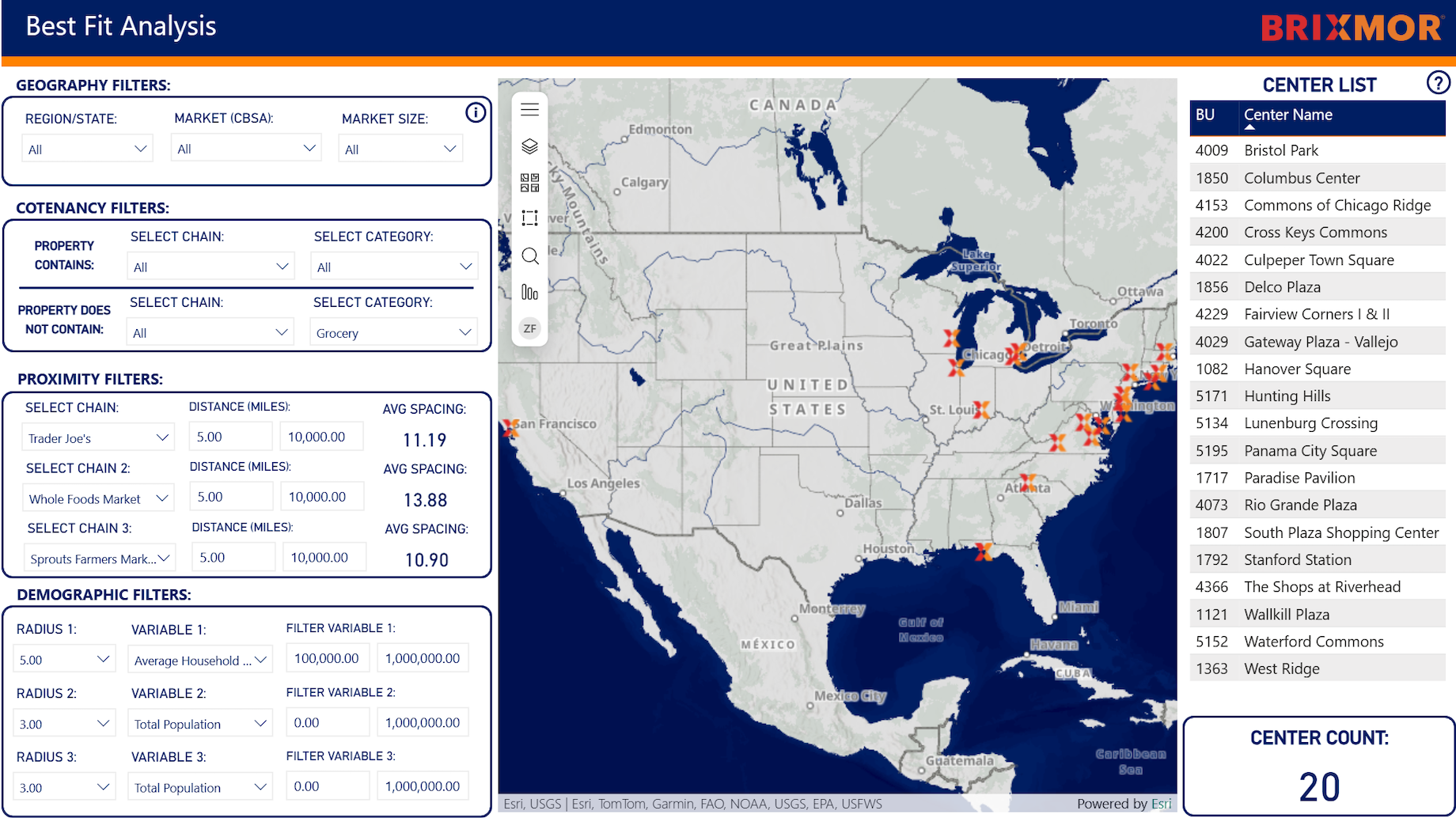
Using a data warehouse and an analytics engine, Brixmor slices and dices both internal data and data provided by third-party platforms. Among the uses Brixmor has developed is the above Best Fit Analysis tool, which allows leasing teams to unearth and communicate well-matched availabilities to leasing prospects. Image courtesy of Brixmor Property Group
As Veren sees it, a well-maintained and thoughtfully managed enterprise data warehouse is pivotal for landlords seeking to work constructively with AI. “That has been one of the keys to what we’ve been doing,” he said. “It’s important to remember that AI can be garbage in, garbage out. It’s really easy to say, ‘I’m going to throw AI at this,’ but if your corpus of data is junk, then AI is just going to give you junk back.”
Landlords Are Using Guardrails and Human Expertise To Quality-Control AI Reporting
Vestar vice president of technology and systems Bill Williams continues to explore how to use AI to analyze new datasets related to retailer performance. One example is the potential use of satellite imagery to analyze parking lot activity across Vestar’s portfolio. Vestar could combine this data with AI-powered conversational queries to better understand the relationship between traffic patterns and retailer performance, he said.
Already, the company has “seen AI deliver real value in solving well-defined problems with strong data,” he said. At The Gateway in Salt Lake City, for example, Vestar’s parking operations rely on AI-assisted platform AirGarage for license plate recognition, payment processing and dynamic pricing. “It works because the problem is specific, the data is relevant and the technology is being applied with a clear purpose,” Williams said.
He stressed the need for guardrails and human oversight, however: “AI analytics is great, but it gets you only about 80% of the way there. Ultimately, you need the intuition and insight of that leasing agent or property manager. Their experience is invaluable. It’s still a community business. You’ve got to know the area and the people and get the right tenant mix. There’s no magic AI tool to replace that.”
Keeping such caveats in mind, landlords’ research and tech teams are optimistic about the future of data. “There’s just so much more that we can figure out about how to integrate all the different new data sources,” Spawn said. “The more we do that, the clearer the picture will get.”
By Joel Groover
Contributor, Commerce + Communities Today