The Short Version
- More than two decades ago, eight artists created a hidden apartment inside Providence Place, turning the shopping center into one of retail real estate’s most unusual stories.
- The 2024 Netflix documentary “Secret Mall Apartment” revived interest in the project and prompted Providence Place to revisit that period in its history.
- The mall’s 2025 activation featured documentary screenings, a re-creation of the apartment, art installations, workshops and partnerships with local schools.
- The activation helped repair Providence Place’s relationship with the local arts community, increased mall traffic 16% year over year during its first four Saturdays and earned Gold in the 2026 ICSC MAXI Awards.
Reframing the Secret Mall Apartment Story
More than two decades ago, eight artists quietly transformed an unused space inside a Rhode Island shopping center into a hidden apartment, where they lived for four years until security busted them in 2007. Conceived as a social experiment and political statement about gentrification and artist displacement in the area, the clandestine apartment became one of retail real estate’s most unusual stories, inspiring the 2024 Netflix documentary “Secret Mall Apartment,” produced by Jesse Eisenberg. For Providence Place, however, the episode remained an uncomfortable chapter in its history.
That changed last year, when the mall used renewed attention from the documentary as an opportunity to engage the community. Providence Place, managed by Centennial since 2024, re-created the secret apartment inside its cinema and surrounded the installation with art exhibits, workshops and interactive digital experiences that invited visitors to revisit the story from a new perspective.
The activation earned Gold in the 2026 ICSC MAXI Awards for helping Providence Place strengthen its local ties. “The main lift for us was that we reintegrated ourselves into the community,” said Anna Colvell, marketing manager at Centennial. “Providence is such an artistic place and such a community-focused place. This was a spot in our history that had become controversial and had alienated some of our community. This was a wonderful opportunity to mend that relationship.”
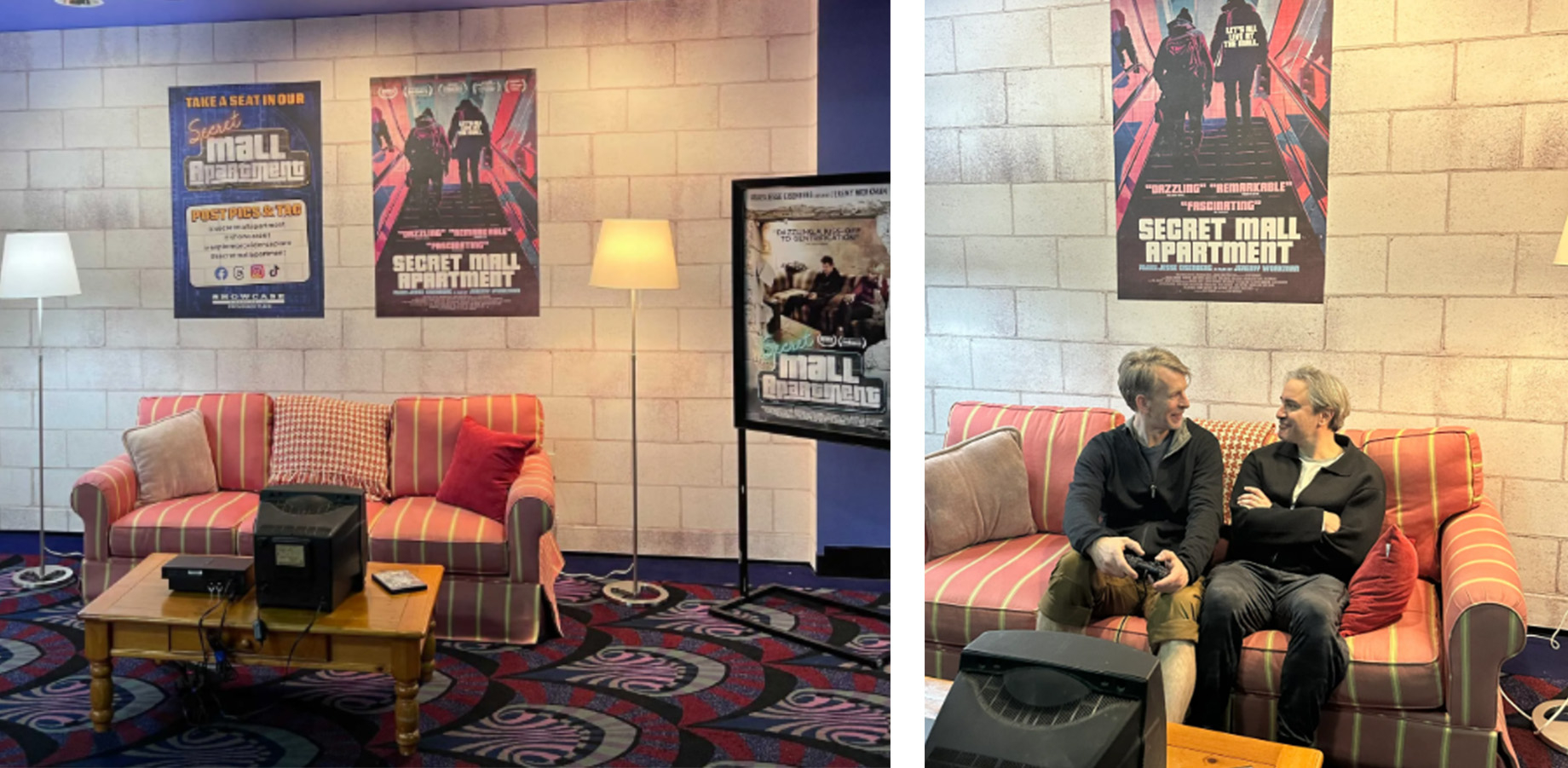
A period-accurate re-creation of the original secret mall apartment sits in the cinema lobby at Providence Place. At right, Michael Townsend, founder of the artist collective behind the apartment, sits with Jeremy Workman, director of the documentary “Secret Mall Apartment.” Photos courtesy of Providence Place
From Hidden Space to National Headlines
In 2003, the Tape Art collective — founded and led by local artist Michael Townsend — discovered a 750-square-foot unused, unmapped space underneath the mall’s movie theater. They outfitted the space with furniture, as well as a false, 5,000-pound wall made of cinderblocks. They connected the “apartment” to the mall’s electricity, ate at the food court and bathed in restroom sinks. Four years later, they were caught and charged with trespassing. Townsend was banned from Providence Place. The discovery made national headlines at the time, and through the years, the episode loomed quietly and strangely over the property.
The documentary’s release presented the property’s management team with a choice: keep distancing itself from the episode or lean into it. “What makes this so interesting is the embracing of the controversy, not hiding it and not avoiding it,” Colvell said. “There’s a lot to be said by looking at controversial moments or awkward moments and asking how we can make them into something positive and restore something that may have been lost.”
Welcoming the Artists Back and Re-Creating the Apartment
The initiative launched in March 2025 with documentary screenings at the mall’s movie theater featuring a Q&A with director Jeremy Workman and Townsend. Several other artists also participated, including fellow Tape Art artist Leah Smith and Colin Bliss, who donated a wooden scale model of the mall for display. Before the first showing, Providence Place formally lifted the ban on Townsend, who had been the sole person at the site when the apartment was discovered. “Our general manager and our security director made the announcement that his ban had been lifted and that we were welcoming him back with open arms,” Colvell said. “It was a really heartwarming moment. Everyone shook hands, and it was great.”
The centerpiece of the campaign was a re-creation of the secret apartment. “We had period-accurate couches, coffee tables and electronics,” said Colvell. “We had the old television and gaming systems set up. When people walked in, they saw it and thought: ‘Oh my gosh, what is that? That’s so cool.’”
Rather than returning it to its original location, Providence Place reconstructed the apartment in the cinema lobby, where it doubled as a photo opportunity for documentary viewers and curious mall visitors. The activation also extended throughout the center with Townsend’s signature tape-art installations depicting the artists behind the original apartment project.
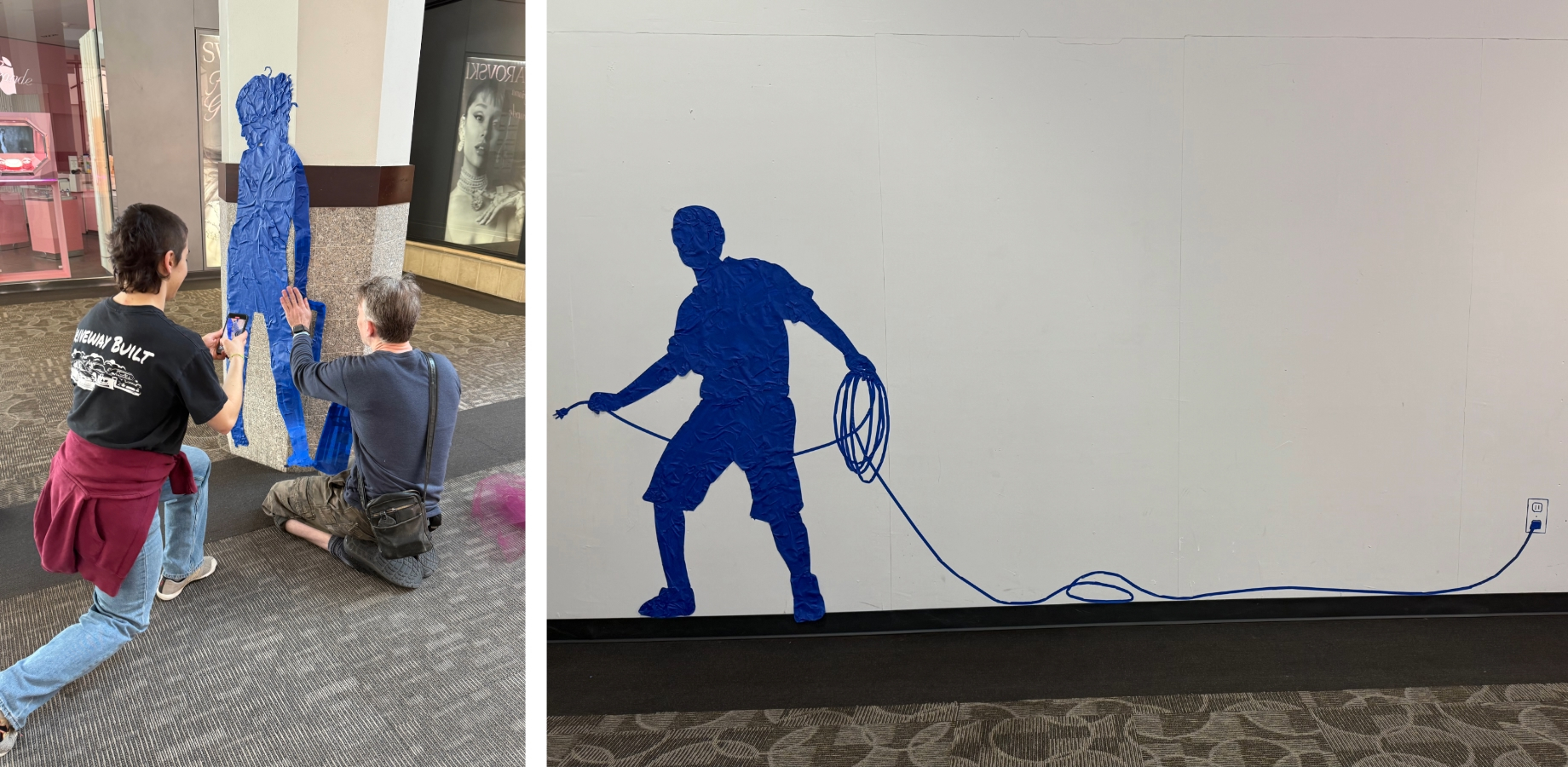
At left, Townsend creates tape art with artist Leah Smith for the 2025 activation. Some silhouettes depicted objects the artists brought into the hidden apartment, including the extension cord used to supply electricity, shown at right. Photos above and at top courtesy of Providence Place
Reconnecting With Providence’s Arts Community
The campaign incorporated workshops, artist collaborations and partnerships with local schools. Artist-led workshops and student-designed installations helped Providence Place forge new connections with the local arts community.
Townsend’s Tape Art nonprofit, which centers on large-scale murals made from tape, held workshops in August that resulted in tape creations spanning two floors of the mall, while Rhode Island School of Design students created an interactive, augmented reality installation inspired by the secret mall apartment.
For the property’s management team, the activation represented an opportunity to embrace the city’s creative identity. “Art is really important to Providence. We wanted to welcome the community and say: ‘Let’s figure out how to make the best of a weird situation,’” said Colvell.
QR codes alongside the tape-art installations invited visitors to continue exploring the project online. The codes directed guests to Tape Art’s Instagram page, where they could view behind-the-scenes footage, learn more about the artists and the project’s history, watch videos like Townsend carrying cinderblocks through the mall and discover content promoting the documentary and the collaborative installation.
Turning Curiosity Into Traffic and Engagement
The campaign attracted not only visitors who came specifically for the exhibit but also shoppers who discovered the installations after arriving at the mall. “The nature of the story and how unusual and outlandish it is really got people’s curiosity going,” Colvell said.
The first four Saturdays of the activation generated a 16% year-over-year increase in mall traffic, and average dwell time rose from the comparable period a year earlier. Earned media exceeded 300 placements and generated more than 3 billion impressions. Campaign organizers also reported approximately $28 million in advertising value equivalency and a return on investment exceeding 6,600%.
The activation earned coverage from national outlets like The New York Times and Bloomberg, while the documentary itself has continued to draw attention to the original story.
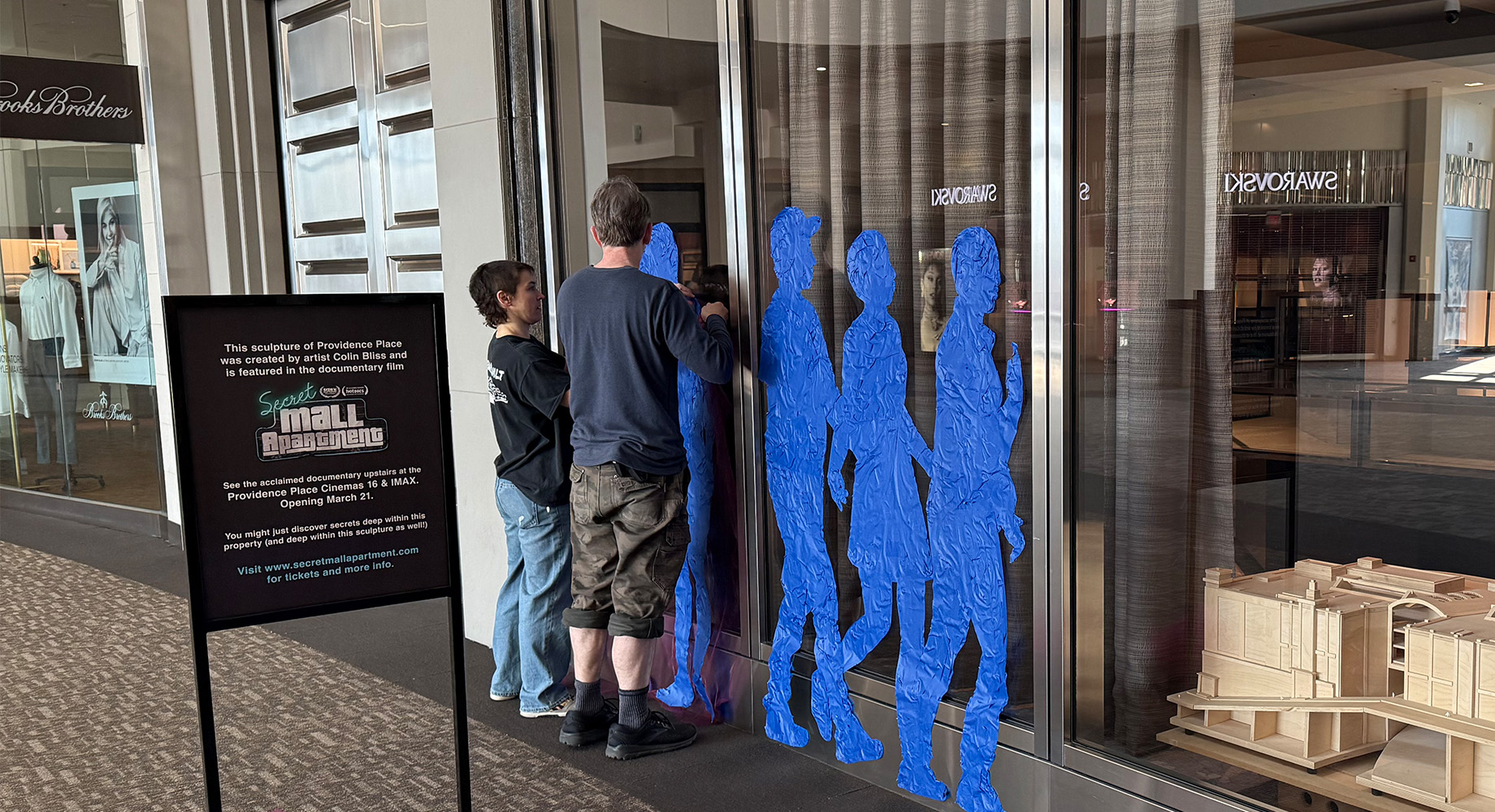
Smith, left, and Townsend install tape-art silhouettes at Providence Place. Beside them is a wooden scale model of the mall created by local artist Colin Bliss. Photo courtesy of Providence Place
Moving Forward by Looking Back
While the activation ended in October, the cinema at Providence Place continues to host occasional film screenings with Q&As. The Secret Mall Apartment campaign demonstrated that a retail property can revisit an unusual part of its history and use it to strengthen ties with residents, artists and visitors.
Following the project’s success, the mall expanded its partnerships with artists and arts organizations through its rotating Art Wall gallery. The space now hosts exhibitions, artist receptions and community events, extending the installation’s momentum. Recent programming has included “Black Love,” a collaborative exhibition by four local artists exploring themes of love, identity and community, and “White Horse,” a solo photography exhibition by Deanna Camp. The artists behind “Black Love” said the Secret Mall Apartment activation, together with work by Townsend and Smith, helped inspire the exhibition, underscoring the project’s lasting influence on Providence’s creative scene.
“It’s all about the nature of having to evolve and learn from our past and be adaptable,” said Colvell.
By Halley Bondy
Contributor, Commerce + Communities Today