The Short Version
- Phillips Edison has added AI-powered, natural-language search capabilities to its property database, allowing brokers and retailers to search availabilities through conversational prompts.
- The tool draws exclusively from Phillips Edison’s property data and can refine results based on factors such as location, space size, property characteristics and intended use.
- The REIT is tracking search behavior, property engagement and leasing inquiries as it plans refinements and explores additional AI applications across the company.
A Conversational Approach to Retail Property Search
To make it simpler for brokers and retailers to unearth space availabilities in its portfolio, Phillips Edison just launched an AI-powered front door to its property database.
Phillips Edison touted a 97.3% occupancy rate as of June 30, but vacancy certainly will loosen across the industry at some point, and AI will be ready to help the property owner compete for tenants. The company’s revamped corporate website puts a natural-language search layer, similar to ChatGPT or Google Gemini, over its leasing portfolio of more than 300 grocery-anchored retail centers.
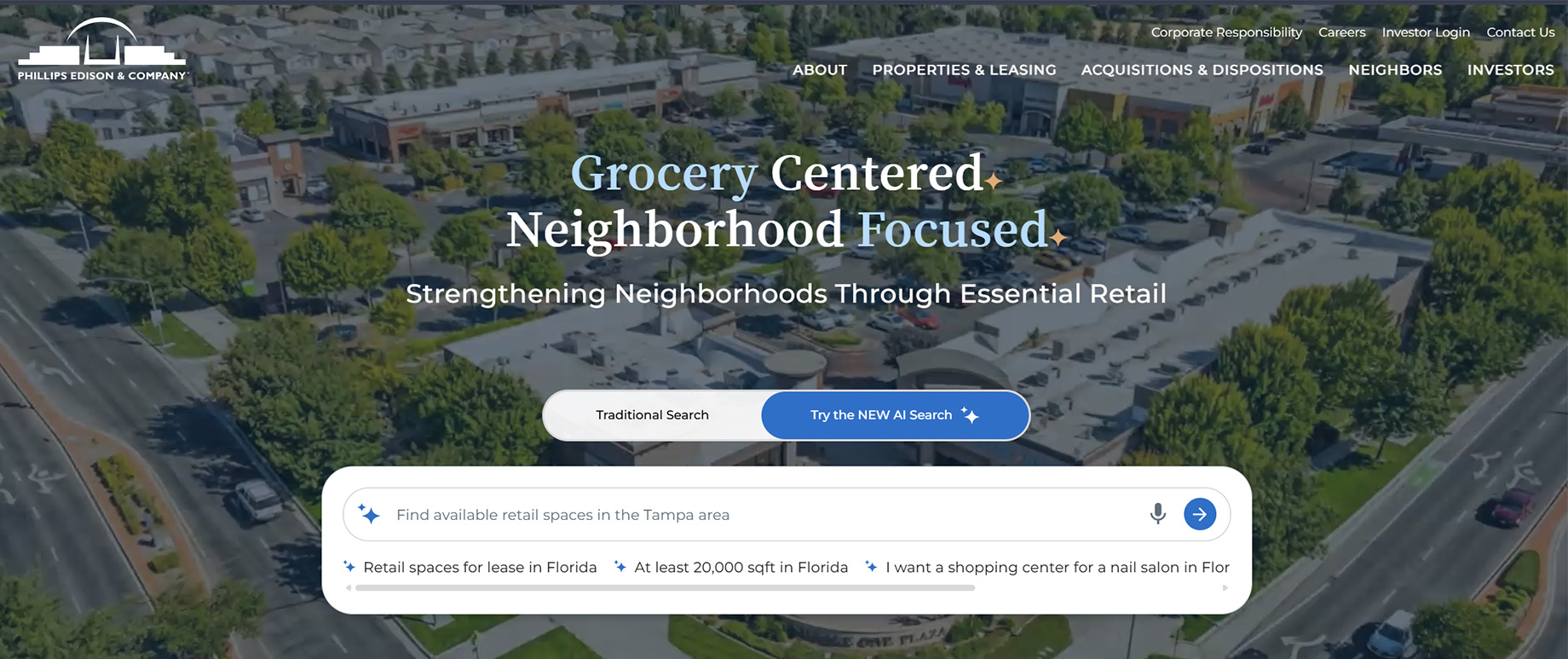
Phillips Edison has added an AI-enabled, natural-language search layer over its leasing portfolio of more than 300 grocery-anchored retail centers. Image courtesy of Phillips Edison
Brokers and retailers that once used a filter-and-drop-down navigation — choose a state, pick a market, set a square-footage range and scroll the results — now can treat site selection within the REIT’s portfolio more like a back-and-forth conversation. Phillips Edison’s revamped website offers a dedicated AI search bar and an “AI mode” to guide the conversation.
CEO Jeff Edison said the update is the REIT’s latest initiative to “translate AI prompts into perfect property placement,” supplying data about Phillips Edison’s portfolio to brokers and retailers “to help them identify spaces that fit their needs and support their growth with greater speed and clarity.”
When a retail real estate broker, for instance, uses the website’s AI functions, the broker can provide natural-language prompts to generate details about location, square footage, property characteristics and intended use, said Phillips Edison senior vice president of marketing Ben Williamson.
How Brokers Can Search the Portfolio With AI
A broker could start by typing: “Find available retail spaces in the Tampa area” into the AI search bar. That prompt would produce a list of eight property matches, and the broker can click on those results for more information or add the properties to their favorites. The broker then could target the search further by entering: “Narrow down to restaurant spaces that are at least 1,000 square feet” into a prompt window on the right side of the screen. This prompt surfaces two restaurant spaces. The broker can tweak the search by entering “Expand radius to 100 miles within the Tampa area,” which would generate a list of four restaurant spaces measuring at least 1,000 square feet.
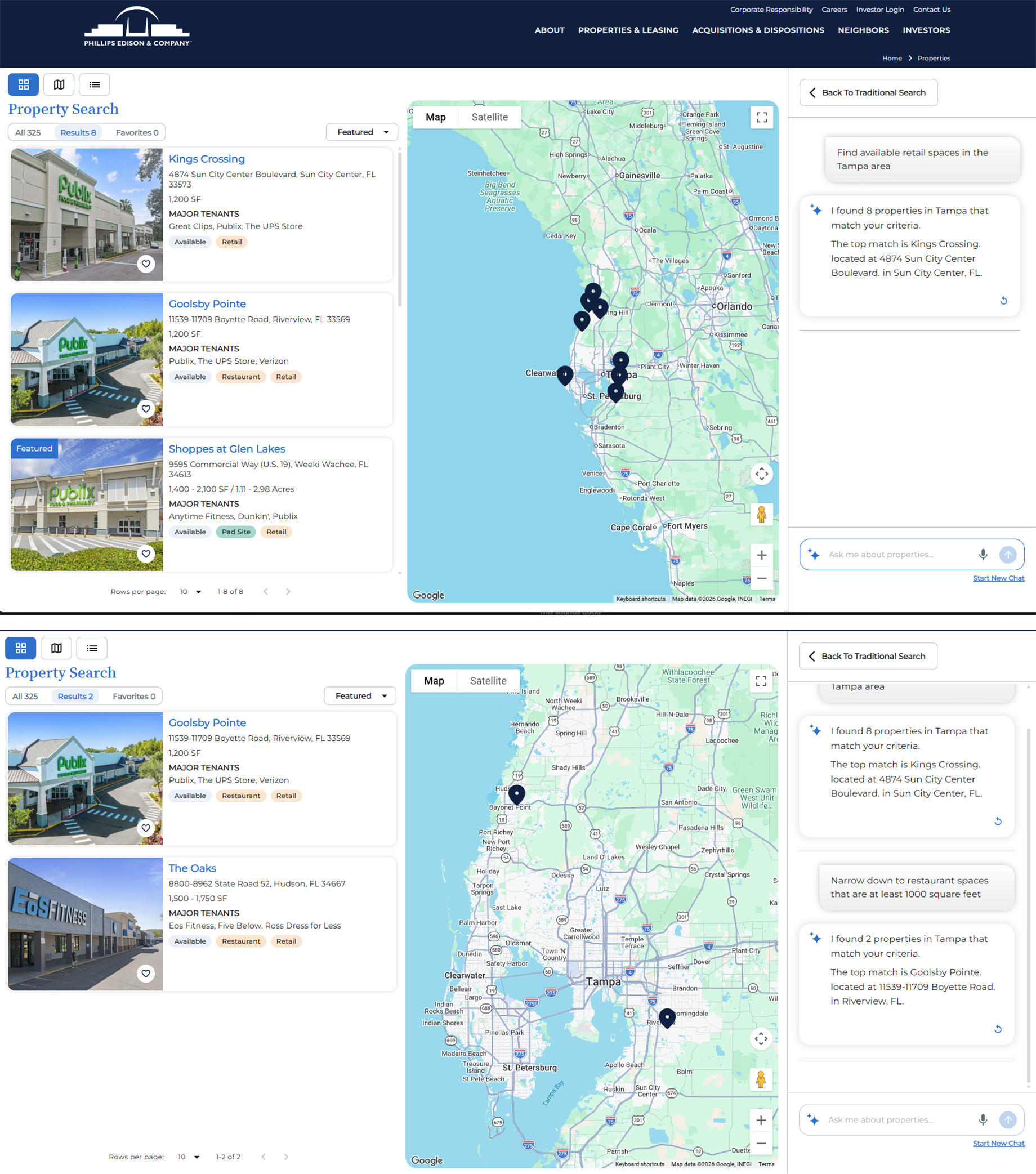
This example shows how Phillips Edison’s AI-powered search lets brokers refine property results through conversational prompts, narrowing a Tampa-area search by use, square footage and radius to identify matching restaurant spaces. Images courtesy of Phillips Edison
Williamson said Phillips Edison’s AI system can make adjustments based on aggregated search activity: “If search trends indicate strong interest in fast-casual locations beyond simply searching for restaurant locations, we can enhance the way our property data is categorized so the platform delivers increasingly relevant results to create a stronger user experience.”
The AI tools draw only on data from the properties section of Phillips Edison’s corporate website. In other words, they don’t tap into third-party data. Property data refreshes each night.
The AI does not negotiate leases, value properties or tackle other tasks on the operations side, according to Williamson. Nor, he said, does the AI integration replace traditional searches on the corporate website. “Our traditional search remains a great resource for brokers and retailers to find properties in our portfolio. Within the traditional search process, we provide the standard approach to search by criteria, such as the property name, city and state,” he said. “Results following traditional search can then be filtered down to such features as use type and square feet. It’s important for us to keep that for audiences that prefer it.”
Tracking How Brokers and Retailers Use AI Search
By introducing the AI-boosted website, Phillips Edison is striving “to be out ahead of where human behavior is going,” said Williamson, citing the rising use of ChatGPT and other AI tools in people’s everyday lives.
Because the platform launched only recently, Phillips Edison is still establishing a baseline for metrics. Chief information officer Gary Bailey said the company is tracking how people use the AI search functions — what they search for, which properties they engage with and prefer, and how often searches convert to information requests or leasing inquiries. Over time, that data should let Phillips Edison measure adoption and see how effectively the tool moves brokers and retailers toward actual leases, he said.
Where Phillips Edison Sees Its Distinction
Phillips Edison said it believes its AI search tool is unique among shopping center REITs, based on its own survey of websites operated by its peers.
Kimco Realty, another owner and operator of grocery-anchored properties, introduced its own tech-driven approach to surfacing vacancies in 2024. Kimco created AI-powered vacancy detail webpages that update marketing information on those availabilities automatically. Kimco picked up a Gold in the 2025 ICSC MAXI Awards for this project.
“How we serve brokers and retailers is the core focus behind our AI website enhancements,” Williamson said. “Seizing on the growing trend of how people request and access information through AI prompts makes sense for us, as we always strive to be a partner of choice providing great service. We’re introducing innovation in a way that takes property data we already have publicly available and presenting information to our audiences through an AI-integrated experience.”
Extending AI Beyond Property Search
Bailey said the new property-search experience stems from Phillips Edison’s broader strategy of grounding AI in “clean, governed data” and refining it through search trends and user feedback. The owner already is mapping out the next phase of its AI search tool, he said, with plans to improve property-match rankings, make the search experience more conversational and precise and simplify the process for interested users to contact its leasing team.
The REIT’s AI ambitions extend beyond property search. Bailey said Phillips Edison is exploring how AI can deliver value across the company, from coding agents that speed up software development to “knowledge centers” powered by large language models. It also is weaving AI-driven recommendations into everyday workflows and training employees to put AI to work in their daily tasks.
AI and technological advances like the new search capabilities are “not a one-time initiative but an always-on mindset,” Edison noted. “We are implementing initiatives that position [us] as an early adopter,” he said, “and we are excited about what’s next.”
By John Egan
Contributor, Commerce + Communities Today