The Short Version
- Machete Group is shifting the mixed-use sports district playbook from event-driven districts to place-driven environments that perform year-round.
- The firm plans projects to benefit from stadium adjacency without relying on game-day traffic as the only driver of demand.
- Active developments and proposals in Orlando, Louisville and metro Atlanta illustrate how the model translates across markets and asset mixes.
From Event-Driven Districts to Place-Driven Mixed-Use
Sports-driven mixed-use districts continue to make headlines as developers and communities leverage the energy of surrounding stadiums to fuel development. The trend is hardly surprising to David Carlock, managing partner of Machete Group, a real estate, entertainment and sports planning and development firm. The company develops stadium- and arena-adjacent mixed-use districts. Early versions of the model focused on entertainment to capture event traffic. The company’s goal today, though, is to build projects that “can stand on their own two feet” year-round, he said.
Machete Group’s model evolved over time, he added, especially as the costs of capital, land, construction materials and labor have increased. “The shift that has occurred in our minds has been to create place-driven projects where people will actually want to live and hang out even on a Tuesday afternoon when there isn’t an event,” Carlock explained. “The projects will still benefit from their adjacency to an arena or stadium or ballpark, but they need to be designed to have a center of gravity that is independent from those venues.”

Machete Group, JMA and the owners of the NBA’s Orlando Magic expect to break ground this year on a $500 million, 1 million-square-foot residential, hotel, retail and entertainment project next to the Kia Center arena in downtown Orlando, Florida. Image courtesy of Lifang
How Machete Group Developed Its Place-First Approach
Carlock founded Machete Group in 2007, summoning 13 years of experience that included planning entertainment and resort projects for The Walt Disney Co.; navigating Hard Rock Cafe’s entrée into hospitality, gaming and live performances; and overseeing the design and construction of the Toyota Center arena for the NBA’s Houston Rockets. Among other endeavors, Machete Group has consulted on the design and construction of the 2008 Summer Olympics basketball arena in Beijing and conducted a comprehensive review of the Professional Bull Riders business on behalf of Spire Capital, which owned PBR from 2007 to 2015.
But Carlock first grasped the possibilities of placemaking destinations alongside sports venues when Machete handled pre-construction planning for Chase Center in San Francisco’s Mission Bay neighborhood, home to the NBA’s Golden State Warriors. Owners of the team had envisioned retail, entertainment office, residential and hospitality adjacent to the arena years before it opened in 2019, but the city ultimately approved only two midrise office buildings, 100,000 square feet of retail and a public plaza as part of the Chase Center, the construction of which was delayed a year by an environmental lawsuit. Meanwhile, the success of The Battery Atlanta — a 400,000-square-foot, $400 million mixed-use project next to the MLB Braves’ Truist Park in suburban Cobb County that opened in 2017 — reinforced Carlock’s belief that the Chase Center’s original, grander vision had merit. “Those projects certainly got us thinking about what would make for the most viable model for this kind of development going forward,” Carlock said. “They have opened the market up to the idea that the developments can work economically in a broader array of potential locations.”
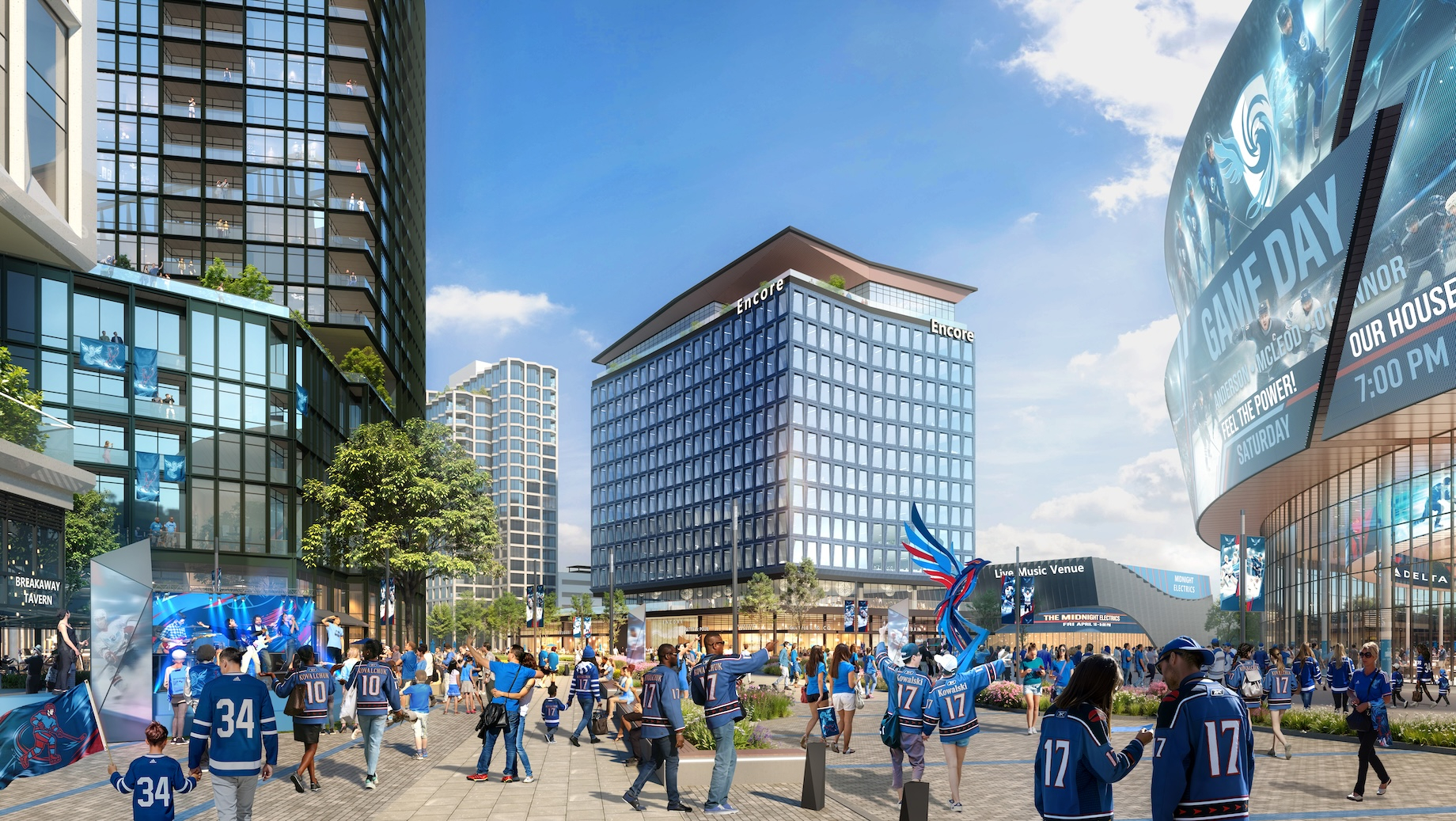
Machete Group, Jamestown and New York Life propose to build a hockey arena as part of the redevelopment of Alpharetta, Georgia’s 1.4 million-square-foot North Point Mall into a mixed-use district. The plan is one of two vying for an NHL expansion franchise. Image courtesy of Jamestown, New York Life and HKS
Active Pipeline: Where Machete Is Applying the Model
Machete Group’s current projects include:
Westcourt: Machete has joined real estate investment management firm JMA and the DeVos family, owners of the NBA’s Orlando Magic, to develop a $500 million, 1 million-square-foot mixed-use project on roughly nine acres directly north of the Kia Center arena in downtown Orlando, Florida. Westcourt will feature high-rise residences, a Kimpton hotel, offices, retail and entertainment. The developers recently hired Turner as general contractor, and construction is expected to begin this year with phased openings beginning in 2028.
Louisville Sports Entertainment District: Machete and Diamond Baseball Holdings, owner of Kentucky’s minor league Louisville Bats, have proposed a $250 million mixed-use destination next to the 13,000-seat Slugger Field. The 500,000-square-foot project would include residential, hospitality, office and retail. Carlock anticipates breaking ground in early 2027.
North Point Mall: Machete has joined Jamestown and New York Life to redevelop the 1.4 million-square-foot North Point Mall in Alpharetta, Georgia, into a 100-acre mixed-use district that could include a home for an NHL expansion team for the Atlanta metro. About 7 miles north, a competing team that includes Krause Sports & Entertainment and JLL is bidding to build an NHL arena at the proposed Gathering at South Forsyth mixed-use development.
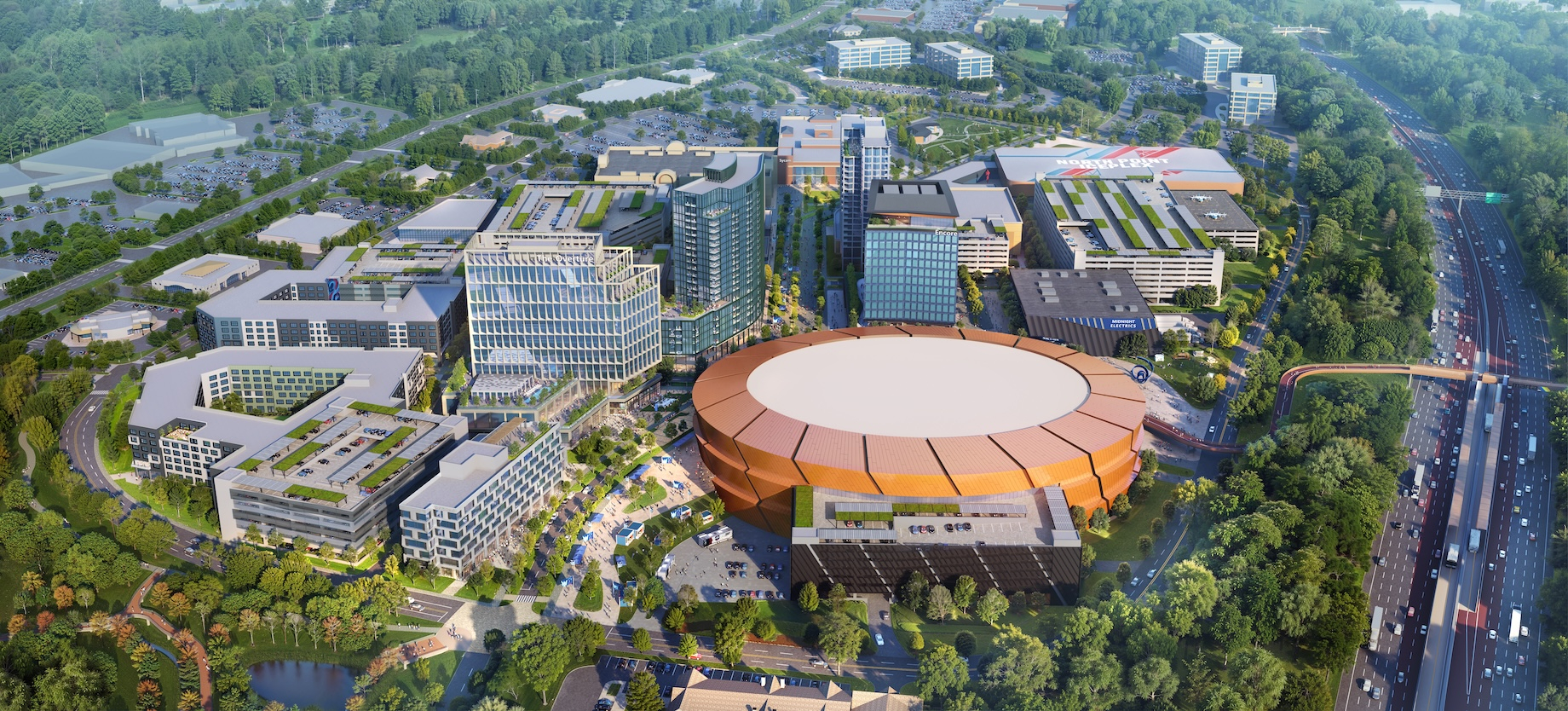
The 100-acre mixed-use district, including an NHL arena, proposed for the redevelopment of North Point Mall Image above and at top courtesy of Jamestown, New York Life and HKS
The North Point Mall project marks Jamestown’s foray into the sports venue field, and it gives the global real estate investment manager an opportunity to leverage and expand its experience in the design and development of retail-oriented mixed-used destinations, said Jamestown director of development and construction for North America Frances Bohn. Machete’s skill set in planning, tenant recruitment and programming sports-anchored projects complements Jamestown’s mixed-use forte, she added. “Fans aren’t just visiting for a game anymore,” Bohn said. “They want restaurants, retail, entertainment and public spaces that offer a full-day experience. Pairing our strengths with Machete’s arena-district proficiency is a natural fit, and sports-anchored districts are a strategic focus for Jamestown moving forward.”
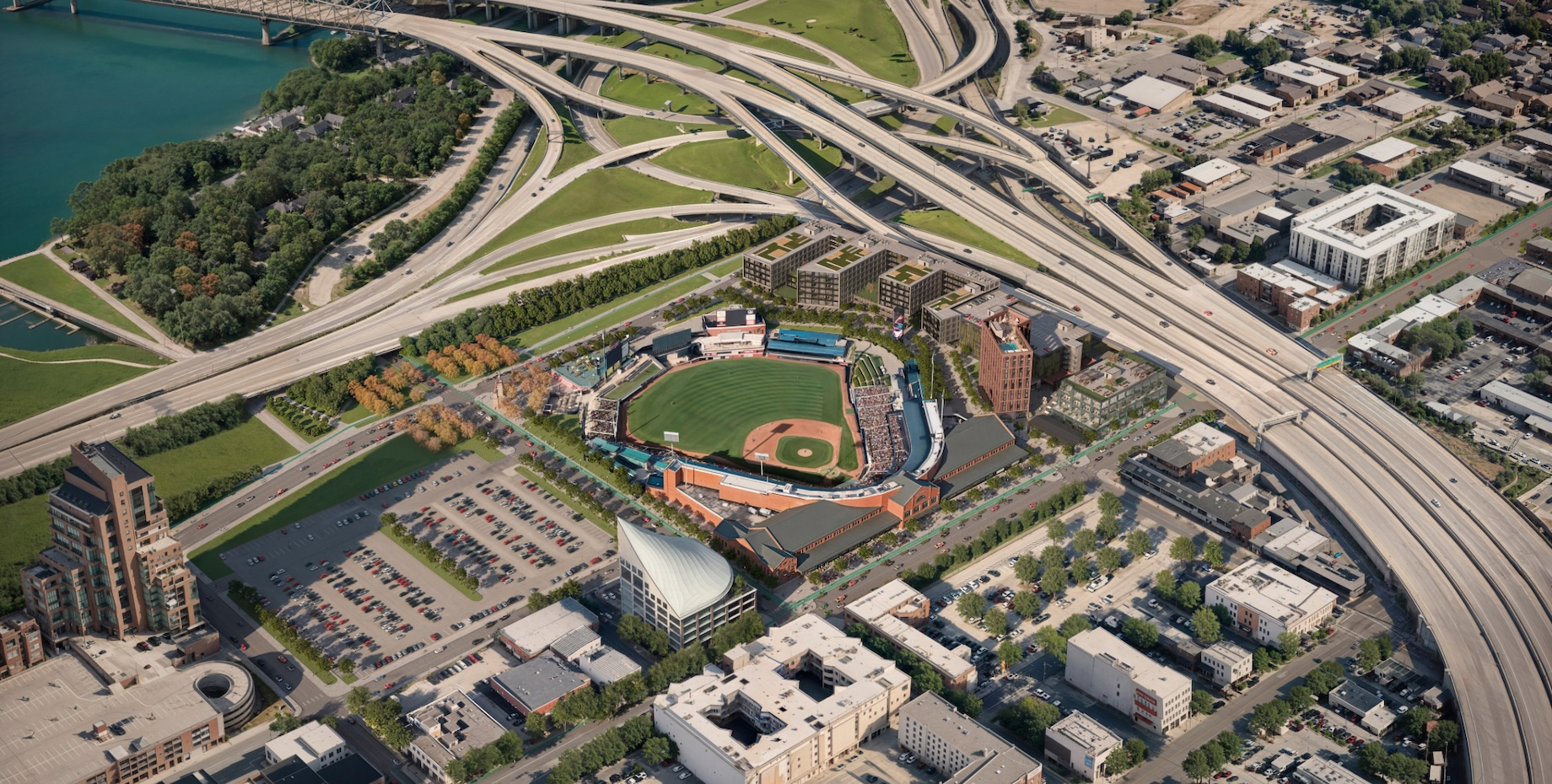
Machete Group and Diamond Baseball Holdings, owner of the minor league Louisville Bats, propose to build a $250 million mixed-use destination next to the 13,000-seat Slugger Field. Image courtesy of Machete Group and Diamond Baseball Holdings
The Built-In Advantages of Sports-Adjacent Developments
Like Jamestown, more developers, team owners and capital providers recognize the viability of sports-adjacent communities, Carlock said. From a team’s point of view, the developments extend the game-day experience and strengthen fan connections that can lead to new or continued purchases of season ticket or suites. To the benefit of the property’s owners and operators, mixed-use districts can impress favorably on the throngs of people who came for the stadium. Additionally, teams and entertainers provide free marketing for the property when they promote their events. He also pointed out that stadiums sometimes can tap into incentives to help fund infrastructure.
“These projects are in higher demand because when investors look at them carefully, there are what we call significant ‘unfair advantages’ that accrue to them,” Carlock said. “But to deliver them and make them successful, it’s important to have the vision and leadership, not only on the private side but also the public side.”
By Joe Gose
Contributor, Commerce + Communities Today