The Short Version
- Large retail property transactions and rising sales volume signal renewed market confidence heading into 2026.
- Institutional investors and REITs are increasing their retail allocations as the sector’s cash flow and yields shine.
- Institutional-investor interest is expanding beyond grocery-anchored centers to include power centers, strip centers and lifestyle properties.
- Competitive debt markets and solid fundamentals support an expectation of accelerated deal flow.
Retail Deal Activity Picks Up as Institutional Capital Flows Back Into the Sector
A flurry of recent shopping center sale announcements, some with sizable price tags, is fueling optimism that 2026 could be a bigger year of dealmaking than 2025.
Investors like the strong cash flow and yields that retail properties are posting thanks to high occupancies and historically low levels of new construction. “There’s a lot of institutional money that has been raised, and we’re seeing more sales activity, as well as cap rate compression,” said Bryan Ley, managing director of investment sales for Northmarq in Los Angeles. He was part of the brokerage team that sold Torrance, California’s Village Del Amo last month for $108.25 million. The 166,365-square-foot community center is anchored by Asian grocer Hannam and has about 45 other tenants.
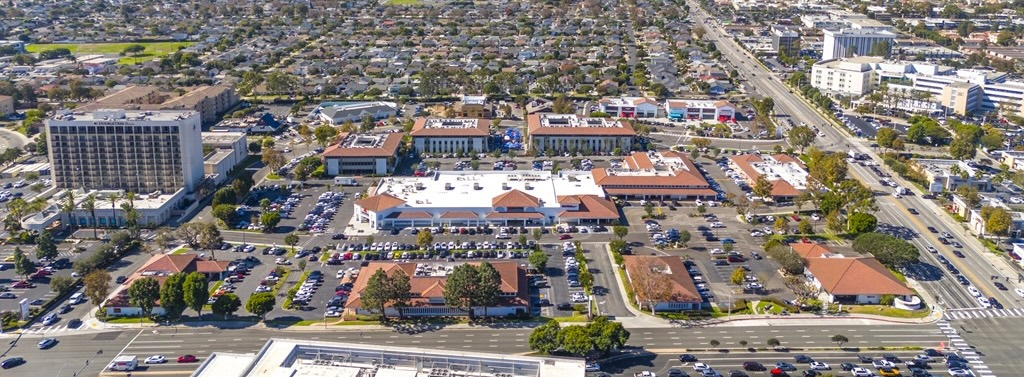
The Village Del Amo shopping center in Torrance, California, sold for $108.25 million earlier this year to a private buyer as part of a 1031 exchange. Photo courtesy of Northmarq
Large Transactions and Rising Sales Volume Signal Market Confidence
The retail sector has seen a noticeable increase in such large transactions over the past six months. In California alone, 18 deals in the second half of 2025 topped $100 million. “In the past, when you would take a $100 million deal to the market, the air was really thin as to how many people could do that purchase,” said Ley. “Now it’s a little bit of a busier offer environment, which is a positive sign for the market.”
Last year, U.S. retail property sales rose 26% to $71.6 billion, according to MSCI. Volume also received a boost from a few megadeals, including the $645.1 million sale of Scottsdale Quarter in Arizona. FalconEye Ventures, founded by tech entrepreneur and CrowdStrike CEO George Kurtz, acquired the 755,000-square-foot mixed-use development last summer.
“The increased level of transaction activity last year reflects the level of demand that we’re seeing for retail across the country,” said Nat Heald, executive vice president in CBRE’s Boston office and lead of the firm’s retail investment sales practice in New England. “That increase in activity is all the more noteworthy given the disruptions that we saw in 2025, specifically around tariffs and regulatory activity,” he added.
Institutional and REIT Demand for Retail Rises
Private investors have been the most active buyers in the retail sector over the last decade, but institutional interest is on the rise. Over the past two years, the volume of bids on retail properties being marketed for sale has grown by 67%, according to JLL; institutional bid volume increased by 102% and REIT bid volume by 117%. “This is the highest level of activity we have seen from institutional investors and public REITs since 2016,” said Jim Galbally, senior managing director and co-head of JLL Capital Markets Americas’ Philadelphia office.
The renewed interest in retail real estate owes largely to the sector’s recent performance. There is a general sense that the toughest days for retail are in the past and retail has a lot of “wind in its sails” to be the favorite asset class for the next several years, noted Ley. “What we’ve been seeing over the last 12 to 18 months is that investors have cycled out of other property types and are refocusing on retail because the yields and returns have been a bit higher and the fundamentals are really strong,” he said.
Retail is outperforming office, industrial and multifamily in the NFI-ODCE Index from NCREIF. “Investors have recognized that retail has been incredibly resilient and a strong returning asset class since COVID, and every year it seems as though more and more investors have become focused on the space,” said Heald. Prior to COVID, when Heald would list a shopping center property for sale in the New England area, it would attract 50 to 75 investors looking for offering information. Now listings are generating interest from upward of 200 interested investors.
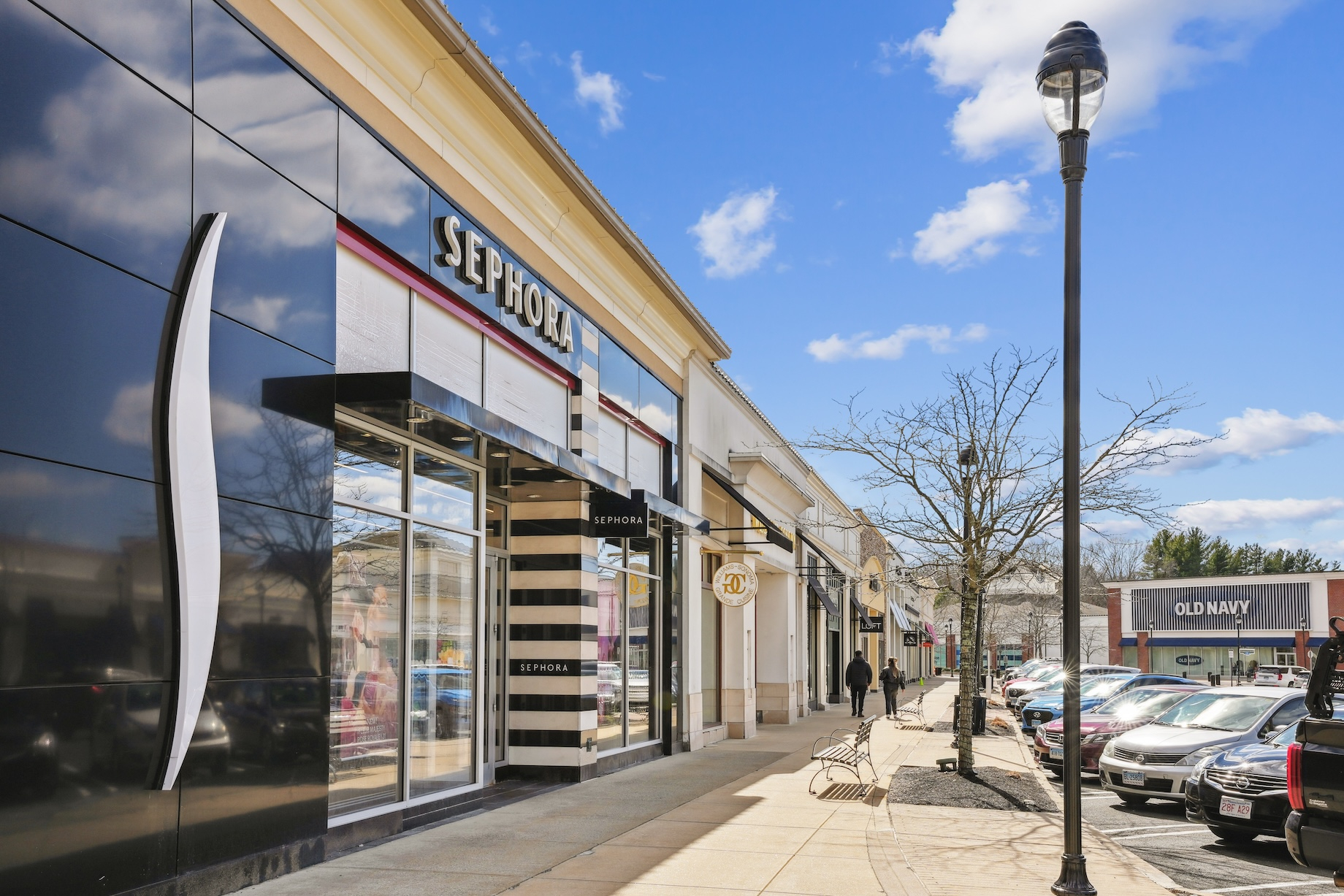
Brand Street Properties and Barings acquired the Whole Foods-anchored Shops at Evergreen Walk in South Windsor, Connecticut, from PGIM for $98.25 million. Photo above and at top courtesy of CBRE
Institutional Investor Interest Expands Beyond Grocery-Anchored Centers
Grocery-anchored retail remains the most favored retail asset type. However, investor interest is expanding to include unanchored strip centers, power centers and lifestyle centers. Class B malls and shopping centers with underperforming occupancy and cash flow still face challenges finding buyers.
“It’s hard to say that there’s one vertical that investors are not interested in,” said Heald. There are institutional capital and/or private capital investors interested in all different types of retail properties. Traditionally, unanchored strip centers have appealed largely to private buyers. These days, however, that category is viewed as more of an institutional product, and interest is incredibly active from both institutions and private capital buyers, noted Heald.
MORE FROM C+CT: Surprise! Unanchored Strip Centers Are Popular With Investors
Investors especially like power centers that include both grocers and big-box anchors like Marshalls or Ross Dress for Less, added Ley. He said those properties get cap rates a little higher than those traditional grocery-anchored centers get, thanks to the big-box risk, but still lower than a traditional power center with no grocer.
Capital Markets Conditions Point to Increased Retail Deal Flow in 2026
Investment sales experts agree that it’s a good time to be both a seller and a buyer, as cap rates are still a bit higher than in 2021. According to MSCI’s RCA CPPI, retail sale prices are holding steady, at a year-over-year gain of 0.2%.
Best-in-class grocery-anchored centers in top markets command the best pricing, with cap rates ranging between 5.25% and 5.5%. Debt costs limit how low cap rates can go. However, strong lender competition is compressing debt spreads for retail, leading to lower cost of capital for buyers, noted Galbally. “Given the strong fundamentals and competitive debt markets, along with the increasing amount of capital flowing into the retail sector, we should see an increase in deal flow and further cap rate compression,” he said.
Financing Conditions Support Pricing and Cap Rate Compression
Market participants are optimistic that transaction activity will continue to increase in 2026. According to CBRE’s 2026 North America Investor Intentions Survey, 55% of investors plan to increase their real estate capital allocation this year, up from the 48% who increased that figure in 2025. And retail is the third most sought-after property type after multifamily and industrial. The 27% of respondents interested in buying retail assets is on par with 2025 and up from 22% in the 2024 survey.
Institutions that have dry powder and conviction around retail could drive more large shopping center sales and portfolio transactions in 2026. For example, Oxford Properties and joint-venture partner Pine Tree recently paid $250 million for two power centers in metro Austin, Texas’ 633,000-square-foot Wolf Ranch and 386,000-square-foot Lakeline Plaza & Village.
“I think we’re going to see more transaction activity this year than in 2025,” said Heald. The buyer demand is there, he added, and landlords who have healthy and vibrant shopping centers also see a fantastic opportunity for profit-taking.
By Beth Mattson-Teig
Contributor, Commerce + Communities Today