The Short Version
- GBT Realty plans to deploy $1.3 billion across build-to-suit development and shopping center acquisitions over the next 18 months.
- The Brentwood, Tennessee-based firm expects to break ground on 33 retail projects in 2026, including triple-net assets and two 300,000-square-foot power centers.
- AEW Capital Management, nearly $500 million in lender commitments and others are backing the expansion.
- CEO Brian Dawson says open-air power centers and grocery-anchored retail are once again penciling out as capital returns to the sector.
A $1.3 Billion Retail Development and Acquisition Strategy Takes Shape
GBT Realty Corp. aims to execute $1.3 billion in build-to-suit development projects and shopping center acquisitions over the next 18 months, primarily in the Southeast and Midwest. While mixed-use is part of GBT’s focus, CEO Brian Dawson and president and chair George Tomlin are doubling down on retail.
According to Dawson, the Brentwood, Tennessee-based company is on track to break ground on 33 projects in 2026, including the development of:
- 30 triple-net lease assets for brands like Speedway, Tractor Supply Co. and Sprouts Farmers Market
- a shadow-anchored Target shopping center in Alabama
- two 300,000-square-foot, ground-up power centers in the Southeast
“George and I spent hours talking about what is best for GBT, and two years ago we started a plan for the company to go back to its roots,” Dawson explained. “GBT at its core is a retail developer and a retail investor. We do it very, very well.”
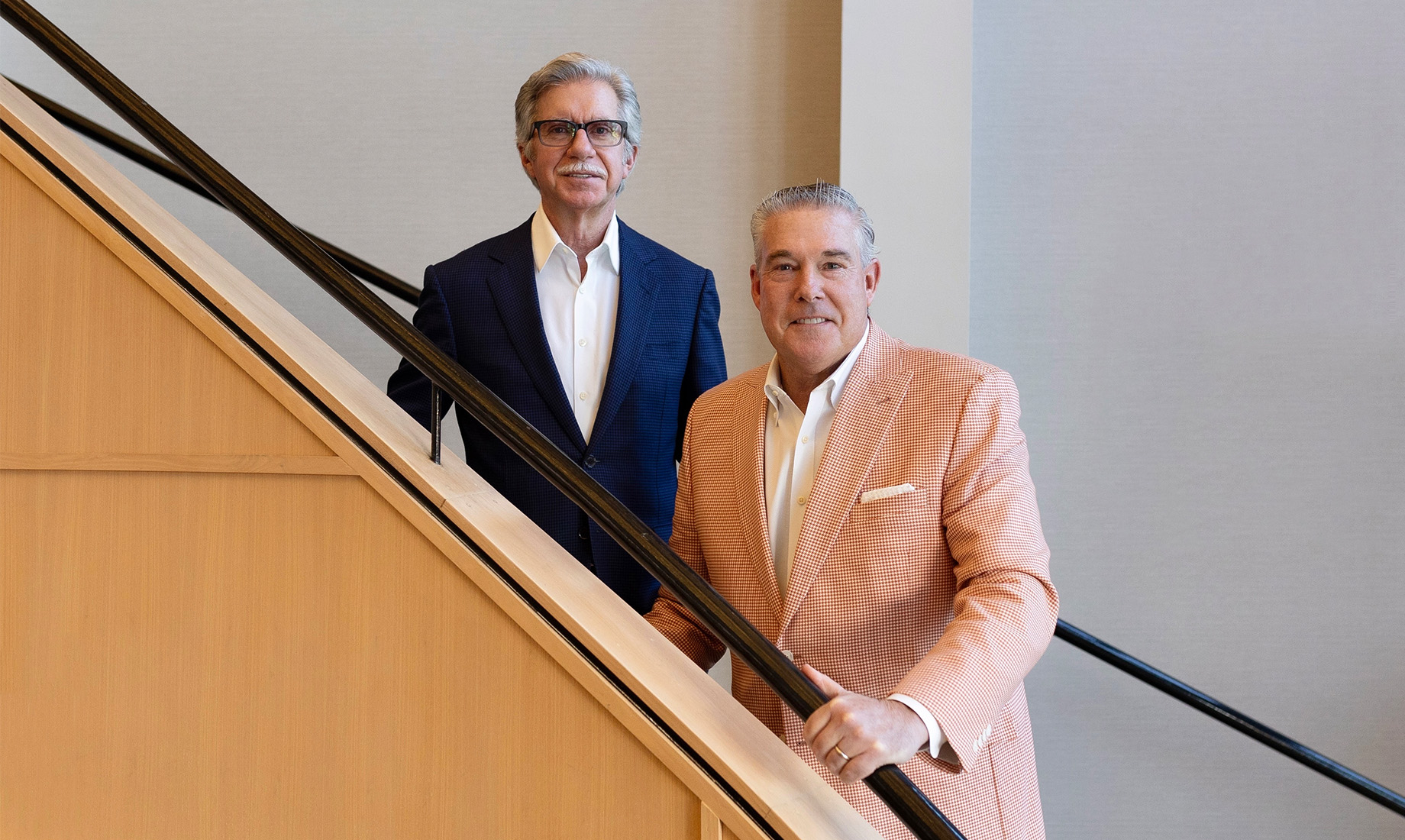
GBT’s president and chair George Tomlin, at right, and CEO Brian Dawson. Photo courtesy of GBT Realty Corp.
A former JLL Capital Markets managing director, Dawson has worked with Tomlin and GBT for years, raising both debt and equity capital and providing financial advisory services. He became CEO in November 2024 as Tomlin, who founded GBT in 1987, shifted to his current role.
GBT now employs 62 people in disciplines like development, construction, acquisitions, leasing and property management. The privately owned company has been involved in projects totaling more than $8 billion: about 40 million square feet of grocery-anchored and neighborhood shopping centers, regional power centers, single-tenant retail and mixed-use developments. With $2 billion in assets under management today, the company has set a target of reaching $3 billion.
“George put his heart and soul into this brand,” Dawson said. “Seeing it be perpetuated is extremely important, not only to George but also to our people here and for their careers.”
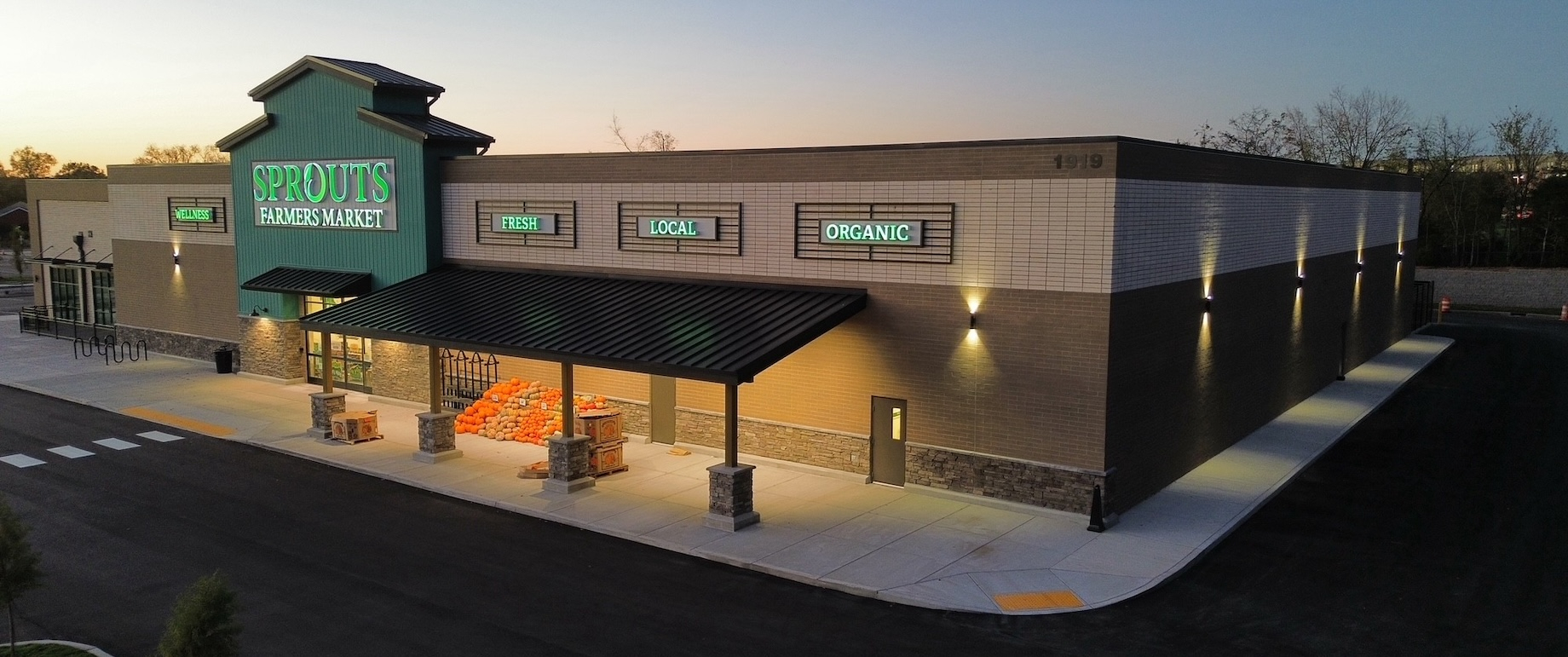
This year, GBT Realty Corp. plans to develop 30 triple-net lease assets involving brands like Speedway, Tractor Supply Co. and Sprouts Farmers Market. Above is a GBT-developed Sprouts that opened last year 20 miles east of Nashville. Photo above and at top courtesy of Ordner Construction Co.
Scaling the Team and Tech To Execute a High-Volume Pipeline
To lay the groundwork for GBT’s $1.3 billion retail push, Dawson hired 12 new employees to acquire land and develop and lease properties. GBT also created three technology platforms to ramp up internal and investor communications. “For us to execute flawlessly as we need to, given the volume that we have in our pipeline, that technology investment was essential,” Dawson said.
The company also made changes to its organizational chart to maximize its ability to deploy investment capital efficiently — for example, dedicating a senior development lead for each retail client, Dawson explained. “This provides consistency and a superior level of quality for each retailer we serve.”
But when it comes to the ability to efficiently develop stores and shopping centers, GBT already had a strong story to tell. From about 2010 to 2020, its triple-net lease division completed 859 Dollar General stores across 30 states. The company has developed 51 Walmarts, more than 20 Targets and multiple Firestone Complete Auto Care locations.
Last fall, the Boston office of AEW Capital Management, a global real estate investment firm with more than $86 billion in assets under management, signed on as a programmatic joint-venture partner. Other sources of GBT’s $1.3 billion in funding include high-net-worth individuals, family offices, other investors, GBT itself, and lenders that have committed nearly $500 million. “The repetition and volume of our programmatic retail development have allowed GBT to align with strong capital providers,” Dawson said.
Pursuing Shopping Center Acquisitions Across the Southeast and Midwest
Over the past nine months, GBT has acquired three assets in the Southeast: an unanchored strip center, a grocery-anchored center and a power center. All are in “solid growth markets,” Dawson said.
The CEO and his acquisitions team have been fanning out to hunt for strong opportunities. “We have a team today up in the Midwest that flew out at 6:15 this morning,” he said in mid-February. “They’ll be up there for the next two days. I’ll be in Texas tomorrow. We’ll reconvene when everybody gets back and compare notes and roll up our sleeves.”
Markets in Florida, Texas, Louisiana and South Carolina are among those on the company’s radar screen, he added, noting that an advantage for GBT is its familiarity with the site criteria and market criteria of many expanding operators. “We have relationships with the retailers that have been built over the decades here.”
Power Centers Make a Comeback in GBT’s Development Pipeline
As GBT moves forward with its growth push, Dawson sees opportunities involving assets that, in his view, are due for a comeback: open-air power centers with multiple large-format anchors and footprints of anywhere from 250,000 to 600,000 square feet.
U.S. developers focused heavily on such properties for 20 years starting in the 1990s but had started to put on the brakes by about 2016. “It took from 2017 to 2024 for the oversupply of those large shopping centers to be absorbed, a long period of time that included both COVID and post-COVID interest rate hikes and inflation,” the CEO said.
Today, the cost of capital is more constrained, and GBT’s programmatic approach to construction helps the company contain project costs. Its construction experts routinely oversee general contractors on retail projects and advise retailers on ways to streamline the process. “Strong retail demand has proven itself out, and the supply of readily available retail space to backfill is no longer there,” Dawson said. “So that is justifying, in certain circumstances, new power center construction.”
On the acquisitions front, meanwhile, it’s all about location. The Target-anchored power center that GBT bought last year in Louisiana is in a retail node that attracts people from 20 miles away.
Investor Demand Shifts Back Toward Retail
In Dawson’s view, retail has overcome the headwinds it faced when investors were worried about Amazon decimating brick-and-mortar sales. While capital continues to zero in on industrial and multifamily residential opportunities, “retail is right there in the big three,” he said.
“I’ll be in New York this week, and everyone — institutional, pension and private equity capital — wants to talk about retail. I’ve been doing this for nearly 40 years, and retail has never been the focus of capital like it is today.”
“I’ve been doing this for nearly 40 years, and retail has never been the focus of capital like it is today.”
By Joel Groover
Contributor, Commerce + Communities Today