The Short Version
- Two college students realized a widespread retail lease management problem while attending ICSC NEW YORK and refined their idea for their start-up, Prismera, to address it.
- Retail real estate teams still rely on outdated systems and manual processes to manage complex, nonstandard lease portfolios, according to Prismera.
- Prismera uses AI to turn leases and amendments into searchable, structured data that supports faster decisionmaking.
- Early stakeholders say the platform reduces time spent on lease abstraction while improving visibility across portfolios.
- As demand grows for better lease intelligence, Prismera is scaling its AI platform alongside industry partners.
The Unlikely Rise of AI Start-Up Prismera
On their first night in New York City in December 2024, college students Riley Hudson and Nicolas Osborn had no meetings set. Their start-up pitch was vague. They had little experience in commercial real estate. To top it off, they had no idea you can’t just register for a conference like ICSC NEW YORK and expect to get on people’s calendars.
After emailing nearly 200 industry professionals at the last minute and getting a single polite rejection, the two improvised: They found the most expensive hotel they could near Javits Center and, other than the time they spent on the event’s show floor, camped out at the hotel bar for two days.
There, Hudson and Osborn chatted with executives who were flummoxed — though some were impressed — by the duo’s scrappiness. Mostly, the students listened to conference attendees as they discussed industry needs. They listened hard. By the time the conference had ended, Hudson and Osborn had a new, solid direction for their tech start-up, Prismera.
Within a year, the founders evolved from commercial real estate outsiders to emerging disruptors, working with top-tier companies and operators like NewQuest, A&H Acquisitions Corp., Waterstone Properties and Prudent Growth.

Prismera founders Nicolas Osborn, at left, and Riley Hudson, at right, at the New York City bar where they drummed up business during ICSC NEW YORK in 2024. Photo credit: Curtis Carlson
The pair launched their company in September 2024, three months before ICSC NEW YORK and about a year before they graduated from college. Now, still barely in their 20s, the founders have built — and are evolving — an AI-powered platform to change how retail real estate teams interact with their most important documents.
Modernizing Lease Workflows Built for Another Era
Prismera transforms labor-intensive processes that have entrenched commercial real estate portfolio management for decades. For companies that manage dozens, hundreds or thousands of tenants, tracking key details, deadlines and portfolio-wide insights is a daily necessity. Yet those companies still handle much of that work through clunky software, manual processes and fragmented workflows.
ICSC+PROPTECH: Las Vegas, May 18-20
Discover innovative property technology, join curated one-to-one meetings, and get direct access to creators powering smarter spaces at ICSC+PROPTECH.
Learn more and registerWhile attending college at Louisiana State University, Hudson did data entry for a real estate company. He encountered issues with real estate technology for the first time. “It felt like it came out in the ’80s,” Hudson said. “You’d have multiple versions of the same document, communication didn’t work and for something that represents so much monetary value, it was insane.”
That frustration became the seed of Prismera. Hudson partnered with Osborn, whom he met through a student emerging technologies club founded by Osborn. The rapid rise of AI and their experience during ICSC NEW YORK crystallized their mission to extract meaning from complex, inconsistent lease documents.
Why Retail Leases Are So Difficult to Manage at Scale
If leases are the backbone of commercial real estate — dictating revenue, obligations and risk — why are they still so difficult to analyze and share?
Retail leases present a uniquely difficult challenge. Unlike office and multifamily assets, which follow more standardized formats, retail leases vary widely in structure, language and amendments.
That variability historically has required human interpretation, often by handsomely paid attorneys or lease administrators, making the process of lease management slow and expensive. Non-AI lease-abstraction tools attempt to streamline the work, but they still rely heavily on manual input.
For early Prismera investor Peter Russell — a former retail real estate executive for Bed Bath & Beyond, Michaels, Gap, Old Navy and more — such tech limitations were grueling. “Without AI, it’s a difficult process,” Russell said. “Most lease-abstract software just stores information in folders on a shared drive. If you need to review details, you have to look up each individual store, one lease at a time. Getting overall insight is a major challenge.” Russell encountered these challenges firsthand during COVID. While overseeing 1,500 Bed Bath & Beyond locations, widespread lease defaults made it nearly impossible to monitor everything in real time. “With AI, you’re not just looking at a lease,” said Russell. “You’re looking across every lease, every amendment, every side letter, every supporting document all at once. A product like Prismera would have been priceless.”
Turning Lease Documents Into Actionable Data
Prismera’s approach treats leases and other core documents not as static files but as data. The platform ingests the core documents of a portfolio — along with amendments — and uses AI to extract and structure the information within them. But the key isn’t just digitization; it’s usability. “We take in every document and leverage that context to automate much of the work that depends on them,” Hudson said. “Then all the collaboration can happen on the platform.” Here’s what he means:
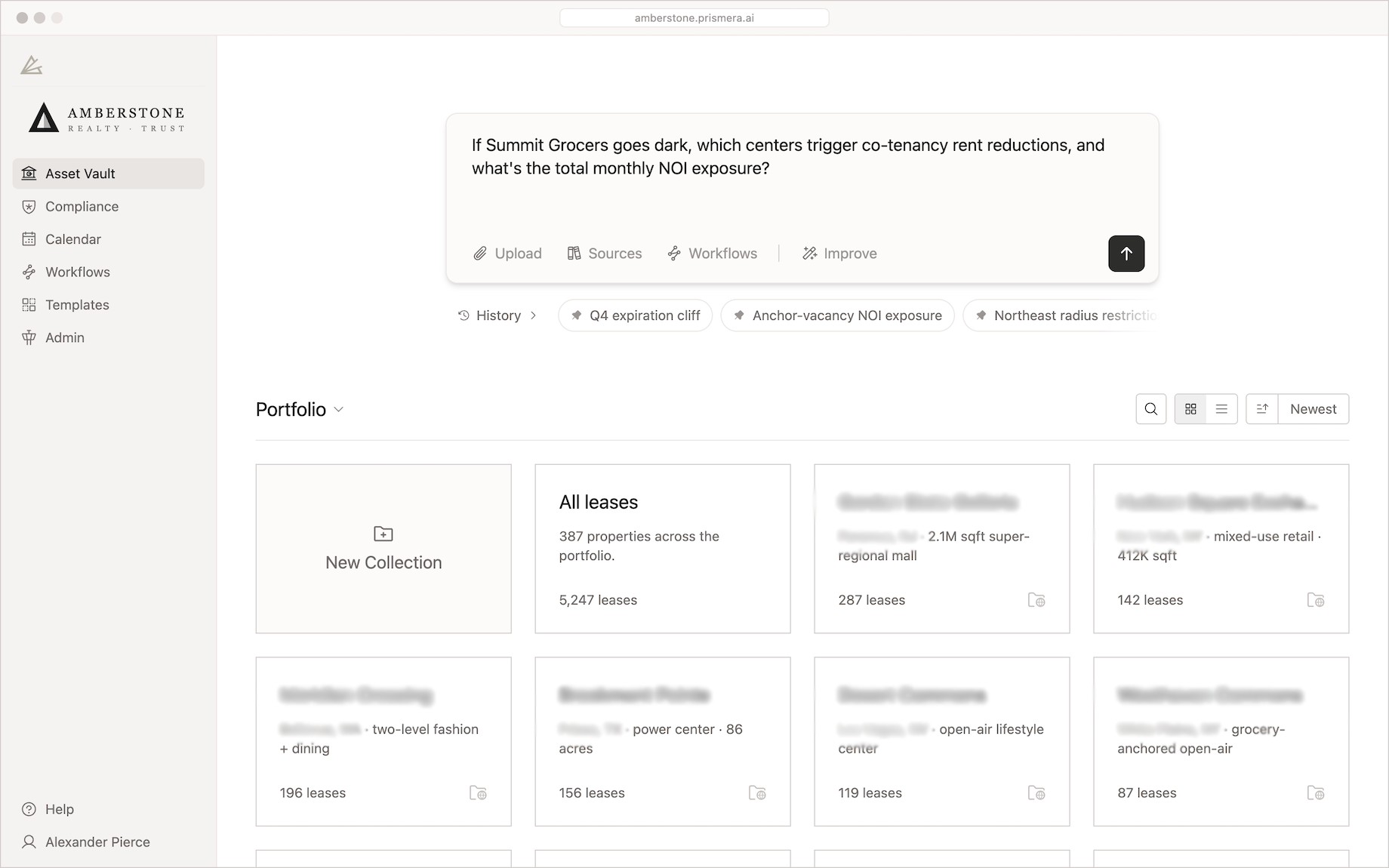
Prismera’s Asset Vault is where users store all their property documents — such as leases, agreements and tenant records — in one place. It organizes records automatically so users can easily search, ask questions and evaluate risk and obligations without manually digging through files. Image courtesy of Prismera. Fictionalized properties and locations redacted by Commerce + Communities Today
A user can upload a full property document package, navigate directly to key clauses, compare terms across properties or generate insights that otherwise would require hours of review. Outputs link back to source documents, allowing users to verify findings instantly.
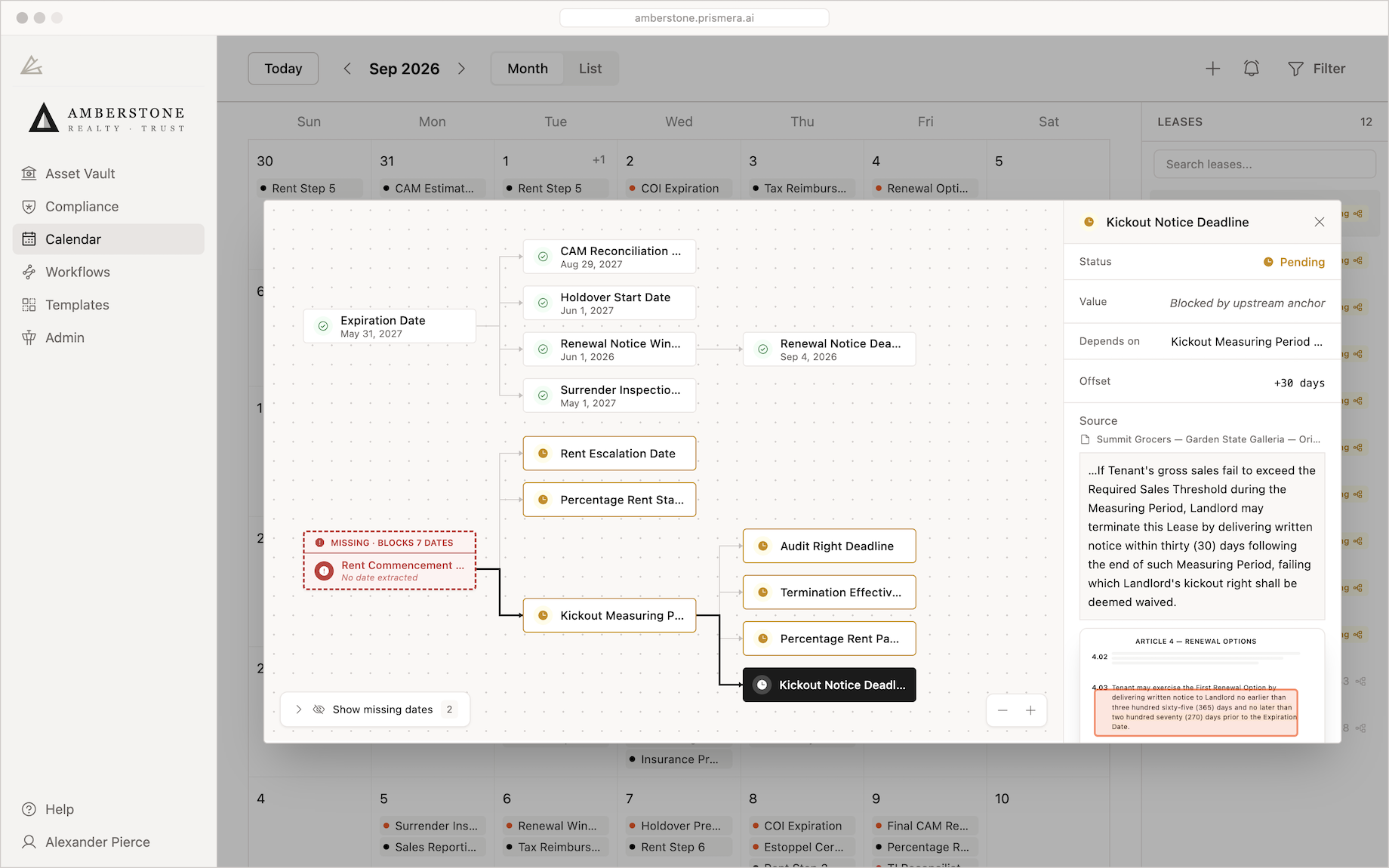
Instead of treating dates like isolated reminders, Prismera’s Calendar shows all important lease dates in one place. It also shows how those dates connect. Each reminder connects to a flow chart that shows what needs to happen first and what deadlines are coming up, such as termination windows, notices and rights. It also flags anything missing. Image courtesy of Prismera
The platform also tracks compliance, making critical dates and insurance obligations easy to monitor.
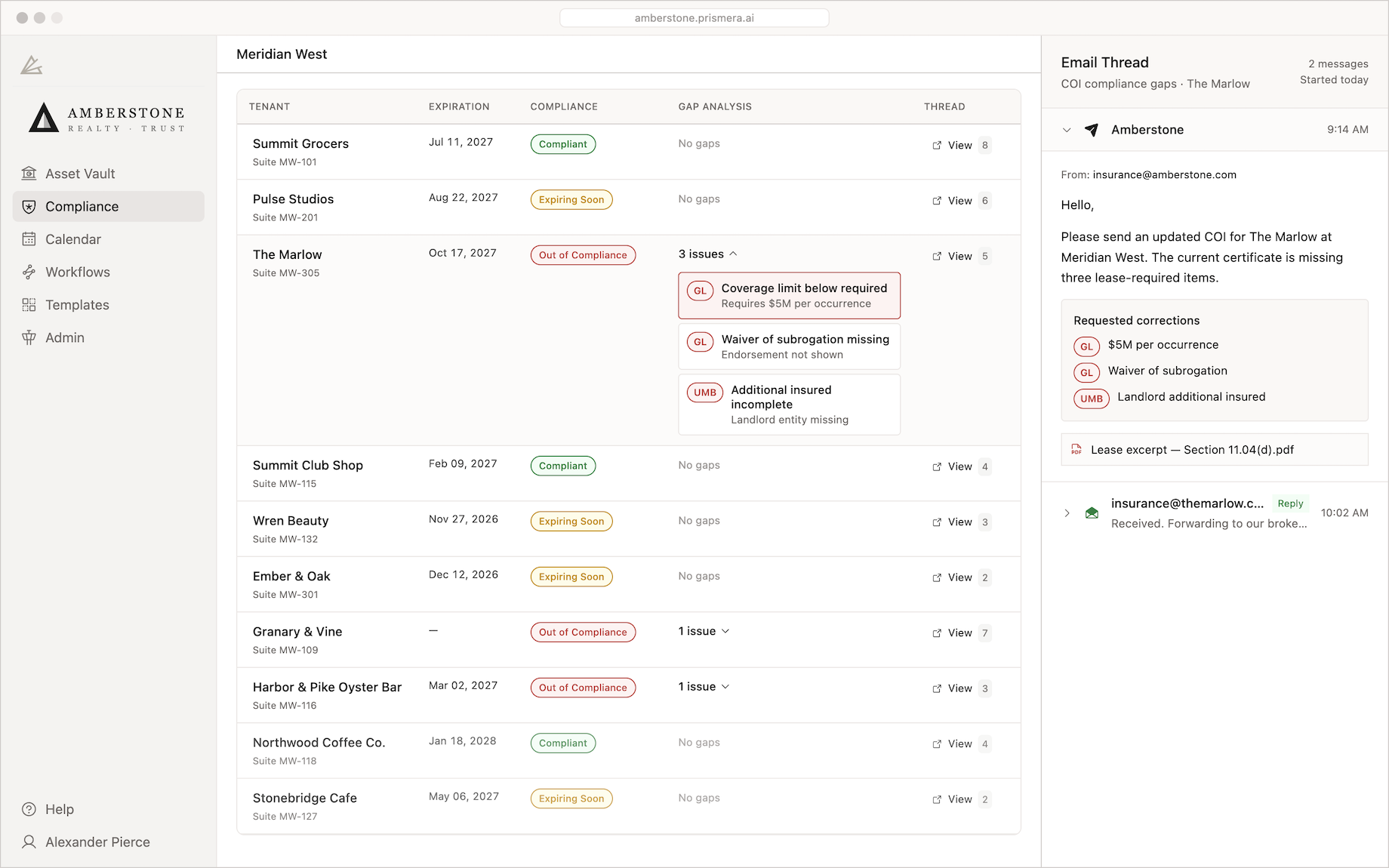
Prismera’s Compliance section keeps track of whether tenants are meeting key lease requirements, such as providing insurance and submitting sales reports. If something is missing, it flags the issue and creates a ready-to-send notice with the relevant lease language attached. When the tenant responds, everything is saved and updated in one place, so nothing gets lost in emails or spreadsheets. Image courtesy of Prismera
Prismera consolidates workflows that traditionally have spread across email, shared drives and multiple systems. Users can communicate with tenants, collaborate with colleagues and manage documents all within a single platform.
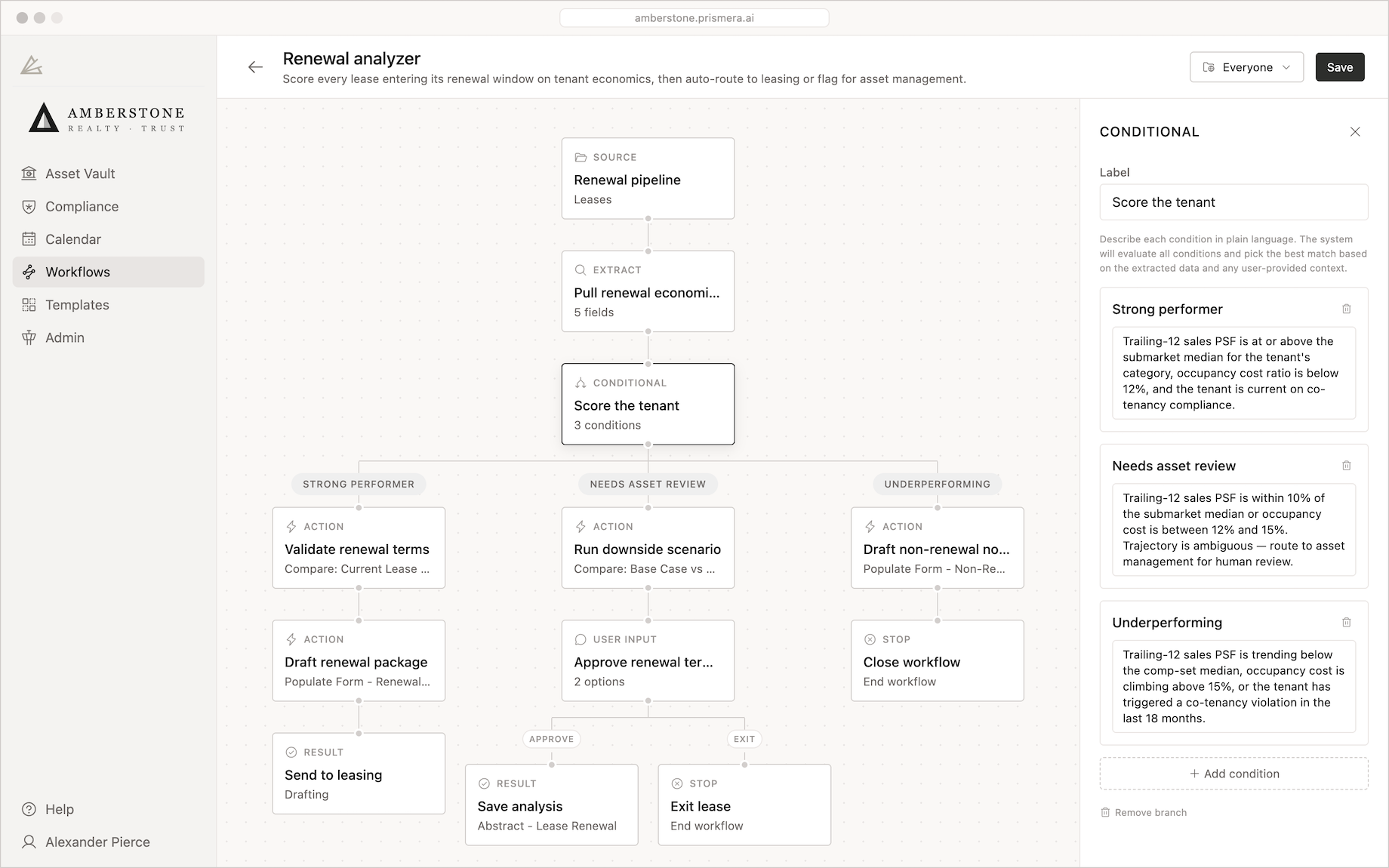
Prismera’s Workflows section functions like a dashboard, showing step-by-step workflow — basically a checklist of tasks tied to leases or documents. Each box represents a step in the process — such as reviewing a lease, sending a notice or getting approval — and it shows what’s already done, what’s next and who’s responsible. Instead of relying on one person to remember every detail, the process is built for the whole team to follow. Image courtesy of Prismera
It’s still early to collect hard results from Prismera, but for users like NAI Elliott director of real estate management Michael Larkin, Prismera already is transforming the way the company’s employees prioritize. “Abstraction doesn’t require someone reading a lease cover to cover for an hour anymore,” Larkin said, “so now, we can be more focused and strategic.”
Instead of digging through documents, a team quickly can surface relevant information, such as use clauses or rent terms, and apply it across a portfolio. “The access to information is the most valuable asset of the product for us,” Larkin added.
Building the Platform Alongside Its Users
Collaboration with users has defined Prismera’s growth. Hudson and Osborn spend significant time observing clients’ workflows and incorporating their feedback into rapid, customized product updates. “Anytime I talk to them, they’ve rolled out something new,” Larkin said.
From Larkin’s perspective, the youth of the company and of its founders isn’t a drawback. “There was definitely some risk for us when we decided to work with them,” he said. “But hearing how intentional they were — how focused they were on building the product and their approach to it — it really stood out. It felt like a leap for us, but the question was: Is this just a temporary fix, or does it put us on the right path for a long-term shift? I think it’s ... a real long-term solution.”
Once a company onboards Prismera, it customizes the platform around each client’s portfolio and workflows so teams seamlessly can manage documents, track obligations and collaborate in one place. “You need to understand your process,” Larkin said. “This doesn’t replace everything — it fits into it.”
Early Growth, Expansion and What Comes Next
Prismera is raising a seed round backed by angel investors from both real estate and AI. The company has relocated twice, from its college roots in Louisiana to Dallas in 2025 and New York in January this year. Prismera currently has three full-time employees and an office in Hudson Yards.
With the company still in its early stages, it’s impossible to predict its trajectory — or where competition may emerge. The founders are acutely aware of how quickly the AI landscape is changing. Still, the direction is clear. As commercial real estate firms contend with aging systems and increasing complexity, tools that unlock the value of lease data are becoming more critical. Since that first, transformative ICSC conference, Prismera has been ready to pivot at a moment’s notice. “We don’t plan very far into the future,” Hudson said. “It’s always evolving.”
By Halley Bondy
Contributor, Commerce + Communities Today