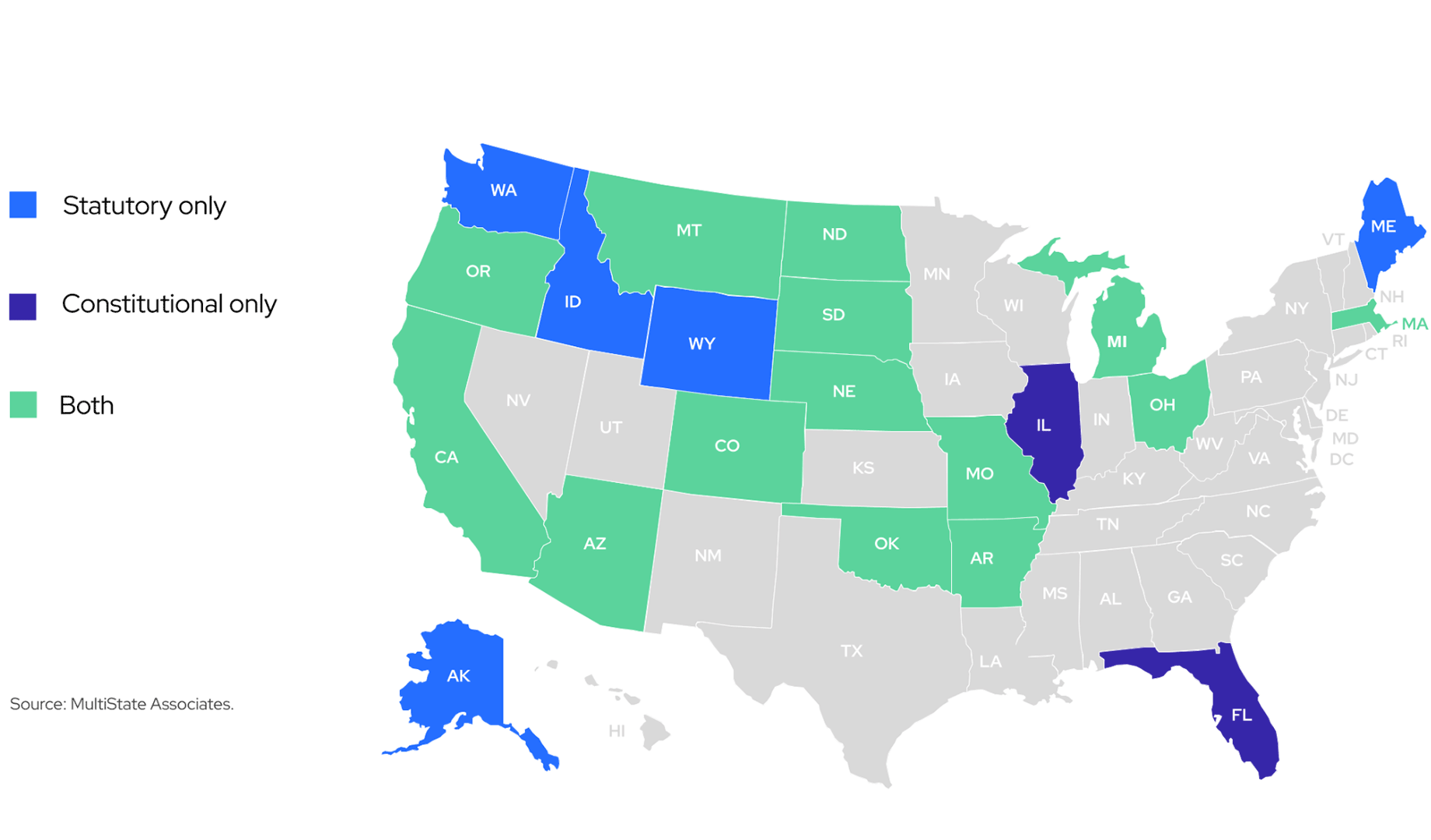
In November, voters will choose their representatives and, in many states, decide whether to approve new laws through ballot measures. Currently 23 states allow citizens to place statutes or constitutional amendments directly on the ballot, bypassing the legislature entirely. The policies covered in ballot measures can range from asking voters to authorize a new bond for a state or localities to whether there should be an increase in the minimum wage.
Out of the 117 ballot measures that voters will be deciding this year, several high-profile measures in California, Utah, South Dakota, Louisiana and Tennessee have implications for commercial property owners.
In California, voters will consider a constitutional amendment that would require a two-thirds supermajority for citizen-initiated local special taxes, while prohibiting charter cities from raising real estate transfer taxes. This measure, which follows a decade-long effort by business coalitions to tighten the state's tax-approval rules, would overturn a 2017 state supreme court ruling that allowed those citizen-initiated taxes to pass with a simple majority. If approved, it will be one of California's most consequential tax policy changes, severely restricting how local governments raise revenue.
This initiative is part of a broader national trend where state legislatures are pushing higher voter thresholds to curb direct democracy. For example, South Dakota's 2026 ballot features a constitutional amendment to require a 60% approval rate for all future amendments, while Utah voters will decide on a similar 60% threshold for any citizen initiatives that create or raise taxes. Critics argue that these new requirements would provide a minority veto to opponents, making constitutional and fiscal changes much harder to achieve.
Meanwhile, Louisiana voters will decide on a constitutional amendment that would offer a tax exemption for rehabilitated blighted property. Louisiana has struggled with blighted parcels in older urban neighborhoods—particularly in New Orleans, Baton Rouge and Shreveport—where rehabilitation costs often exceed post-renovation appraised values. To address this, the amendment creates a constitutional carve-out, allowing the legislature to use the tax code as a redevelopment tool without violating the state's uniformity-of-taxation requirements. This measure, which required a two-thirds majority vote in the General Assembly to reach the ballot, is part of the broader ballot property-tax package.
In Tennessee, voters will consider a constitutional amendment to explicitly ban the enactment of a statewide property tax. Although Tennessee does not currently have a state property tax, the measure would constitutionally bar any future legislature from imposing one. This strategy would secure the state's low-tax environment into law, restricting future legislative revenue options regardless of the state’s fiscal circumstances.
As Election Day approaches, more initiatives are likely to meet the qualification thresholds to be added to state ballots. In Nebraska, a proposed ballot measure, which is still gathering signatures, would cap annual property tax increases at either 3% or the state's revenue growth rate, whichever is lower. Additionally, an initiative proposed in Ohio would prohibit all taxation of real property. Though neither measure has officially made the ballot yet, both demonstrate how voters can directly influence fiscal policy.
BALLOT MEASURES