Companies are increasingly seeking ways to reduce their carbon footprint, often pledging to buy more renewable energy or reduce greenhouse gas emissions. While many lawmakers have encouraged businesses to adopt environmental goals as part of a broader transition to cleaner forms of energy, recent federal and state proposals show a push to speed that process up, impacting both retailers and commercial property owners alike.
In March, the U.S. Securities and Exchange Commission (SEC) proposed rules requiring publicly traded companies to provide climate-related information in their annual reporting to the SEC, including a company’s direct greenhouse gas emissions (Scope 1), indirect emissions produced from the purchase of energy (Scope 2), and indirect emissions produced along their value chain (Scope 3). The SEC has yet to issue a final rule, but this has not stopped state lawmakers from proposing legislation requiring certain corporations to disclose their emissions.
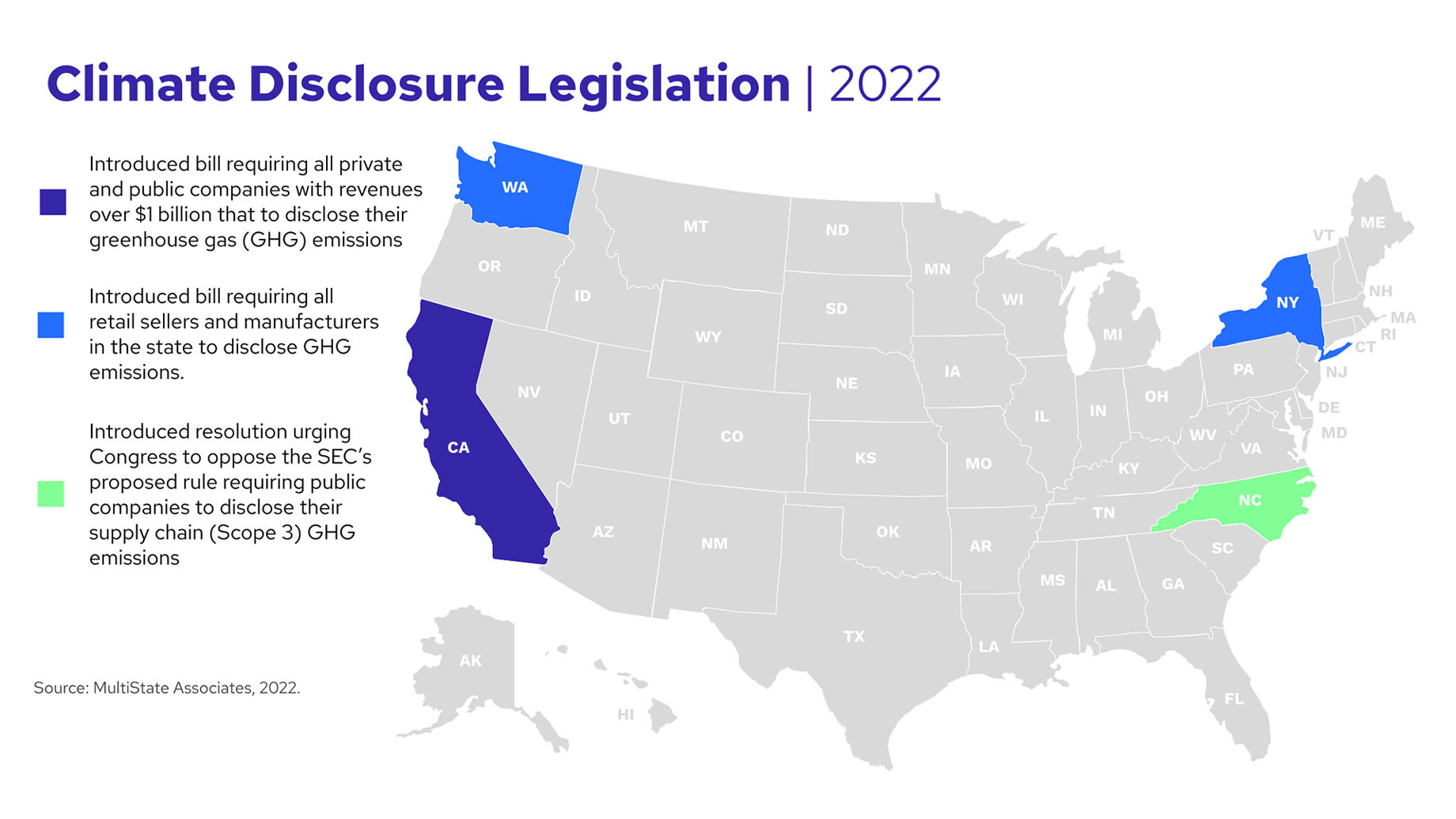
In California, lawmakers this year introduced legislation (CA SB 260) that went further than the SEC proposal by requiring both public and private companies with annual revenues over $1 billion dollars that do business in California to publicly disclose their greenhouse gas emissions. Even though the bill — called the “California Climate Corporate Accountability Act” — failed to pass the legislature this session, if passed it would have been the first corporate disclosure requirement of its kind to be signed into law.
While smaller in scope, two bills introduced in New York (NY SB 7428 & NY AB 8352) this year would require fashion retail sellers and manufacturers with worldwide gross receipts greater than $100 million to disclose their environmental policies, including greenhouse gas emissions. Neither bill made it out of committee before adjourning for the year. And in Washington, a bill introduced in January (WA SB 5904) would have also required fashion retail sellers and manufacturers to disclose environmental policies. That bill also never advanced out of committee.
Regardless of whether these policies are enacted, there is greater attention from a public policy perspective on ways to make commercial buildings more environmentally friendly. Commercial buildings used by both businesses and governments account for 18% of U.S. primary energy use, and federal lawmakers have increased assistance for commercial buildings to make energy efficient upgrades. As more tax dollars are spent on climate initiatives, expect lawmakers at all levels to look for ways to measure the real impact of these investments and hold all receiving entities accountable.