The Short Version
- Surfaice is developing AI tools to automate repetitive store-development tasks, including punch-list walkthroughs and construction budgeting.
- The company’s platform is designed to work alongside systems like Procore, Lucernex, Smartsheet and SiteRise rather than replace them.
- Surfaice says early retail project managers are testing the technology to speed workflows, improve consistency,and surface missing or conflicting project details.
How Surfaice Wants To Streamline Store Development
Surfaice CEO and co-founder Alim Uderbekov was a bit nervous. Live demos are always a gamble, and a project manager at a construction site in Texas was about to test an AI agent created by Uderbekov’s proptech start-up.
The project manager worked for a discount retail chain that rolls out hundreds of stores each year. In the test, conducted this past February, his task was to walk the site and talk out loud to a Surfaice AI agent on a tablet about work that needed to be corrected or finished. The agent then was to generate a punch-list walkthrough cataloging those remaining tasks. “The PM was able to just walk and talk very easily, and the agent handled the rest,” Uderbekov recalled. Surfaice’s AI tool for store prototypes updated the punch items, flagged what was missing and generated a report for vendors on the spot. “That was the moment we realized this would actually work,” he said.
ICSC+PROPTECH: Las Vegas, May 18-20
Discover innovative property technology, join curated one-to-one meetings, and get direct access to creators powering smarter spaces at ICSC+PROPTECH.
Learn more and registerAI Could Help Automate Repetitive Store-Development Tasks
Punch lists are just one of dozens of what Uderbekov calls “standard playbooks for the retail store life cycle” that Surfaice aims to enhance and automate. According to the proptech CEO, that same discount retailer is also working with Surfaice to automate the creation of store-development construction budgets, which break down anticipated expenses like materials, labor, equipment and permits on a store-development project. Walking the jobsite, a project manager or superintendent might note aloud the number of required signs for that store or the length or width of the walls. The AI tool would then build a construction budget based on that voice-activated input.
In addition to Uderbekov, among Surfaice’s co-founders is chief revenue officer Joe Valeri, a 25-year technology veteran who in 2013 founded Lucernex, a lease-management and store-development life cycle system for retailers. Another Surfaice co-founder is chief development officer Genevieve Davis, who previously filled store design and construction roles at companies like GetGo, 7-Eleven, Grocery Outlet and Southeastern Grocers. Surfaice advisers include JLL managing director Laura Tinetti, who has led expansions for the likes of Nordstrom, Ikea, Target and HSBC.
As Uderbekov sees it, prototype-based store expansions are particularly well-suited for AI-powered analytics and automation because they are broadly similar from one project to the next. “McDonald’s or 7-Eleven already know exactly how to build a store,” he said. “The standards exist. The process exists. What AI does is let the same team open more stores faster.”

Surfaice co-founders Genevieve Davis, at center, and Alim Uderbekov, at right, spoke at last year’s Plug and Play Silicon Valley Summit in Sunnyvale, California, which showcased hundreds of start-ups, with a heavy focus on AI. Photo courtesy of Surfaice
How Surfaice’s AI Punch-List Walkthroughs Work
Uderbekov grew up helping his construction engineer father on jobsites. “On a punch walkthrough, you’ve got the architect, the [general contractor], every vendor in the room — everyone taking their own notes, comparing against the plan, tracking what’s been checked and what hasn’t,” he said. “That’s exactly what our agent now does. You just pull out your phone and say: ‘Note this. Flag that.’ It builds the report and distributes it to vendors. One walkthrough, done … It’s like having an intelligent personal assistant.”
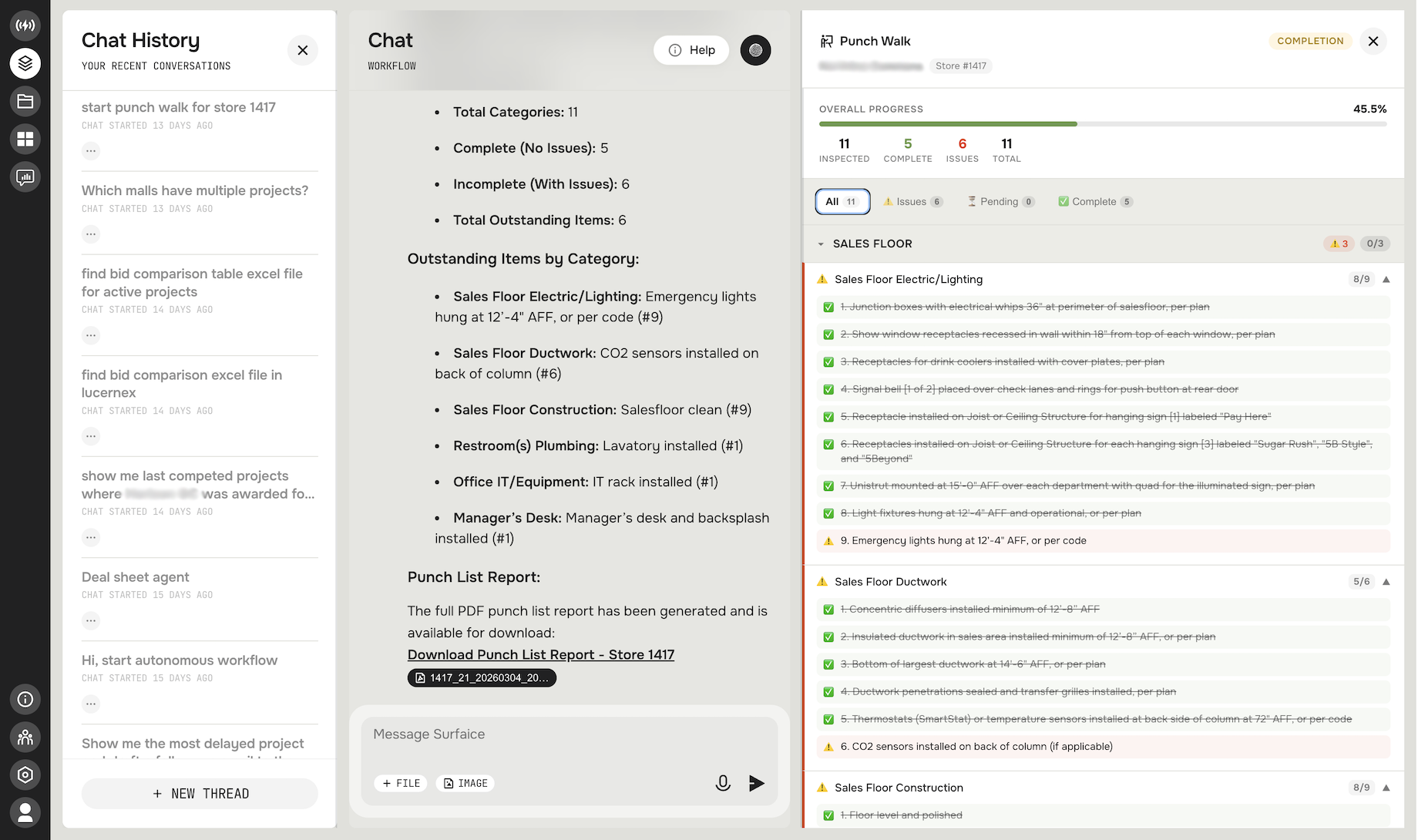
A user interface screenshot for AI-automated construction punch-list walkthroughs from Surfaice Image courtesy of Surfaice
Part of the pitch is that Surfaice’s AI tool analyzes voice input based on retailers’ past prototype projects. If a project manager forgets to specify the number, sizes and types of the rooftop HVAC units, it might send a friendly reminder to add this standard data. Another example of a potential reminder: “Since this is a 58-foot-wide store, you will need 300 feet of lineal wall.”
Uderbekov also is designing the tool to call attention to conflicts that might go unnoticed in a manually generated document. Imagine a construction pro who initially describes a store as all-electric but later mistakenly tells the AI there will be two gas ranges.
Surfaice Sits on Top of Existing Store-Development Systems
Last year, Surfaice began rolling out AI-powered playbooks for another retail client, JD Sports. The retailer has used them within its real estate and construction workflows as part of a broader effort to standardize processes and improve data accessibility across systems, Uderbekov said.
The playbooks form an AI-enabled operational layer, helping teams interact with information across platforms like Procore, Lucernex, Smartsheet and SiteRise more consistently and efficiently, he said. Rather than replacing existing systems, the goal is to enhance them by reducing manual effort, improving visibility and helping teams make more informed decisions.
According to Uderbekov, the playbooks support day-to-day execution by surfacing priorities, maintaining data integrity, identifying risks and assisting with document and communication workflows. Common use cases include:
- identifying stores with possession dates but no scheduled construction starts
- collecting and organizing documentation for construction tenant allowances
- preparing standardized materials for project closeout
In some cases, teams have reported meaningful time savings, Uderbekov said, while also benefiting from more consistent outputs and processes.
Added chief revenue officer Valeri: “For years, our industry treated data as structured tables filled manually by teams. Today, every document can effectively become a database.”
At last count, Surfaice’s website was advertising 111 “playbooks” that bring AI automation and analysis to store-life cycle tasks. They include:
- scoring development sites
- comparing contractor and vendor bids
- abstracting leases
- ferreting out co-tenancy clause violations
- auditing common area maintenance reconciliations
- tracking and managing permits, change orders, requests for information, lease renewals and closeouts
Uderbekov envisions retailers quizzing the AI tool to get a clearer picture of what’s happening with store development across their portfolios. For example, a retailer could ask the AI to drill into the performance of a particular project manager or provide a breakdown of West Coast stores by actual budget, forecast budget or fully lease-executed.
Retail Project Managers Are Testing Surfaice in the Field
Surfaice is set to roll out voice-enabled AI punch-list walkthroughs this month for the discounter that ran that first test in Texas. The punch lists will tie into the retailer’s Smartsheet project-management platform. Next will come construction budget-building as well as use of Surfaice as an enterprise management tool.
Both the construction and retail industries can be slow to change, but as Uderbekov sees it, companies that embrace AI early thus can gain an edge. “One of the people I talked with was leading a big national retail brand,” he said. “He told me that he had developed a formula in Excel 15 years ago, left the company and recently learned they’re still using it.”
By Joel Groover
Contributor, Commerce + Communities Today