Futuro Academy is a lot like many schools. Its mission is to provide a high level of education that helps develop the leaders of tomorrow. But unlike other public schools, Futuro Academy got its start in an empty grocery store.
It’s one of the U.S.’s about 8,000 public charter schools. As public schools, they’re free and open to any student. A key difference is that they typically are managed by nonprofits. One of the biggest challenges is finding a facility because they don’t get school buildings from their local school districts, said Mark Medema, managing director for the Charter School Facility Center at the National Alliance for Public Charter Schools. “For the most part, they are out on their own trying to find a place to open up these public schools,” he added.
Futuro Academy opened in 2017 in a portion of a vacant 40,000-square-foot grocery store in East Las Vegas with 115 students in kindergarten and first grade. The school has expanded in phases and now occupies the full building with 460 students from kindergarten through fifth grade. “A lot of the same logic in terms of where you put a grocery store applies to a school,” said Futuro executive director and lead founder Ignacio Prado. The store-turned-school is in a highly visible location near a residential population with ample parking and good accessibility.
Though it needed a lot of retrofitting, there was a lot of good existing infrastructure the school could utilize, noted Prado. For example, existing plumbing could serve restrooms and science classrooms, and a grease trap and interceptor made it easy to create a kitchen and cafeteria. The tall ceilings made it easy to run infrastructure, upgrade and reconfigure the store into classrooms. “The building has worked out great,” said Prado. “There were a whole lot of things that were overlaps on what are typically very expensive modifications to buildings that already existed.”
In addition, the store itself had been vacant for about five years, and the school has helped revitalize the area.
Growing Demand for Space
Charter schools searching for locations hope to convince landlords of the synergy they’d bring to the table as tenants. Charter schools started 30 years ago, according to the National Alliance for Public Charter Schools, and have been growing in number by 7% a year. “There’s always demand, and there are lots of kids on the waitlist for this type of school,” said Medema.
Some have particular focuses, such as serving students with autism or a curriculums built around, music, Spanish immersion or science, technology, engineering and math. They’re not one-size-fits-all. In fact, by nature, they’re very flexible and come in different sizes and formats. Some are more “microschools” with 50 to 100 children from kindergarten through second grade. Those might need less than 10,000 square feet. As schools grow, they might need upward of 100,000 square feet. Other charter schools might open multiple campuses and grow into a network of locations. The most popular size for charter schools is 30,000 to 40,000 square feet, which typically accommodates about 400 students, noted Medema.
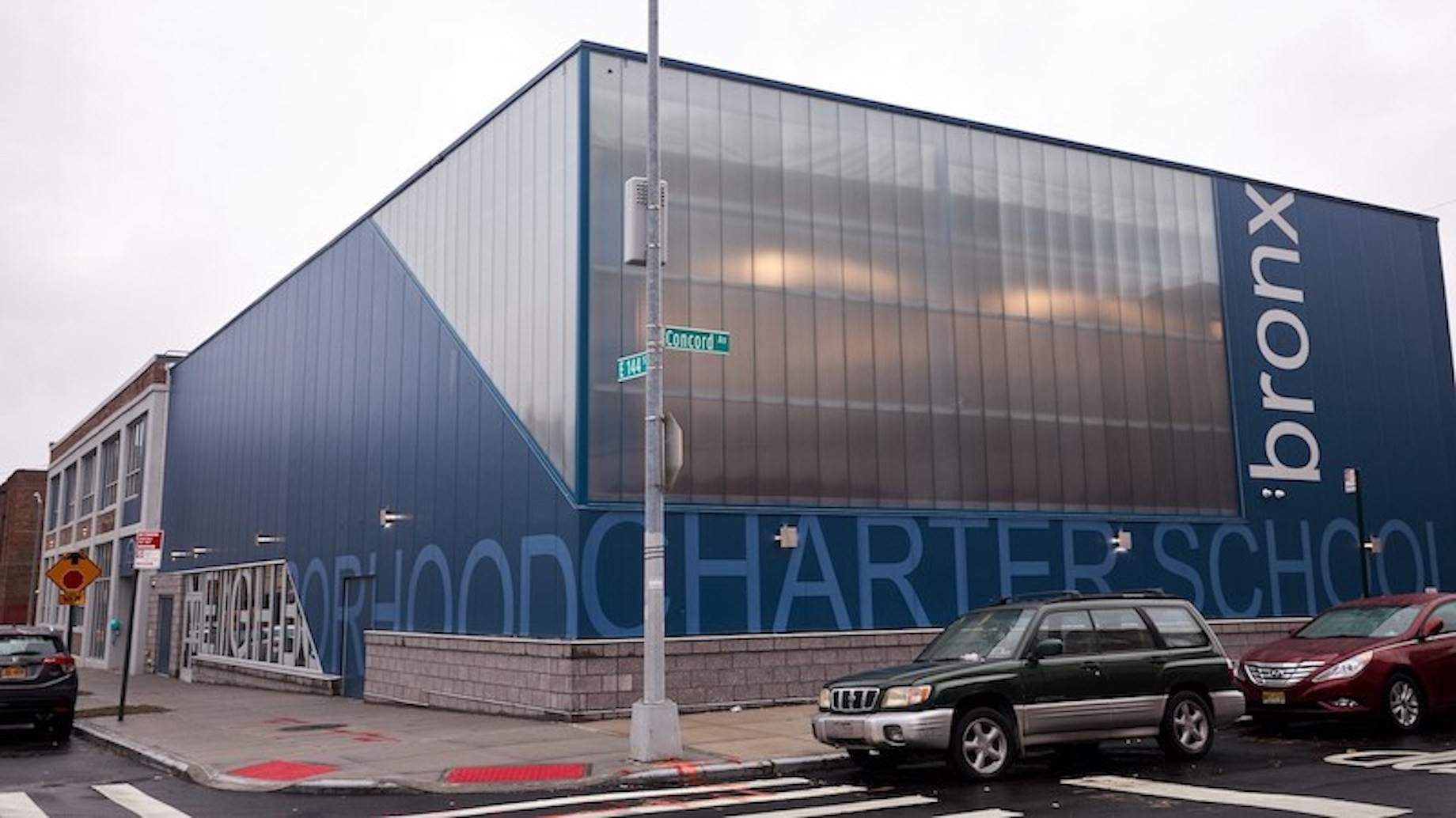
The 58,000-square-foot Neighborhood Charter School in the Bronx borough of New York City, occupies a former warehouse. Photo credit: Transwestern
An ideal location will have all the usual amenities any public school offers, such as ball fields, a gymnasium, an auditorium and a cafeteria. “Unfortunately, that’s not the reality,” said Medema. Charter schools tend to work with whatever they can find. Ideally, there’s outdoor space and indoor space for physical education, but some schools might have to make do with a large, single-story room where kids can get their energy out. One important thing, he added: a location that can handle the traffic flow of families dropping off and picking up children before and after school.
Many charter schools started in locations like church basements and vacant YMCAs. The shifting economics of retail and office properties in recent years, especially post-COVID, has charter schools looking at more commercial spaces. “Charter schools are a great alternative use for retail property owners and landlords to learn about,” said Medema.
An empty big-box retail store has the space and a large parking field. For example, the Alturas International Academy opened in a former Sears at Idaho Falls, Idaho’s Grand Teton Mall in fall 2021. Although it joined tenants like Dick’s Sporting Goods, Dillard’s and Old Navy, the school is closed off to the rest of the mall.
Landlords Weigh Pros and Cons
Colliers has a number of success stories involving the adaptive reuse of former retail centers to K-12 charter schools. One is the conversion of a vacant Smith’s grocery in the Phoenix metro to Chandler Preparatory Academy. The school, which serves 700 sixth through 12th graders, features a gymnasium, lecture halls, more than 40 classrooms and laboratories, and a football field carved out of part of the former parking lot.
Schools do have compliance and safety protocols, including unobstructed, vehicle-queuing lanes for dropoff and pickup and cross-parking agreements that can complicate drive aisles and traffic lanes, noted Todd Noel, vice chair and leader of the U.S. education practice group for Colliers. That being said, schools view retail centers favorably, as schools look for the same things as retailers, such as population density and the related convenience for students and families, strong traffic counts and convenient transportation corridors, he said. “Aside from rental income, schools draw traffic, and tenants love traffic,” said Noel. Although most retailers would miss out on the morning rush, as they’re not typically open that early, quick-service restaurants, coffee and breakfast options fare well near schools, he added.
Though landlords are exploring nontraditional tenants to fill space, generate foot traffic and serve their communities, they understandably are hesitant about taking on schools. There aren’t too many examples that prove schools are a good fit, said JLL Retail Property Management managing director of agency leasing and development Paul Chase. Some factors to consider, he said, are whether it would disrupt other tenants. Would noise or traffic congestion conflict with other tenants? Does the community need it? Is there a suitable location within the property? Is there ample parking? Is there good access and traffic flow for pick-up and dropoff?
“It could have a positive impact for a center, but it would have to be placed in the right position for a particular center,” noted Chase. “It couldn’t take up a dominant location within a center. In most cases, it likely would have to be tucked in an area that complements the other areas.”
Medema pointed to another incentive for landlords: steady income. Charter schools are publicly funded and like permanency, which means a solid revenue stream almost like a long-term annuity. Medema believes schools can create synergy for retail and mixed-use centers. There’s potential to use the school as a draw in retail merchandising and to attract tenants looking for that demographic, such as a swim school, karate class or college prep tutoring. Tenants also could tap into a an after-school and weekend labor pool of high school students.
A charter school can complement the community experience of a mixed-use center, added Noel. “Parents are dropping their kids off and entrusting others for their safety and well-being, so the facility needs to exude the level of confidence parents deserve and it is both the landlord and the school’s responsibility to do that. Schools are unique in this regard. Yet another reason they become a critical fabric of a community.”
By Beth Mattson-Teig
Contributor, Commerce + Communities Today