The Short Version
- From mall redevelopments to rural retail expansion, the 2026 ICSC Excellence in Community Advancement winners span urban, suburban and rural markets, showing how growth strategies vary by scale and context.
- Infrastructure‑led development and transit connectivity — including major roadway and rail investments — continue to drive deal feasibility and long‑term value.
- Adaptive reuse and data‑driven retail recruitment are key strategies for unlocking underutilized sites and attracting tenants.
- Measured outcomes matter: Projects are generating new tax revenue, jobs and sustained economic activity through aligned public and private investment.
- Innovation in Community honoree: The BullStreet District demonstrates how long‑term planning and phased development can convert dormant public land into a major economic engine.
5 Public‑Private Partnerships Delivering Local Value
The 2026 ICSC Excellence in Community Advancement Awards honor public‑private partnerships that exemplify how retail and mixed‑use development serves communities. Recognized during ICSC LAS VEGAS, this year’s winners highlight the role of coordinated investment, infrastructure planning and inclusive engagement in projects that expand economic opportunity and strengthen long‑term community vitality.
ICSC established the awards as part of its Community Advancement operations to spotlight collaborations between municipalities and private developers that deliver measurable public benefit. The 2026 winners span a range of contexts and development types, from large‑scale urban and suburban redevelopments to new rural projects in communities with fewer than 50,000 residents. Honorees are recognized in Redevelopment and New Development categories, reflecting both the reinvention of legacy assets and new retail and mixed‑use destinations. To be considered, projects must have been operational before Nov. 1, 2025.
This year’s recipients highlight several themes: adaptive reuse of obsolete properties, infrastructure‑led growth, transit‑oriented development, data‑driven retail recruitment and long‑term public return on investment. The Innovation in Community distinction, selected by the judges and the ICSC Community Advancement Advisory Committee, was awarded to The BullStreet District in Columbia, South Carolina, recognizing a complex, multiphase redevelopment that pairs long‑range planning with design innovation and sustained public benefit.
Together, this year’s award recipients demonstrate how thoughtful public‑private partnerships can turn underutilized sites into resilient economic anchors, serving communities of all sizes while setting new standards for inclusive and forward‑looking development.
The Shops at RedBird
Urban/Suburban Redevelopment
Public Sector Partner: City of Dallas
Private Sector Partner: Russell Glen
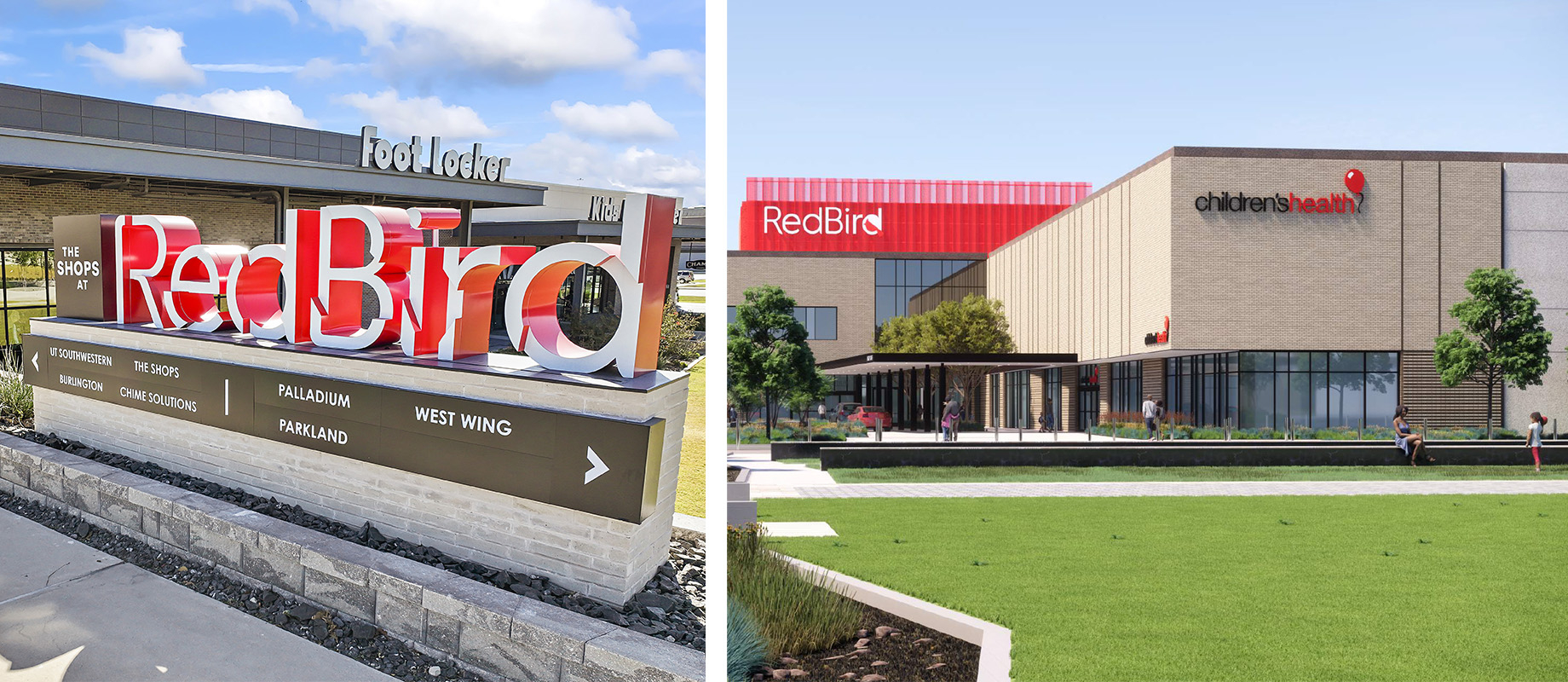
The redeveloped Shops at RedBird includes a 20,000-square-foot Foot Locker Power Store. A Children’s Health Specialty Center, shown in a rendering at right, is slated to open in late 2027. Images courtesy of Russell Glen
For decades, the former RedBird Mall sat largely vacant at the center of Southern Dallas. Led by Russell Glen in partnership with the city of Dallas, the Shops at RedBird reimagined the 1970s‑era mall into an open, walkable mixed‑use campus, leveraging catalytic municipal investment and layered private capital to unlock more than $400 million in redevelopment.
Instead of demolition, large portions of the original structure were adaptively reused, converting vacant anchor boxes into light-filled medical, educational, retail and civic uses. The former enclosed mall was reconfigured into a multinodal campus with new exterior entries, improved pedestrian circulation, connected trails and a one-acre central lawn designed for events and everyday gathering.
Community engagement shaped the project from the outset, with more than 50 meetings influencing tenant mix, public space programming and the integration of healthcare, childcare, workforce and entrepreneurship resources. Regional connectivity was strengthened through approximately $80 million in Texas Department of Transportation frontage road and access improvements along Interstate 20, expanding the project’s reach and supporting long‑term economic impact.
Additional Key Stakeholders
- Architects: Omniplan, Parscale Group and Perkins&Will
- General Contractors: Whiting-Turner, VCC and Con-Real
- Management Company: Kobalt Investment Co.
- Leasing Companies: Russell Glen Company and Colliers
FROM THE C+CT ARCHIVE: From Old Mall to 100-Acre Live-Work-Play Community: Terrence Maiden Lifts Up an Overlooked Community
Tractor Supply Co.
Urban New Development
Public Sector Partner: City of Warrensburg, Missouri
Private Sector Partner: CMK Properties
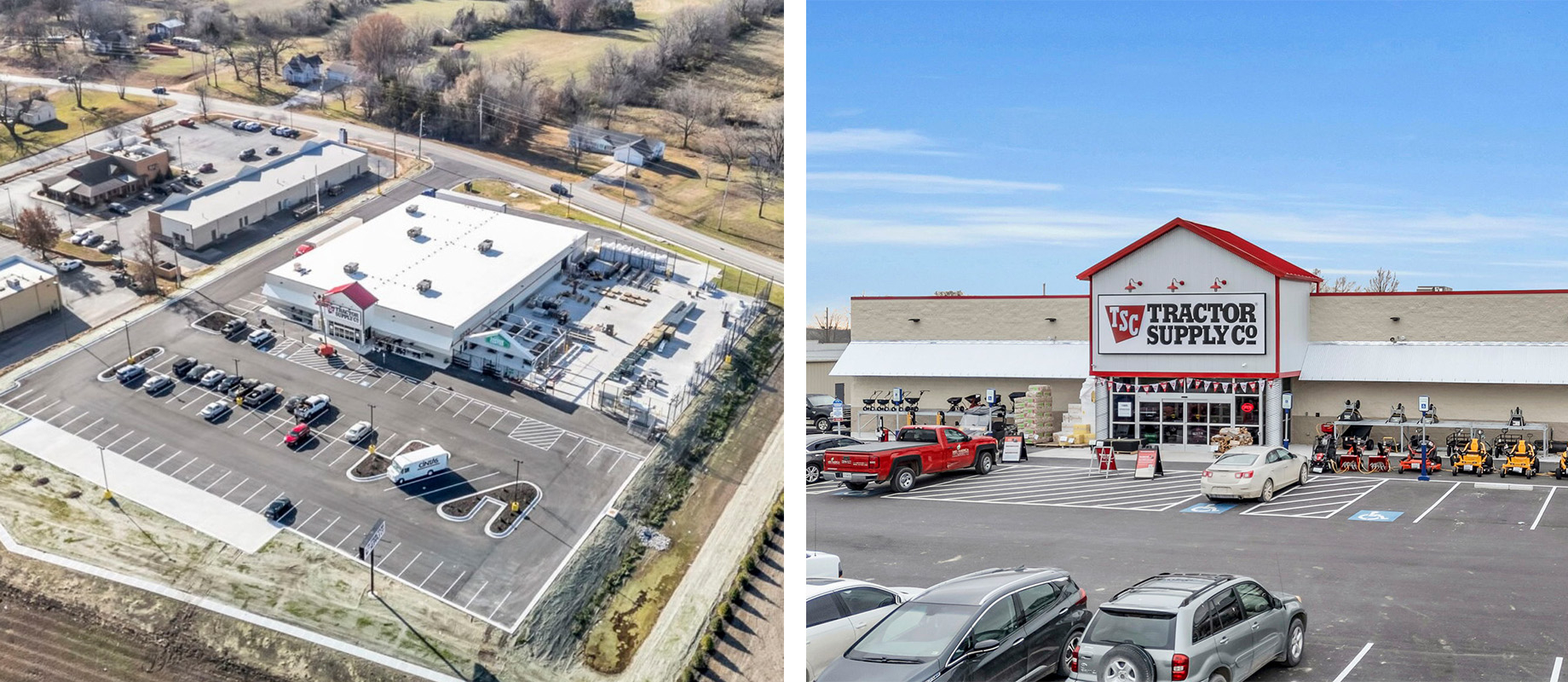
At left, an aerial view of the Tractor Supply Co. site along Warrensburg, Missouri’s Maguire Street corridor; at right, the completed store, which fills a key retail gap for the city and surrounding rural communities. Photos courtesy of Tractor Supply Co.
For a community of roughly 20,000 residents, attracting a national rural‑lifestyle retailer required proving demand beyond the city limits. The city of Warrensburg, Missouri, working with CMK Properties and Retail Strategies, used trade‑area analytics and coordinated infrastructure planning to recruit Tractor Supply Co. to a site along Maguire Street, the city’s primary commercial corridor. Sited on 4.5 acres, the 24,000‑square‑foot store fills a long‑standing retail gap for Warrensburg and surrounding rural communities, providing access to farm supplies, pet products, tools and home improvement goods.
The partnership paired private development capital with proactive municipal coordination, including streamlined planning and permitting and a tax-increment-financing structure to support roadway access, utilities and stormwater infrastructure. These public improvements strengthen the broader corridor, while new jobs and increased sales and property tax revenue advance Warrensburg’s economic development goals and reinforce how smaller cities can use data‑driven recruitment, collaboration and targeted public tools to attract essential retail.
Additional Key Stakeholders
- Development Company: CMK Properties
- Retail Recruitment Firm: Retail Strategies
Douglas Square District, Georgia
Rural Redevelopment
Public Sector Partner: City of Douglas, Georgia
Private Sector Partner: Jones Co.
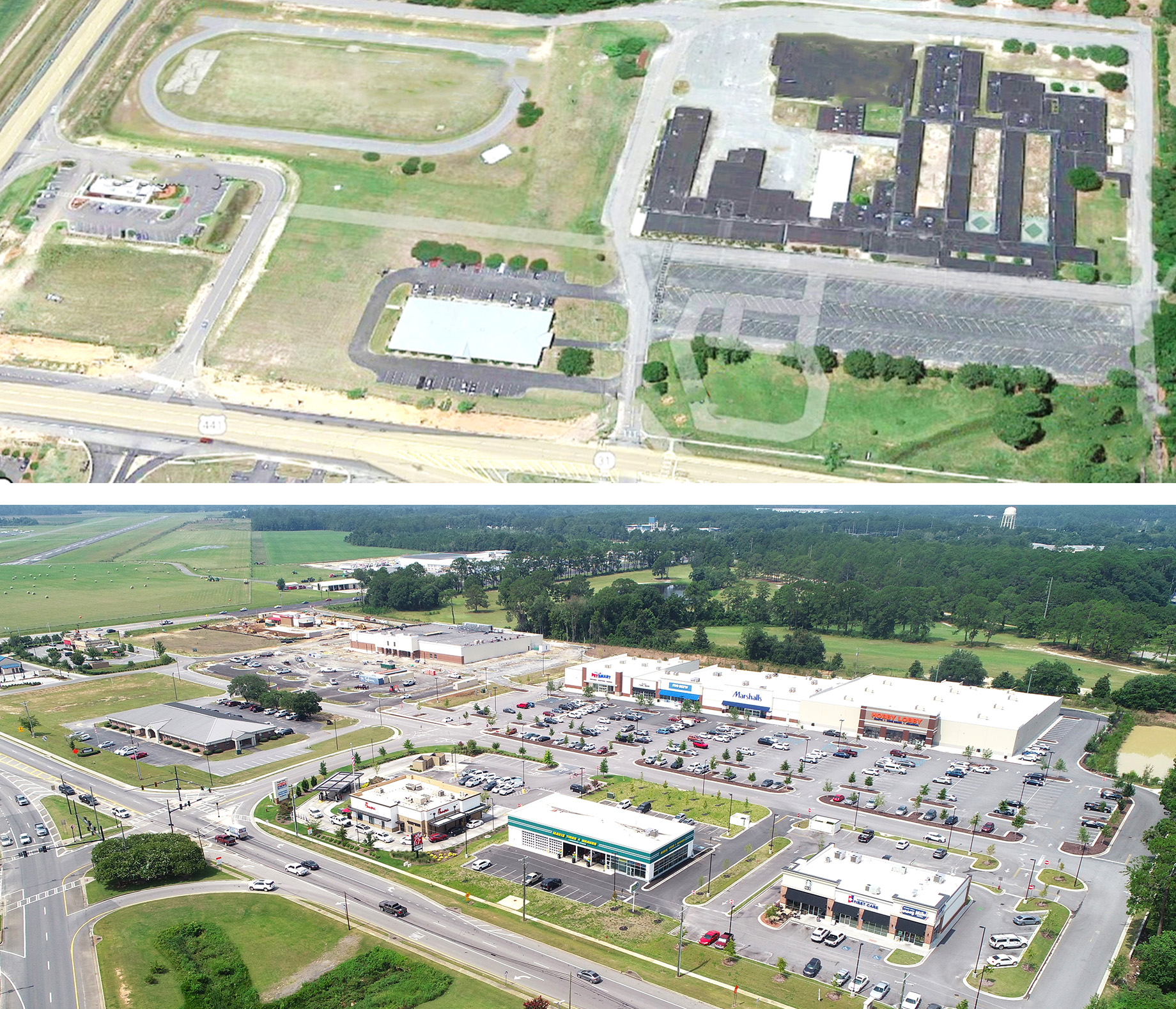
An aerial view of the former high school site in Douglas, Georgia, is shown at top, with the completed Douglas Square development below. Photos courtesy of the city of Douglas, Georgia
Douglas Square is the redevelopment of a vacant former high school site into a regional retail destination through a broad public-private partnership led by the city of Douglas, Georgia. Working alongside Coffee County, the school district, state agencies and private developers, the city created a tax allocation district to address infrastructure deficiencies that long had stalled reinvestment. Targeted public funding for utilities, transportation, site preparation and parking reduced development risk and generated more than $40 million in private investment.
The master-planned project delivers nearly 360,000 square feet of retail, integrated public parking and pedestrian connections linking the site to downtown Douglas and South Georgia State College. National retailers including Publix, Chick-fil-A and Starbucks now anchor the development, retaining local spending and drawing shoppers from across the region.
Public engagement and the voter-approved TAD shaped project priorities and phasing. Since opening, Douglas Square has increased the local tax digest by more than $10.5 million, supports as many as 275 permanent jobs and has catalyzed surrounding commercial development, downtown reinvestment and new housing.
Additional Key Stakeholders
- Development Company: Perlis Nease Development
- Architect: Phillips Partnership
- General Contractors: Stellar Contracting and Buxton Construction
- Management and Leasing Company: JBS Capital Investments
- Additional Public Entities: Coffee County Commission, Douglas-Coffee County Economic Development Authority, University System of Georgia, South Georgia State College and Georgia Department of Transportation
Grapevine Main
Urban/Suburban New Development
Public Sector Partner: City of Grapevine, Texas
Private Sector Partner: Coury Hospitality
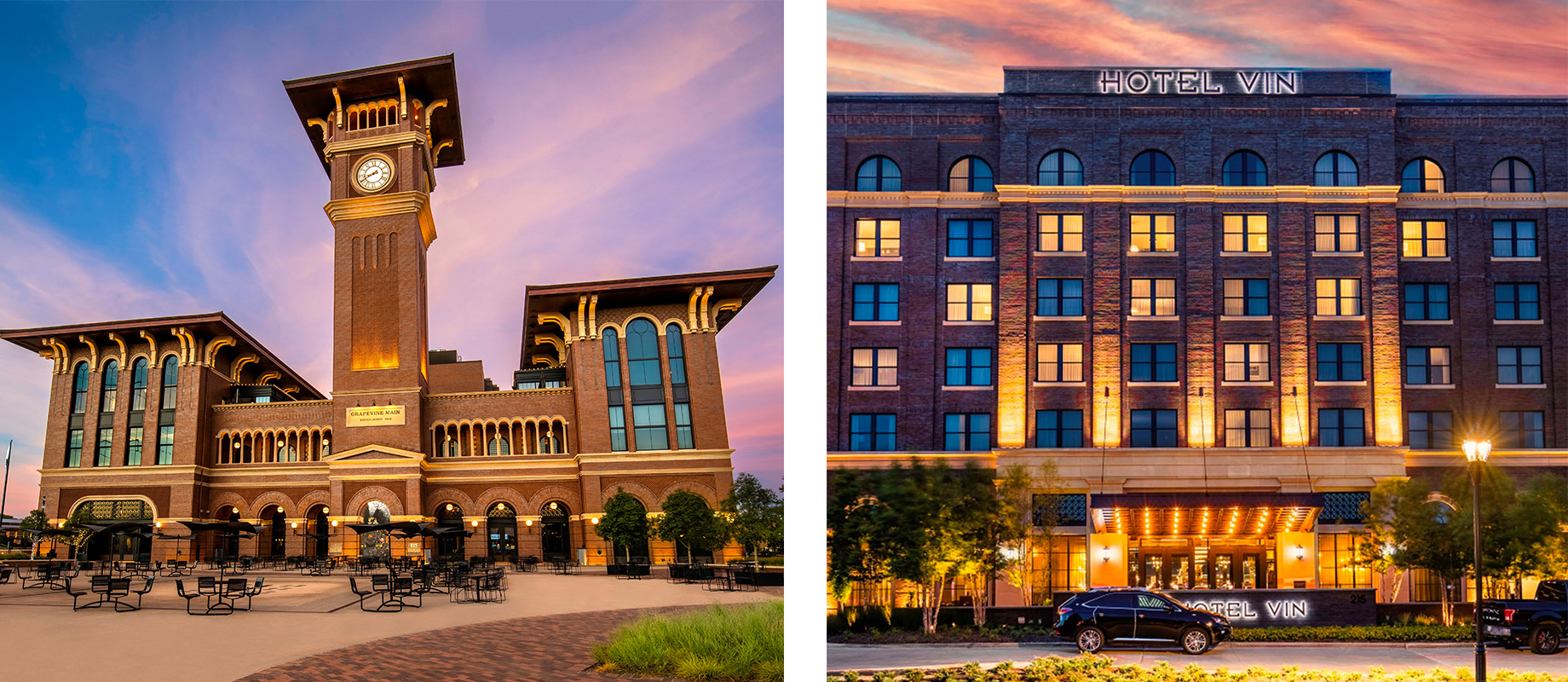
The Grapevine Main rail station, shown at right, anchors the transit-oriented development, while Hotel Vin, part of Marriott’s Autograph Collection, has helped drive growth in Grapevine’s hotel occupancy tax collections. Photos courtesy of The City of Grapevine
Grapevine Main is a $120 million, transit-oriented, mixed-use development delivered through a public-private partnership between the City of Grapevine, Texas; Coury Hospitality; and Trinity Metro. Located on the city’s historic Main Street and connected to TEXRail service to DFW International Airport, the project
Integrates Hotel Vin, a city-owned European-style food hall, the Grapevine Main rail station; and the 38,000-square-foot public Peace Plaza. Architectural design reinforces Grapevine’s historic character while bringing together hospitality, retail, entertainment, dining, transit and public space through shared parking, pedestrian connections and coordinated infrastructure.
The City of Grapevine supported the redevelopment with a $2 million performance-based incentive, tax increment financing and shared investment in public parking and infrastructure, along with targeted use of hotel occupancy tax funds — together representing roughly 7% of total project costs — while Coury Hospitality provided most of the private capital and assumed operational risk. Trinity Metro funded and operates the rail station and commuter line.
Since opening, Grapevine Main has driven a 23% increase in visitation to the area, while businesses within a five‑minute walk of the TEXRail station have seen sales tax revenue rise 38% and the opening of Hotel Vin helped increase citywide hotel occupancy tax collections by 18% between 2019 and 2024.
Additional Key Stakeholders
- Architects: Architexas (master planning), GSB (hotel) and Studio Outside (landscape)
- General Contractor: Manhattan Construction
- Additional Public Entity: Trinity Metro
The BullStreet District
Innovation in Community
Public Sector Partner: City of Columbia, South Carolina
Private Sector Partner: Hughes Development Corp.
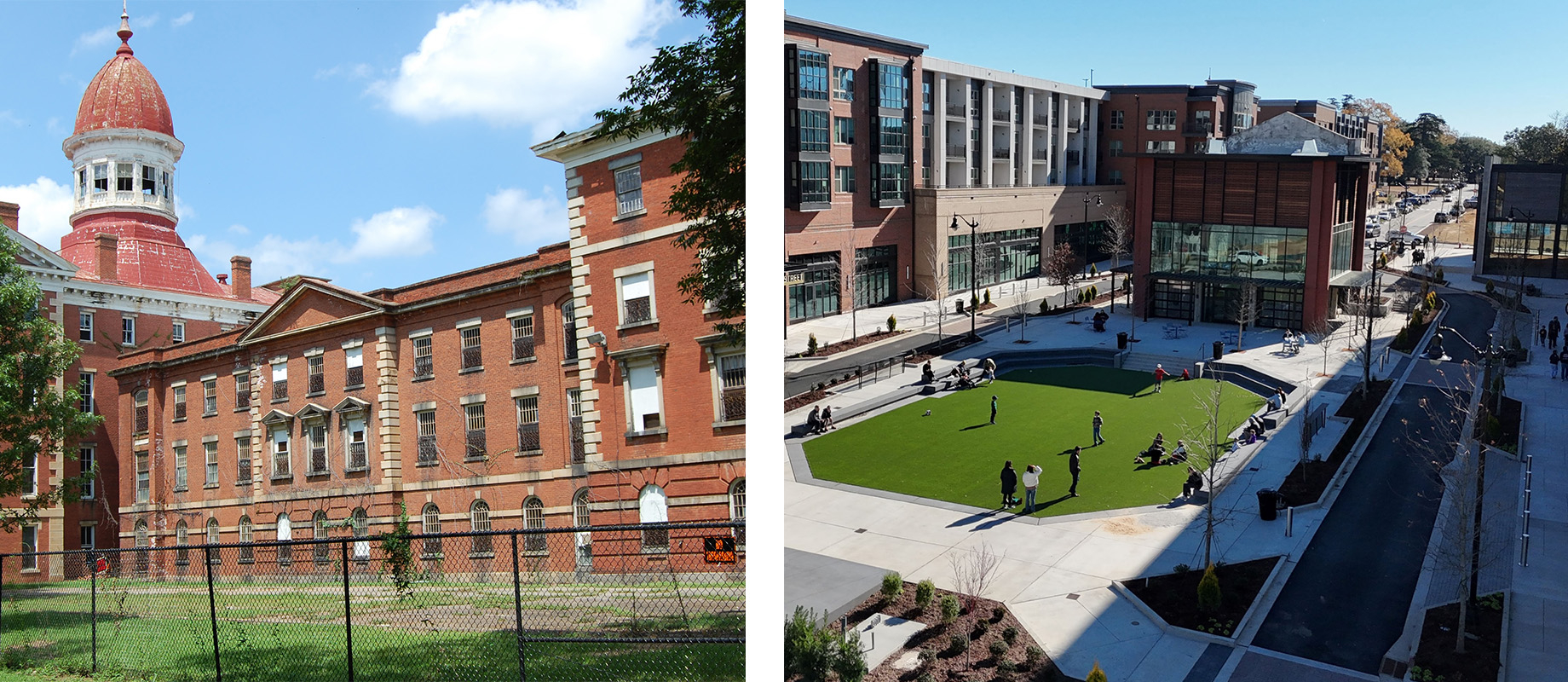
At left, a South Carolina State Hospital building prior to redevelopment; at right, a portion of the completed BullStreet District, featuring a mix of uses and 20 acres of public green space for residents, workers and visitors. Photos above and at top courtesy of Hughes Development Corp.
The most direct measure of The BullStreet District’s public return on investment is its growing contribution to the local tax base. In 2025, South Carolina’s BullStreet District generated more than $2.2 million in real estate tax revenue for the city of Columbia or Richland County — a sharp reversal from a state‑owned hospital campus that had sat dormant for decades.
That tax growth stems from the ongoing redevelopment of 181 acres of the former South Carolina State Hospital through a public‑private partnership between the city and master developer Hughes Development Corp. The partnership aligned public investment in infrastructure and site preparation with private capital for vertical development, coordinating land disposition and construction across multiple phases. Still in mid‑buildout, the district is entitled for 3.3 million square feet of commercial space and 3,558 residential units, pointing to significant long‑term fiscal growth.
BullStreet is rooted in New Urbanist principles, supporting walkable streets, mixed uses and human‑scale design. Embedded gigabit infrastructure, which enables high-speed internet, has attracted major employers like Capgemini, Scout Motors and AECOM, while a separate $69 million corporate headquarters investment is expected to create nearly 300 jobs. Community benefits include extensive historic preservation, diverse housing options, Segra Park sports and entertainment venue, 20 acres of public green space and year‑round civic programming. The district generates not only property taxes but also ongoing sales and income tax revenue, through retail, dining, entertainment and employment, converting a once‑idle public asset into an active urban center.
Additional Key Stakeholders
- Property Owners: City of Columbia, University of South Carolina, Proffitt Dixon Partners, Clachan Properties, Cason Development, Four Oaks Property Group, Avant Holdings, Diversified Development, Downtown Church, Merrill Gardens and Connelly Development
- Additional Public Entities: Richland County, National Park Service, South Carolina State Historic Preservation Office and SC Housing
By Katie Kervin
Managing Editor, Commerce + Communities Today