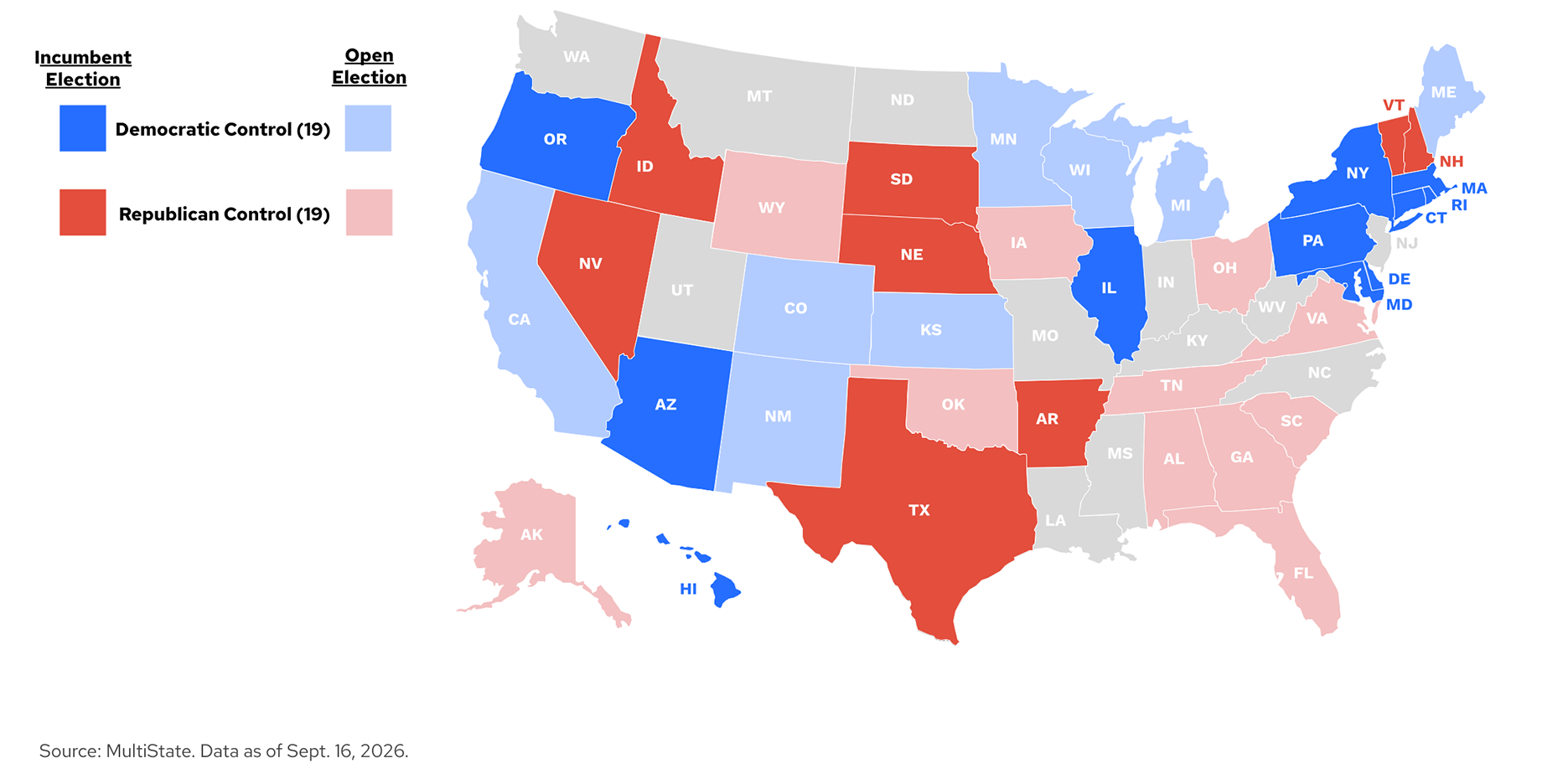
With less than fifty days until Election Day, this cycle’s gubernatorial elections are shaping up to be one of the largest shares of open-seat contests since 2010. Thirty-six states are holding elections for governors this year, with 19 of the states having an open election with an incumbent running. These elections provide insight into voters' positions on trending issues and offer a chance for new policymakers to bring different priorities to state governments. Not only are there highly contested gubernatorial races this fall, but state trifecta control is at stake in several states where control of the legislature could flip.
Balance of Power in State Legislatures at Stake
Wisconsin’s elections are expected to be watched closely as the balance of power in the state legislature is considered a toss-up, and there is no incumbent running for Governor. In the August Democratic primaries, Milwaukee County Executive David Crowley pulled off a surprisingly narrow victory against Representative Francesca Hong. On the Republican side, U.S. Congressman Tom Tiffany won the primary by more than 90 percentage points with the endorsement of President Donald Trump. Crowley has focused his campaign on housing supply, childcare access, and education funding. Tiffany’s campaign has taken a hard line against taxpayer-subsidized data centers, renewable energy on agricultural lands and rising residential utility rates driven by data centers.
Similarly, Michigan’s election is highly competitive, with an open seat for Governor and control of the legislature also at stake. Jocelyn Benson, Michigan’s current Secretary of State, is running as the Democratic nominee, and John James, a former member of Congress, is the Republican counterpart. Both candidates are running campaigns focused on reducing the cost of living for residents.
Gubernatorial Toss-Up Races
Georgia will also have an open seat in November and is one of the high-profile races this cycle. Democrat Keisha Lance Bottoms, the former Atlanta mayor, is running against Republican Rick Jackson, a first-time candidate and founder of Jackson Healthcare. Current polling has this race neck and neck, with the Cook Political Report listing it as a toss-up. Democrats are vying for a win in Georgia, which hasn't elected a Democratic governor since 1998. However, outgoing Governor Brian Kemp has high approval ratings for a later-term incumbent, and the state has had a solid economic record in recent years, giving Republicans a strong track record to run on.
Nevada’s gubernatorial race between Republican incumbent Governor Joe Lombardo and Democrat Attorney General Aaron Ford is another close race. Despite Lombardo being the incumbent, this election is one of the closer gubernatorial races in the country, and both campaigns are responding by spending heavily on affordability messaging. Additionally, Flock cameras have come up as a voter issue in this election, with Ford wanting to pause them until rules are in place, while Lombardo, also former Sheriff of Clark County, has backed their responsible use of these cameras. Nevada’s legislature tilts Democratic, so this is another state that has potential for a trifecta control for Democrats.
Finally, the Ohio gubernatorial election to succeed term-limited Governor Mike DeWine (R) has drawn high-profile attention. Republican nominee Vivek Ramaswamy, a biotech entrepreneur and 2024 presidential candidate, is running against Democrat Amy Acton, former Director of the Ohio Department of Health under DeWine. In a state that has trended Republican in recent years, the Cook Political Report listed the state as lean Republican but shifted it to a toss-up in July.
Governors Bringing New Policy Priorities
For many states, the upcoming elections mean less of a change in political control and rather an opportunity for new faces to lead the state. In open seat races like Iowa and Florida, the leading candidates from the incumbent party could shift the focus of the office to new policy priorities. Iowa’s Republican primaries resulted in a surprising victory for Zach Lahn, a farmer and relatively unknown candidate backed by the Make America Healthy Again (MAHA) movement. The MAHA movement viewed Lahn’s victory as a sign that their message was resonating with voters, given his support for transitioning away from toxic chemicals.
Meanwhile, in Florida, the gubernatorial race will be a question of whether the political agenda Ron DeSantis (R) has built during his term will survive under a potential new Republican governor. Republican nominee and U.S. Representative Byron Donalds has centered his campaign on state affordability, lower taxes, and government efficiency, running to continue Trump’s agenda more than DeSantis’s specific legacy. Republicans maintain a stronghold in the state, but it remains to be seen how Donalds’ campaign message of continuing Trump’s agenda resonates with voters.
Governors: 2026 Election Preview